Repository navigation
Conversation


## Summary

Preserve `_extra_N` document widget values by resolving them to the Nth
serializable live widget during Agent graph apply.

## Changes

- **What**:
- Resolves an `_extra_N` document key to the Nth **serializable** live
widget, both on the creation path (`positionalWidgetValues`) and on
later document frames (`documentWidget`). A `serialize: false` widget
does not consume a position.
- A named entry always beats an alias for the same position
(`supersededOverflowAlias`), judged against the node's whole document
map so an alias-only partial frame cannot overwrite a named value.
- Document entries for widgets that only exist after `configure` are
applied **after** `configure` (`mountedWidgetValues`), because a dynamic
combo's setter mounts those widgets during `configure`. An earlier
revision extended `widgets_values` instead, which blanked the position
before the alias; `7a6912e` pins that regression out.
- Document entries are ordered before application
(`ordinaryWidgetEntries`): named entries first, then aliases by
position, so a selector mounts its dependent widgets before the aliases
that address them. Y.Map insertion order no longer decides the outcome
(`f7574fa`, with a red-then-green test).
- Partial frames resolve the changed-name set through the alias
(`changed`), so a rejected human `set_widget` op — whose name set
carries the widget's **real** name — still reverts a value the document
stores under an alias.
- A pending local write is re-asked under the resolved widget name, so
an alias frame cannot rewind an edit the user is still making.
- Coverage: 38 unit tests in `liveGraphApplier.test.ts`, plus a new
cloud browser spec `agentOverflowWidgetOnNodeCreate.spec.ts` for the
creation leg. The sibling
`agentDynamicComboSetWidgetSilentlyDropped.spec.ts` covers the update
leg.

## Review Focus

- **The positional lookup stays scoped to serializable widgets.**
`serializableWidgets()` is the only index source on both paths.
- **Telemetry, stated precisely.** On the **update** path, both a
malformed key (`_extra_01`) and an out-of-range key (`_extra_9`) report
`agent_graph_widget_missing` and are not applied. On the **creation**
path an out-of-range key reports; a **malformed** key is silently
ignored — unchanged from base, because it never resolves to a position
and so never reaches `applyWidgets`. Measured, not inferred: with
`_extra_01` added to the document before the create frame, widget values
stay `[11, 20, 42]` and `reportError` is not called, while the same
probe on `_extra_9` catches one report. Routing every unmatched
creation-path key through the post-`configure` apply is FE-3036-adjacent
and deliberately out of scope here.
- **Ordering is load-bearing.** `ordinaryWidgetEntries` is the only
thing keeping alias application after selector setters.

Linear:
https://linear.app/comfyorg/issue/BE-16625/widget-catalog-arity-mismatch-extra-n-positional-overflow-is-a

## Screenshots

Creation leg, `agentOverflowWidgetOnNodeCreate.spec.ts` run against the
cloud distribution with only `liveGraphApplier.ts` swapped between base
and this head. The seed carries `widgets_values: ['faithful', 91, 71]`;
the catalog names `mode` and `mode.a` only, so the host stores the tail
under `_extra_2`, and `mode.b`'s node-def default is 70.

`29ef774` extends the same post-`configure` apply to a document entry
addressed by the widget's
**real name**. `mode.a` is catalogued, so the host stores 91 under that
name, but the constructor
builds it no sooner than `mode.b`: it is past the array `configure`
restores, so the alias and the
name are the same lost-value bug. The earlier `mode.a` assertions
(`toBeDefined()`, `/^(80|91)$/`)
were satisfied by the node-def default of 80 and so passed while 91 was
dropped; both now pin 91.

| Rendered node | `mode.a` | `mode.b` |
| --- | --- | --- |
| Base `a24212f` — **before** | 80 | **70** — the node-def default; the
document's 71 is lost |
| `7a6912e` | 80 | **71** — the aliased document value reaches the
widget |
| Head `29ef774` — **after** | **91** — the named document value reaches
the widget too | **71** |

The spec is therefore red on the parent and green on the fix:

```
# before: base liveGraphApplier.ts
Error: expect(locator).toHaveValue(expected) failed
  Expected: "71"
  Received: "70"
1 failed

# after: this head
1 passed
```

```bash
COMFYUI_PORT=8197 bash scripts/start-comfyui-e2e.sh
VITE_USE_LEGACY_DEFAULT_GRAPH=true DISTRIBUTION=cloud \
  DEV_SERVER_COMFYUI_URL=http://127.0.0.1:8197 pnpm dev --port 6241 --strictPort
PLAYWRIGHT_LOCAL=1 PLAYWRIGHT_SETUP_API_URL=http://localhost:8197 \
  PLAYWRIGHT_TEST_URL=http://localhost:6241 DISTRIBUTION=cloud \
  pnpm exec playwright test \
    browser_tests/tests/agent/agentOverflowWidgetOnNodeCreate.spec.ts \
    --project=cloud --workers=1 --retries=0
```

CI also records a walkthrough of **both** agent specs at this head —
`playwright-video-new-tests` on run
[37127894596](https://github.com/Comfy-Org/ComfyUI_frontend/actions/runs/37127894596)
uploads
`test-results-cloud/tests-agent-agentOverflowW-689c7-he-position-before-it-alone-cloud/video.webm`
alongside the update-leg recording.

---------

Co-authored-by: Claude Opus 5 (1M context) <noreply@anthropic.com>
Co-authored-by: Alexander Brown <drjkl@comfy.org>
…8934)

## Summary

Two black-box guards keeping a search-box placement's `flags.ghost` out
of a node the user has already put down — the browser-reload route and
the remote-`add_node` route. Tests only; no production code changes.

## Changes

- **What**: `browser_tests/tests/agent/agentGhostFlagSurvival.spec.ts`
(2 green regression guards), plus one read-only harness accessor,
`AgentConversationHarness.hostNode(nodeId)`.

`LGraph.add` sets `flags.ghost` while a search-box placement is still
following the cursor, and the placement click that clears it locally
mints no op — so the flag has two routes into a node that is already
placed. `agentPlacedNodeGhostFlag.spec.ts` on `main` covers the
tab-switch route; these are the other two.

1. **Outbound.** Place a node through the search box (asserting it
really was ghosted when the op was minted from it), assert the minted
document snapshot carries no `ghost`, then reload with local workflow
state cleared so the node can only come back from the document, and
assert it returns solid, not `pointer-events-none`, and selectable.
2. **Inbound.** Push an `add_node` whose verbatim `node` snapshot does
carry `ghost: true` and assert the resulting node is still solid,
clickable and selectable. This is the black-box twin of the unit guard
in `src/workbench/extensions/agent/crdt/ghostPlacementFlag.test.ts`.

## Review Focus

**The inbound payload is constructed, and the spec says so.** I first
wrote this test assuming the live mint poisons the document, and it does
not — `layoutMintPort.ts` strips `ghost` on the way out, which test 1
now asserts directly. So test 2's `ghost: true` is put back on
deliberately: the claim is about the **read** side, which is what a
peer, a writer from before the strip existed, or an agent edit copying a
stale snapshot would send, and the op vocabulary inserts `node`
verbatim. Both strips are load-bearing and neither is redundant:

| mutation | effect |
|---|---|
| `layoutMintPort` keeps `ghost` | test 1 fails at the document
assertion |
| `graphMutations.cloneNodeFlags` keeps `ghost` | test 2 fails at
`data-ghost` |
| **both** disabled | test 1 reproduces the reported symptom end to end
— a translucent, unclickable node after a browser reload |

That third row is the reason the reload leg is worth having rather than
vacuous. All mutations reverted; `src/` is untouched in this PR.

**Why a new accessor.** `hostNode(nodeId)` returns the library's
projection of one node, so a test can assert what the document actually
holds instead of assuming it — which is exactly the assumption that was
wrong here. Read-only, no new dependency; it sits beside the existing
`hostNodeIds` / `hostNodePositions`.

### Verification

Local cloud rig (own ComfyUI e2e container, dev server on the 6200
band), `--project=cloud --retries=0`.

- 2/2 green, then 6/6 under `--repeat-each=3`, zero flake.
- `agentPlacedNodeGhostFlag.spec.ts` (the tab-switch sibling) and
`agentPastedNodeOrphanedOnRetarget.spec.ts` (the other
`reloadWithoutLocalWorkflow` consumer) re-run green against the modified
fixture.
- Gates: `typecheck:browser`, `oxfmt --check`, `oxlint --type-aware`,
`eslint` clean; pre-commit and pre-push (knip, fallow) pass,
`complexity_introduced: 0`.

…on (#20177)

<!-- ccr-slack-attribution -->
_Requested via [Slack
thread](https://comfy-organization.slack.com/archives/C09KFK2ABB8/p1791182719420129?thread_ts=1791182719.420129&cid=C09KFK2ABB8)_

## Summary

**Before:** The Sentry alert "AgentApiError: Authentication method not
allowed for this endpoint. Accepted: bearer_jwt, x_api_key" (thrown from
`GET /agent/run-mode`) cannot be diagnosed. #20046 added telemetry for
agent 401/403s, but it only records the operation, status and auth
scheme under a constant message, and drops the backend's own refusal.
That cannot separate a cookie-only web session, a request with no token
yet, and a request with the wrong credential.

**After:** Agent 401/403 reports keep the same stable message and
grouping, and add tags for the credential kind actually sent
(`session-cookie`, `bearer`, `api-key`, `none`), the backend error type
and code, and the accepted auth methods, plus an allowlisted
classification of the backend's refusal. No backend free text is
reported. The next event tells us which of the three cases it is. This
is diagnostics only, not a behavior fix.

## Changes

- **What**: `AuthScheme` and `AuthCredential` now live in
`src/types/authTypes.ts`, and `authCredentialOf` derives the credential
kind from the shared `AuthHeader` keys. `fetchApi` reports the kind
through an optional `onAuthCredential` callback that cannot break the
request. The new pure module `src/platform/auth/authRejection.ts` parses
a rejection body with the generated ingest schemas
(`zAuthTypeNotAllowedError`, `zErrorResponse`) and returns tags:
`backendReason`, `backendErrorType`, `backendErrorCode`,
`acceptedMethods`. Backend values come only from the lists exported
there, anything else is `other`, and response text is never copied.
`agentRestClient` adds `credential` and the backend tags to the existing
report, and a failure inside classification or reporting is swallowed so
the original `AgentApiError` is thrown unchanged. Unit tests sit next to
each module.

## Review Focus

**Why not a fix:** I could not show from the code that forcing a bearer
credential for agent routes is right. Per the generated ingest types, a
route that does not take a credential answers `auth_type_not_allowed`,
and that includes the web session while the server-side
`web_session_enabled` is off for the user. So a likely cause is the
client web-session flag (or a session/dev override, which skips the
server pairing in `useFeatureFlags`) disagreeing with the server flag,
which is a flag-pairing problem rather than something a bearer override
should paper over. The other candidates are an unauthenticated request
(`credential: none`, with a legacy session cookie still riding along) or
a wrong credential kind. Switching agent requests off the cookie path
would also diverge from the unified web-session design and could break
users the server does accept. The new tags settle which case it is.
Operation already names method and endpoint one-to-one, so no separate
route tag was added (path-derived tags were rejected in #20046 because
of ids and cursors).

**Backport:** this builds on #20046, which is on `main` but not on
`cloud/1.54`, `cloud/1.55` or `core/1.55`. A backport of this PR alone
will conflict unless #20046 lands there first.

🤖 Generated with [Claude Code](https://claude.com/claude-code)

https://claude.ai/code/session_01S5cB4waJ1vMLEm9A1XeYfj


---
_Generated by [Claude
Code](https://claude.ai/code/session_01S5cB4waJ1vMLEm9A1XeYfj)_

---------

Co-authored-by: Claude <noreply@anthropic.com>
Co-authored-by: Christian Byrne <cbyrne@comfy.org>
## What

Allow **Queue Selected Output Nodes** to execute an Agent-inserted root
output whose raw node ID contains colons, such as
`insert:<opId>:root:node:<originalId>`.

`getExecutionIdsForSelectedNodes()` still used strict multi-segment
execution-ID construction for the root leaf. That returns `null` for the
colon-bearing IDs created by `insert_workflow`, so selecting the
inserted `SaveImage` output produced “Could not resolve path to selected
nodes” even though the full workflow validated and was ready to run.

The root case now uses the existing `createLeafNodeExecutionId()`
contract added for PM-1580. Nested paths remain on the strict
delimiter-aware path.

## User evidence

- Production Agent feedback surfaced 2026-10-07 from a `prod-v2` session
on Agent release `v0.381.0`.
- The affected workflow came from an Agent-inserted Krea template and
had root IDs in the `insert:...:root:node:...` form.
- Agent-side validation reported 22 converted nodes, zero
errors/warnings, `ready_to_run: true`, and `spends_credits: false`;
selected-output queueing failed before execution.
- Related earlier locator/callback repair: #18616 / PM-1580. This closes
the analogous selected-output execution helper gap.

## Test plan

- `pnpm vitest run src/utils/graphTraversalUtil.test.ts` — 115 passed
- `pnpm exec oxfmt --check src/utils/graphTraversalUtil.ts
src/utils/graphTraversalUtil.test.ts`
- `pnpm exec oxlint --type-aware src/utils/graphTraversalUtil.ts
src/utils/graphTraversalUtil.test.ts`
- `pnpm exec eslint --no-cache src/utils/graphTraversalUtil.ts
src/utils/graphTraversalUtil.test.ts`
- `pnpm typecheck:app`
- Commit and push hooks passed, including the changed-file fallow audit.

No feature flag, exposure, workflow content, model choice, or credit
behavior changes.
## Summary

Fixes
[FE-2616](https://linear.app/comfyorg/issue/FE-2616/agent-remove-parallel-node-selection-persistence-and-make-composer)
by deleting `agentNodeSelectionStore` and its duplicate reference cache.

```diff
- agentNodeSelectionStore: picking, reference cache, reload handshake, preference restoration
+ canvasStore: transient picking state and entry/exit
+ agentComposerStore: draft references scoped by workflow instanceId
+ afterLoadGraph: revalidate composer references without selecting canvas nodes
```

## Evidence

- **Before:** reversing exit order makes the regression test fail:
tracking was still active during deselection.
**After:** 644 unit/component tests pass across 17 targeted suites; six
existing browser lockdown tests pass against the cloud build with a
local backend and mocked agent/auth APIs.
- Rendered picking and Escape exit inspected: selected node retained
while picking, widget layer inert, sidebar/minimap hidden; exit restores
presentation without changing preferences.
- Commit hooks passed formatting, lint, application typecheck,
unused-i18n and frozen-directory checks.

## Review Focus

References survive workflow rename, panel remount and root/subgraph
reload. Target changes still clear them. This removes the path-keyed
cache addressed by #16770.

## Merge Danger

**Door:** two-way. No persisted-data migration or public API change.

**Blast Radius:** canvas. Existing select-only input guards remain. The
minimap now stays hidden throughout picking; toggling its preference
takes effect on exit. Sidebar selection and minimap preferences are no
longer temporarily overwritten.

---------

Co-authored-by: Christian Byrne <cbyrne@comfy.org>
…9984)

## Summary

Pins the cloud mobile-web workflow-binding contract the agent panel
already honours, at the viewport PM-1933 was reported from, after
production telemetry refuted the defect reading that ticket left open.

## Changes

- **What**: one new black-box spec,
`browser_tests/tests/agent/agentMobileNewTabWorkflowBinding.spec.ts`,
running in the `cloud` project at a Pixel 5 viewport (393 CSS px,
Android Chrome — the reporter was on 394×853). It pins, in one user
journey:
- a new chat on a freshly opened blank tab targets **that tab**, not an
account-saved workflow;
- the first turn on a tab with no cloud id sends `current_tab_unbound`
and names no workflow, rather than silently retargeting the saved one;
- a target hand-picked from the workflow chip **survives the following
turn** with no second pick;
- at this width the docked panel is the entire viewport, so the chip is
the user's only view of the binding and the close control is the only
way back to the canvas.

No production code changes.

## Review Focus

**Why this is a guard and not a repro.**
[PM-1933](https://linear.app/comfyorg/issue/PM-1933) was filed from one
mobile report ("the agent is disconnected from my workflow") and left
two readings open: a real binding defect, or a designed mint that only
reads as a defect on a phone. A seven-day aggregate read of
`app:agent_workflow_bound` settles it against the defect reading:

- `minted` binds are the first bind in their thread 3297/3300 times
(desktop) and 557/558 (mobile) — a mint does not displace an existing
binding;
- of 659 mobile threads with any bind, 51 saw the bound workflow change
and **47 of those were the user's own `selector_chip` picks**; only 4
threads (0.6%) saw a change from any other source, against 2.4% on
desktop;
- in the reported thread itself the first two bind events name the
**same** workflow, so the "three workflows" headline is two user picks
plus one duplicate re-report.

So the spec encodes what the code does, which is what the telemetry says
users get. Both load-bearing assertions were mutation-checked: inverting
"must not retarget the saved workflow" and inverting "the hand-picked
target holds" each fail the spec.

**The turn-completion mock.** The workflow chip is disabled while a turn
is in flight, so the spec closes each turn with an `agent_message_done`
frame over a routed `/ws`. Without it the second half is untestable —
and that disabled window is not academic: the reported session waited
101s and 121s for its first reply.

**Not a duplicate.** `agentFirstTurnOnUnsavedTab.spec.ts` pins the
unbound first turn's payload at desktop width and stops at the send;
`agentNewChatTargetWorkflow.spec.ts` pins picker retargeting without
sending. Neither runs at a phone viewport, and neither pins a
hand-picked target surviving the next turn.

## Verification

```
PLAYWRIGHT_SETUP_API_URL=http://localhost:8194 PLAYWRIGHT_TEST_URL=http://localhost:6214 \
  pnpm exec playwright test browser_tests/tests/agent/agentMobileNewTabWorkflowBinding.spec.ts \
  --project=cloud --workers=1
# 1 passed (3.7s)
```

Dev server run with `DISTRIBUTION=cloud` as the agent specs require.
## Summary

Strip doc-owned `__incarnation` storage from outbound human `add_node`
snapshots so a contaminated live serializer cannot make the doc host
reject and revert the user's node.

## Changes

- **What**: Sanitizes only `__incarnation` at `wireNodeSnapshot`, while
preserving extension-owned payload fields and the existing doc-host
guard.
- **Tests**: Adds the exact imported missing-node/`last_serialization`
reproduction plus a cloud Agent harness case through the real human-op
sender and host applier.

## Review Focus

The sanitizer is deliberately at the command-site wire boundary; it does
not weaken shared-package validation or add reconciliation.

Linear:
https://linear.app/comfyorg/issue/PM-1931/sentry-alert-on-cloud-frontend-prod-doc-host-rejected-an-add-node

Mutation proof: removing the two-line sanitizer makes the focused unit
test expose `__incarnation: "0"` and makes the browser case lose the
newly added node after host rejection.

…neage reset (#19614)

*PR Created by the Glary-Bot Agent*

---

Test-only. One new file, no production code touched.

## Why

PM-1790 reported video playback restarting on every agent turn. It was
the same event as the PM-1784 canvas flicker, not a separate media bug:
`GraphCanvas` renders one node component per `nodeDataStore` record
keyed by node id, the `VideoPreview` inside it keeps playback state
nowhere but its `<video>` element, and the pre-#18700 reset dropped
those records before any replacement existed.

#18700 fixed it — `replaceOnNextFrame` clears nothing until the
replacement frame arrives — but nothing pins the media half, so a change
there restores the symptom silently.

**The existing coverage cannot see this.**
`agentCrdtProjection.integration.test.ts` asserts graph contents, and
`agentCanvasBlanksDuringRunTurn.spec.ts` asserts
`toBeVisible`/`toHaveCount` — which a *remounted* node also satisfies.
Remounting is exactly what restarts playback, so element identity is the
distinct guarantee.

## What it pins

Element survival, not playback. happy-dom models no media pipeline, so
asserting `currentTime` would only restate identity. Survival is the
guarantee that matters: the browser keeps playback going precisely when
the element is never unmounted.

The tests pin the **boundary**, not a happy path — the guarantee turned
out narrower than it looks. The element survives for as long as the id
stays in the store across renders (including when `LiveGraphApplier`
*recreates* the underlying `LGraphNode`, which the retyped case shows),
and is lost the moment that id lapses for even one render.

## Evidence the tests bite

Each claim below was run, not reasoned:

| Mutation | Result |
| --- | --- |
| `v-if="false"` on the `VideoPreview` branch in `NodeContent.vue` |
**3/3 fail** |
| Eager clear reinstated in `replaceOnNextFrame` | **2 fail** (3rd is
the control asserting the element *is* lost) |
| Same, minus the `await nextTick()` between reset and replacement | **1
fails** — the gap is load-bearing |

That first row is the one that matters most: an earlier revision of this
file fabricated its own `<video>` and stayed green when production
`VideoPreview` was deleted. It now mounts the real
`NodeContent`/`VideoPreview`.

The `nextTick` models the replacement frame being a network round trip
behind the reset, so the canvas renders in between. Without it the tests
cannot tell an atomic swap from a clear that is merely refilled before
Vue next flushes.

## Scope — what is stood in for

Recorded in the file header rather than left implicit:

- **`GraphCanvas.vue`'s node list** is reproduced rather than mounted,
so its `:key="nodeData.id"` — the single production line this guarantee
rests on — is copied here. Re-keying it would restore the symptom
without failing anything in this file, and nothing else in the repo
asserts identity across a reset either.
- **`LGraphNode.vue`** derives the `media` prop from `nodeOutputStore`
(`nodeMedia`) behind its own `v-if` gates; `media` is a constant here. A
retype that made that derivation return `undefined` or flip to `'image'`
would destroy the element without failing anything below.
- Production appends a fresh `rand` per url on non-cloud builds
(`app.getRandParam`), so a surviving element can still be handed a new
`src`. Urls are held fixed and `src` is asserted unchanged, which keeps
identity honest but does not cover that derivation.

Placed under `renderer/` because `workbench/` may not import `renderer/`
(`eslint.config.ts`), and it imports both layers.

## Verification

- `pnpm exec vitest run src/renderer/extensions/vueNodes/
src/workbench/extensions/agent/` — 3585 passed, 3 expected-fail, 1
failure. That failure is `agentSubgraphDefinitions.test.ts`'s lib0
`deepFreeze` `RangeError`, pre-existing on `main` and caused by this
sandbox running Node 22 against a repo wanting `>=26.8.2`; the file is
not in this diff.
- `pnpm exec vue-tsc --noEmit`, `pnpm knip`, `pnpm exec eslint`, `pnpm
exec oxlint --type-aware`, `pnpm exec oxfmt --check` — all clean.
- The one `eslint-disable testing-library/no-node-access` is scoped to a
single line: `<video>` exposes no implicit ARIA role and no accessible
name, so the last hop must be a direct read. It is reached through the
node's testid and the `role="region"` wrapper, so it still fails if the
element leaves that subtree — narrower than the sibling
`VideoPreview.test.ts`, which disables the same rule plus
`no-container`.

Relates to PM-1790, PM-1784.

---------

Co-authored-by: Glary-Bot <glary-bot@users.noreply.github.com>

…resh (#18772)

## Summary

One black-box spec pinning what the agent panel shows after a browser
refresh taken while a turn is running. Tests only — no production file
is touched. Both tests land as **expected failures**.

Rank 14 of the in-app-agent program's user-story test matrix
(`slack-19`, `linear-10`): *"After a refresh I cannot tell the agent is
working, and my next message is rejected."*

## Changes

- **What**:
`browser_tests/tests/agent/agentTurnStateAfterRefresh.spec.ts`, two
`test.fail()` tests built on the existing `agentTurnLockFixture`.
- After a mid-turn `page.reload()`, the panel must still show the turn
running — Stop, not Send.
- The next message must not come back `409 a turn is already in progress
for this thread`.
- **Breaking**: none.

## Review Focus

**This is the trigger `agentTurnSurvivesSocketDrop.spec.ts` deliberately
left open.** Its header says *"Deliberately not a refresh or a tab
reopen: PM-1154 and PM-1043 cover those triggers"* — those ticket ids
appear nowhere else in the repo and no spec picks the trigger up. This
file does.

They are close relatives, not the same defect. In the socket-drop case
the socket blips and `useAgentSession.onStatus(false)` settles the turn
locally. Here the page is torn down entirely and the client rebuilds its
view of the turn from `hydrateFromServer`. The server's assistant row is
still `streaming` in both cases, which is why the same 409 lands at the
end of both journeys — but the path there is different, and a fix for
one need not fix the other.

**Observed after the reload**, against the fixture's fake server: `Stop`
count 0, `Send` count 1, working row 0, "Worked for…" summary 0. The
panel is indistinguishable from idle while the server still holds the
turn.

**Structure mirrors the socket-drop siblings deliberately.**
Preconditions (panel back, transcript intact, composer present) and the
nudge that draws the 409 stay *above* `test.fail()`: a body-level
`test.fail()` only sets the expected status once it executes, so a panel
that failed to come back would otherwise read as the expected failure.
The transcript assertion is not this file's guarantee —
`agentChatRefreshPersistence.spec.ts` owns that — it is there only to
prove the spec got far enough to be testing the busy state.

## Verification

Run locally against a cloud dev server, `--project=cloud`, 3 repeats,
6/6 stable (both expected to fail, both did):

```
pnpm exec playwright test browser_tests/tests/agent/agentTurnStateAfterRefresh.spec.ts \
  --project=cloud --repeat-each=3
```

Each failure was confirmed to be its stated reason by removing
`test.fail()` and re-running:
- `locator('#agent-panel-root').getByRole('button', { name: 'Stop',
exact: true })` — element(s) not found.
- the `a turn is already in progress for this thread` alert — expected
0, received 1.

---------

Co-authored-by: Amp <amp@ampcode.com>

)

## Summary

On iPhone Safari, the workflow page playground runs off the right edge
of the screen. The inputs, sliders, and the Sign in to run button are
cut off. On phones the playground is one grid column, and the output
column has no `min-w-0`. So that column grows to the minimum width of
its output video, and some Safari versions use the video's natural width
(956px for the motion transfer example). Chrome lets the video shrink,
so desktop and Android look fine.

The model page uses the same `PlaygroundOutput` in a column that already
has `min-w-0`, and it does not overflow. This PR adds the same class to
the workflow page column.

## Verification

- Formatting, eslint, and `WorkflowPlayground.test.ts` (14 tests) pass.
- No new test. The existing `keeps the workflow form inside a phone
screen @mobile` e2e test already checks this, but it runs only in
Chromium (Pixel 5), where the bug does not occur. Playwright's WebKit
also renders prod correctly from a clean load, so a WebKit test would
pass without the fix too.
- Needs a check on a real iPhone: open `/hub/workflows/motion-transfer/`
on this preview and confirm the Input card and Sign in to run button fit
the screen.

…y Pay is taking the tab there (#20433)

## Why
QA re-check on testbilling after #20415: with Alipay, the "Complete
verification" button still shows on the payment page before the tab is
redirected to the verification page, so the customer can open it twice.

## Root cause
#20415 hid the button only after `openUrl`, the hosted-page handoff.
Alipay doesn't go through `openUrl`. Its pending op is an embedded
challenge, and Stripe's `handleNextAction` redirects the tab itself, so
the handoff flag never flipped. The op's `action_url` kept rendering as
"Complete verification" while this tab's own Pay was already taking the
customer there.

## How
`payingOnOwnSite`, the flag for a Pay with a method that finishes on its
own site (already used for the page-exit journey), becomes a ref. While
it is set, `actionUrl` resolves to `null`. A `pageshow` with `persisted`
(Back from Alipay via bfcache) clears it together with the hosted
handoff flag, so a customer who comes back gets the button again.

## AS IS / TO BE
_pending capture_

## Test plan
- [x] CheckoutView: an Alipay Pay with a pending challenge carrying
`action_url` shows no "Complete verification" (red without the fix).
After a persisted `pageshow` it shows again.
- [x] vitest `apps/billing-web/src/views`: 390 passed

- Fixes FE-3272 (follow-up to #20415)
- QA report (original thread):
https://comfy-organization.slack.com/archives/C0932CGKT5K/p1791361715679299?thread_ts=1791246295.718539&cid=C0932CGKT5K
- QA re-check:
https://comfy-organization.slack.com/archives/C0932CGKT5K/p1791389210987859?thread_ts=1791246295.718539&cid=C0932CGKT5K
…plan's prices as numbers (#20448)

## Why
The bot sync #20408 (cloud@7c76793) is red, and the 1.56 QA fixes stack
on these types (FE-3293 #20430; FE-3292 next). cloud#12343 / #12371
added `cancelable` and the op plan's `tier` / `price_cents` /
`monthly_price_cents` / `currency` / `team_credit_stop_id` to
`BillingOpStatusResponse`.

## Root cause
The new plan prices are int64, so the generated zod coerces them to
`bigint`, while the generated TS type says `number`.
`BillingOpStatusSchema` in account-core already maps the other cents
fields through `wireCents`, but not these two, so `BillingOpStatus`
stopped accepting a `BillingOpStatusResponse` (typecheck failure in
`customerActionParity.test.ts`).

## How
- The bot's regenerated `packages/ingest-types`, unchanged.
- `BillingOpStatusSchema` extends `plan` with `price_cents` /
`monthly_price_cents` read through `wireCents`, the same way as
`amount_charged_cents` and `credits_added`.

## AS IS / TO BE
Not user-facing: types plus schema only. AS IS is CI typecheck red on
#20408; TO BE is green here.

## Test plan
- [x] account-core `src/core/billing`: 736 passed
- [x] `typecheck:app` and `typecheck:account-core` (pre-commit)

Supersedes #20408.

---------

Co-authored-by: github-actions[bot] <41898282+github-actions[bot]@users.noreply.github.com>
<!-- ccr-slack-attribution -->
_Requested by **Allyson Toy** · [Slack
thread](https://comfy-organization.slack.com/archives/C0B61J7QCJW/p1791313120280459?thread_ts=1791313120.280459&cid=C0B61J7QCJW)_

## Summary

**Before:** the /events page shows the Comfy Agent banner.

**After:** the /events page (en and zh-CN) shows the dev challenge
banner until Oct 19, 9am PT, then the Comfy Agent banner again.

How: `EventsPage.astro` (the shared body for `/events` and
`/zh-CN/events`) passes `challengeBannerConfig` to `BaseLayout`, the
same way #20238 did for `/platform`. `activeBannerFor` falls back to the
sitewide banner once `endsAt` passes. Event detail pages
(`/events/<slug>`) are unchanged.

## Verification

- `vitest run src/config/banner.test.ts`: added /events rows to the
`activeBannerFor` table (challenge banner at 08:59 PT, Comfy Agent
banner at 09:01 PT), 8/8 pass.
- `pnpm typecheck` (website), oxlint and format clean.
- As with /platform, the window is evaluated at build time, so the
switch back needs a deploy after Oct 19, 9am PT.


---
_Generated by [Claude
Code](https://claude.ai/code/session_0153SmmLNRp7NqLreMydkAbR)_

Co-authored-by: Claude <noreply@anthropic.com>
## Summary

Replaces pointer gesture handling in the classic canvas and Vue nodes
with one pure state machine, per ADR-CANVAS-GESTURE-0029. This combines
and supersedes #17113, #17116, #17122 and #17308.

```text
pointer events (classic canvas or Vue node)
  CanvasPointer | useNodePointerInteractions          # adapters
    captureGesture(element, pointerId, cancel)        # lost capture -> cancel; release stops listening first
    reduceGesture(state, event)                       # pure: idle | pressed | dragging
      effects: click doubleClick startDrag movePress moveDrag endDrag cancelDrag
        classic -> onClick onDoubleClick onDragStart onDrag onDragEnd onDragCancel
        Vue     -> processSelect, useNodeDrag start/handle/end/cancelDrag
  resolvePointerTarget                                # classic canvas only: hit-test once per press
```

- **Reducer:** `reduceGesture(state, event)` classifies click, drag and
double click. The `down` event carries `CanvasPointer.gesturePolicy()`
(`maxClickDrift`, `doubleClickTime`), and the pressed state keeps it, so
a setting change applies to the next press. `up` carries
`acceptsDoubleClick`; Vue nodes pass `false`, so a quick second
ctrl/shift click toggles selection as on main. An interrupted drag emits
`cancelDrag`.
- **Distance only:** a press becomes a drag only when it moves further
than `Comfy.Pointer.ClickDrift`. Time-based promotion is removed.
`Comfy.Pointer.ClickBufferTime` stays registered as hidden and
deprecated, which keeps its typed key and gives the remaining
`get`/`set` callers a default. Its translations are removed.
- **Vue nodes:** pointer events route through the same reducer.
`handleNodeSelect` and `toggleNodeSelectionAfterPointerUp` are deleted,
and Vue nodes no longer use `useClickDragGuard` (load3d and linear mode
still do). Selection uses pointer-down modifiers, matching the classic
canvas. Alt-clone requires `LiteGraph.alt_drag_do_clone_nodes`, no ctrl,
and `canvas.allow_interaction`, as on the classic canvas. Pinned nodes
take no pointer capture and never move. A node pinned mid-drag is not
snapped. An interrupted drag calls `useNodeDrag().cancelDrag()` without
snapping. A release while space-panning ends the drag normally, with
snap, as on main.
- **Press target:** the classic canvas resolves the primary-button
target once per press into an exhaustive `PointerTarget` union. A node
is a target only when the canvas or node allows interaction. Otherwise
the press falls through to badge, subgraph IO, reroute, link, group or
empty. Ctrl/meta in panning mode uses `resolveSelectableTarget` only
when no node was hit. Hidden reroutes no longer capture selection.
- **Interruptions:** `captureGesture` sets capture and cancels on
`lostpointercapture`. Its release function stops listening before it
releases capture, so the `lostpointercapture` the browser fires after
`pointerup` does not cancel. Chromium fires no event when the captured
element is removed. Both adapters recover because a buttonless move
counts as a release and a new press from the same pointer cancels the
stale one. There are no window blur or visibility listeners. Interrupted
classic moves keep their position through `onDragCancel` without
snapping. Interrupted resizes close their change transaction.
- **Drag zoom:** any press or buttonless move ends an active drag zoom,
as do a release over the canvas and teardown. It still holds no capture,
so a release outside the canvas ends at the next buttonless move or
press.
- **Number widgets:** moving within the drift threshold still forwards
to `onDrag`, so a slow nudge can adjust the value and then open the
prompt on release. This is intentional and documented in the ADR.
- `unbindEvents` now removes capture-phase listeners with the capture
flag.

Docs: docs.comfy.org/interface/settings/lite-graph still lists "Pointer
click drift delay". Remove it; click versus drag now depends only on
"Pointer click drift (maximum distance)".

## Evidence

- **Before:** characterization tests from #17110 recorded time-based
promotion as `it.fails`. Three Vue e2e tests were `test.fail`: a slow
group-title click moved the group; Vue nodes dragged at 3 px instead of
the 6 px `ClickDrift`; Vue nodes came to the front on release, not on
press.
**After:** the `it.fails` passes as `it`, and all three `test.fail`
markers are removed.
- Reducer tests cover each phase's transitions, repeated moves while
dragging, the drift boundary, and the double-click time and 3 × drift
distance boundaries.
- Vitest over `src/lib/litegraph`, `src/renderer/extensions/vueNodes`,
`src/platform/settings` and `src/renderer/core/canvas`: 269 files, 3694
passed, 8 expected failures (pre-existing markers), 5 skipped.
- `pnpm typecheck:app` passes.

## Merge Danger

**Door:** two-way. No persisted data changes; reverting restores the
previous handlers.

**Blast Radius:** pointer interactions.

Every click, drag, double-click and selection path on the canvas and on
Vue nodes goes through the new code.

`CanvasPointer` public changes against main:

- `eLastDown` is removed, so readers get `undefined`.
ComfyUI-compare-videos reads `pointer.eDown ?? pointer.eLastDown`, and
basify also reads it.
- `static bufferTime` is removed. Assignments to it have no effect.
- `onDragCancel` is added. `reset()` calls it when it interrupts an
active drag.
- `dragStarted` is a read-only getter. Extensions that write it would
throw; no in-repo writer exists.

Callbacks assigned through `onClick`, `onDoubleClick`, `onDragStart`,
`onDrag`, `onDragEnd` and `finally` keep working.

User-visible changes on Vue nodes:

- The drag threshold is `Comfy.Pointer.ClickDrift` (default 6 px)
instead of a fixed 3 px.
- An unpinned node comes to the front on press.
- A context menu opened during a node drag is suppressed and cancels the
drag.

Open PR #20098 edits `handleNodeSelect` and
`toggleNodeSelectionAfterPointerUp`, which this PR deletes.

Part of FE-2040.

---------

Co-authored-by: Amp <amp@ampcode.com>

…3036) (#20087)

## Summary

Two widgets on one node cannot share a name — `WidgetId` is
`graphId:nodeId:name`, so the second is the same identity, not a second
one. Where a repeat cannot be renamed apart, it is refused and reported
instead of being kept under a name another widget already holds.

Linear: [FE-3036](https://linear.app/comfyorg/issue/FE-3036). This is
the alternative asked for on
[#19717](#19717).

## Changes

- **What**: `dropUnrenamableDuplicateWidgets` (`src/types/widgetId.ts`)
renames the duplicates it can and returns the ones it cannot, each with
its cause. A rename takes the first `name#n` that neither the node nor
the widget store holds, so a stale store entry cannot make a renamable
widget look unrenamable. There are **two** enforcement points:
`syncWidgetOrder` covers every array mutation (`addWidget`, a raw
`push`, a splice, a whole-array assignment) but enforces nothing until
the node has a graph id, and `attachNodeToStores` →
`refuseAmbiguousNodeWidgets` covers the join itself, because
`LGraph.add` normalizes the widgets view before `node.graph` is set.
First occurrence wins.
- **The criterion is whether the name could be *written*, not whether
the write *landed*.** `BaseWidget.set name` delegates to
`widgetValueStore.renameWidget()` and leaves the name unchanged whenever
the store declines — which it does for a missing graph, a missing entity
or a missing order entry, none of which depend on the candidate name. So
`nameIsWritable` decides removal and the read-back decides only whether
the pair is reported: a duplicate whose rename was merely declined is
**kept** and reported as unresolved. (This is
[#20104](#20104),
folded in here so that no head of this PR ships a widget-deleting rule.
#20104 is now wholly contained in this branch.)
- Four `errorType`s, in `src/AGENTS.md`'s
`<category>_<operation>_<subject>` form, because the causes are
different failures: `failure_renaming_widget_duplicate_name` (removed),
`failure_reading_widget_name` (no derivable id: a throwing accessor, a
value that will not coerce, or one `encodeURIComponent` rejects),
`failure_resolving_widget_duplicate_name` (kept, reported once per
widget rather than on every commit) and
`failure_tearing_down_refused_widget`.
- An **empty** name is declined by the store, not refused: it renders,
fires its callback and serializes, so removing it would lose a working
widget (#13773).
- A rename while the node is detached lands locally when the store holds
no entry for the widget. `_state.nodeId` outlives `graph.remove`, which
deletes the node's entries, so declining there left a re-added node
carrying one name twice, and that bails registration for *every* widget
on the node: the node drew nothing. Measured before and after in
`widgetsView.refusalCriterion.test.ts`, and `uniqueWidgetName.spec.ts`
counts rendered rows after the re-add.
- A refused widget's own store entry is released, by identity. It
otherwise sat under the name it had registered, and `registerWidget`
keeps an existing value for a same-type re-registration — so the next
widget of that name came up holding a dead widget's value.
- ADR-ECS-0008 carries the invariant, the refusal, the four causes, the
two enforcement points and the boundaries, including what is accepted
rather than fixed.
- **Breaking, with migration guidance for extension authors**: a widget
whose name cannot be made unique on its node is no longer added. Give
widgets distinct names *before* the node joins a graph; if you redefine
a widget's `name` after `addWidget` (`Object.defineProperty`, a frozen
object, a getter with no setter), make sure it does not land on a name a
sibling holds. To tell whether your widget survived, read it back off
the node — `node.widgets.includes(widget)` — rather than assuming
`addWidget`/`addCustomWidget` kept it; a refusal also emits one of the
`errorType`s above. A duplicate whose `name` is writable is renamed, so
ordinary dynamic widgets are unaffected.

## Review Focus

**Refusing is a repair, not only a restriction.** Before this change, a
node carrying an ambiguous pair rendered **no widgets at all**:
`BaseWidget.setNodeId` calls
`ensureUniqueWidgetNames(this.node.widgets)` and returns early when it
fails, for *every* widget on the node. Measured on the parent through
the real app when this PR was opened: `node.widgets` held `["duplicate",
"duplicate"]` while the canvas rendered 0 widget rows, and nothing the
user typed on that node survived a reload.

**One accepted consequence, recorded rather than left implicit.**
`LGraph.configure` adds each node before configuring it, so a removal
has already happened when values are restored, and positional restore
counts the widgets the node has now: for `[a, dup, b]` saved as `[1, 2,
3]`, `b` is handed `2` and `3` is dropped. It takes all three of a
pre-change workflow, a widget whose `name` cannot be written, and no
saved name register — a renamable duplicate is kept, and
`widgets_values_named` restores each widget under its own name. All
three are measured in `widgetsView.refusalValueRestore.test.ts`, and the
ADR records why the index-map alternative is not taken here.

**Two findings deliberately left for the consolidation they belong to**,
both raised in review and neither a wrong value: teardown a caller
attaches *after* `addWidget` returns never runs for a refused widget,
and `litegraphService.addInputWidget` resolves the widget it just
created by identity or by name and so cannot tell a refused widget from
one an extension removed. Both want an explicit accepted/refused result
out of `addCustomWidget` — the same change that would collapse
`dropUnrenamableDuplicateWidgets` and `ensureUniqueWidgetNames` into one
walk. That is a larger piece of work than this PR and is tracked in
[FE-3222](https://linear.app/comfyorg/issue/FE-3222).

## Tests

- `browser_tests/tests/widgets/uniqueWidgetName.spec.ts`: two cases
sharing one node-type patch, one save-and-read helper and a test-scoped
workflow name the fixture deletes.
- The refused duplicate: one row rendered under the name, the typed
value in the saved document, and the same value after close and reopen.
Red on the parent (`toHaveCount(1)` receives 0).
- A duplicate formed while the node was detached: after the re-add the
node draws `alpha` and `alpha#1`, and saves both values.
- Unit cases: `src/types/widgetId.test.ts` (35, including the
pre-existing id tests), `widgetsView.uniqueWidgetName.test.ts` (23),
`widgetsView.refusalCriterion.test.ts` (6),
`widgetsView.emptyWidgetName.test.ts` (3),
`widgetsView.refusalValueRestore.test.ts` (3), plus two in
`src/scripts/domWidget.test.ts` for the registration guards.

Mutations, each reverted before the next, every suite green unmutated:

| Mutation | Result |
| --- | --- |
| drop the `addWidget` refusal guard (attached node) | 1 failed |
| drop the `onAdded` refusal guard (node joins a graph) | 1 failed |
| let a duplicate's rename move an entry it is not bound to | 1 failed |
| leave the refused widget's own entry behind | 1 failed |
| decline a detached rename again when the store holds no entry | 2
failed |
| ignore names the store holds when choosing a suffix | 1 failed |
| dedupe the unresolved report per name instead of per widget | 1 failed
|
| release a kept duplicate as if it were refused | 2 failed |
| drop the guard against a hole in `node.widgets` | 1 failed |

Commands:

- `pnpm typecheck`, `pnpm typecheck:browser`, `pnpm knip` exit 0. `oxfmt
--check` clean on the changed files. `oxlint --type-aware` reports no
errors. Its only `comfy(no-restricted-paths)` warning is the
pre-existing `widgetsView.ts` dependency on `widgetValueStore`; refusal
telemetry is now reported from `attachNodeToStores` in the app layer.
- `pnpm exec vitest run src/types src/lib/litegraph src/core/graph
src/scripts src/stores src/services src/utils/litegraphUtil`: 288 files,
4696 passed, 10 expected fail, 0 failed.

## Screenshots (if applicable)

Before/after stills are in [this
comment](#20087 (comment)):
the parent draws 0 widget rows for the detached-collision node, this
head draws `alpha` and `alpha#1`, and the refused-duplicate node keeps
its one usable row.

---------

Co-authored-by: Claude Opus 5 (1M context) <noreply@anthropic.com>
Co-authored-by: Alexander Brown <drjkl@comfy.org>
Co-authored-by: GitHub Action <action@github.com>
…erver says the payment is cancelable (#20430)

## Why

QA 1.56: buy Creator with a 3DS card, upgrade to Pro, fail the 3DS.
"Confirm upgrade" stays disabled. The plan-change op stays `pending`
(`failed_retryable`, `awaiting_invoice_payment`) for up to ~23h, and the
server refuses a new subscribe while it is open. The customer is stuck
with no way out.

## Root cause

The plan-change confirm locks while an earlier payment needs the
customer. `isVerificationRecoveryActive` holds it for `failed_retryable`
under embedded checkout, and the in-app `isSubscribing` stays busy
because the subscribe waits on a terminal that never comes. Nothing on
the confirm can end the stuck attempt. `POST
/api/billing/ops/{id}/cancel` exists, but the confirm had no server
signal for when it would work. cloud#12343 adds that signal:
`cancelable` on `GET /api/billing/ops/{id}`.

## How

- **SDK (`account-core`):** `PendingBillingOperation.cancelable` carries
each poll's `cancelable` from the generated, zod-validated
`BillingOpStatusResponse`. Absent means no claim, and a later poll
replaces an earlier one. A cancel refusal (`NOT_CANCELABLE` /
`PAYMENT_IN_FLIGHT`) now keeps the server's `serverMessage`. The
existing `commands.cancelOperation` is reused; it already wakes the
lifecycle.
- **Shared confirm (`account-ui`):** `CheckoutTransitionConfirm` takes
`paymentCancelable`, `cancelingPayment` and `cancelPaymentError`, and
emits `cancelPayment`. It shows a secondary "Cancel payment and try
again" with a busy state and the failure sentence. The confirm's busy
state doesn't block it.
- **billing-web `CheckoutView`:** offers the action only when
`pendingOperation.cancelable === true`. It calls
`commands.cancelOperation` once (single flight). On failure it shows
`serverMessage`, or the generic copy when there is none.
- **Cloud app (`useSubscriptionCheckout`, SDK rail):** the rail record
projects `cancelable` (`=== true`). `billingSdkStore.cancelOperation`
projects the result, and failures carry `serverMessage`. Both transition
dialogs pass the action through
`SubscriptionTransitionPreviewWorkspace`.
- **No inference of server state:** the action is gated only on
`cancelable === true` and never derived from status, phase,
`authentication_state` or challenge. After the cancel, the lifecycle's
own re-read settles the op to `failed` (recovery `retry`). The existing
failed path then releases the confirm. Nothing fakes a local state.
- **Limitation:** the legacy (non-SDK) subscription rail has no
`cancelable` and no op-cancel command, so it shows nothing there.

## AS IS / TO BE

| AS IS | TO BE |
| --- | --- |
| _pending capture_ | _pending capture_ |

## Test plan

- [x] `account-core`: `operationState.test.ts` covers the latest poll's
`cancelable` (true / false / absent). `subscriptionCommands.test.ts`
covers that a refusal carries `serverMessage`.
- [x] `account-ui`: `CheckoutTransitionConfirm.test.ts` checks the
action shows only for `paymentCancelable` true (false/absent show
nothing), one emit per click even while the confirm is busy, the busy
state, and the failure sentence.
- [x] billing-web: `CheckoutView.test.ts` checks the action shows only
for `cancelable: true`. One click calls `cancelOperation('op_1')`
exactly once, and once the op settles to failed, "Confirm upgrade" is
enabled and the action is gone. A refused or failed cancel shows the
server's sentence.
- [x] app: `operationRecordView.test.ts`,
`subscriptionOperationView.test.ts` and
`useSubscriptionCheckout.test.ts` cover the rail cancel (once, busy,
`serverMessage`).
- [ ] Manual: reproduce the QA steps against an env with cloud#12343.
Check that the action appears, the cancel settles the op, and "Confirm
upgrade" is usable again.

Commits: `test(billing)` (red) then `fix(billing)` (green). The red
commit adds the shared confirm's presentational props so the host tests
compile under the pre-commit typecheck.

## Plan position

| Item | Ticket | PR | Status |
| --- | --- | --- | --- |
| Server `cancelable` on op status | - | cloud#12343 | merged |
| Ingest types sync | - |
#20408 | open |
| **Cancel payment and try again** | **FE-3293** | **this PR** |
**open** |

```mermaid
graph LR
  A["cloud PR 12343: cancelable"] --> B["PR 20408: ingest types"]
  B --> C["FE-3293: cancel and try again"]
  style C fill:#f9d71c,stroke:#333,stroke-width:2px
```

Stacked on #20408
(`update-ingest-types`). It gets retargeted to `main` after that merges.

- Fixes FE-3293
- QA report (original thread):
https://comfy-organization.slack.com/archives/C0932CGKT5K/p1791358396550379?thread_ts=1791246295.718539&cid=C0932CGKT5K

---------

Co-authored-by: github-actions[bot] <41898282+github-actions[bot]@users.noreply.github.com>
… managed-builds catalog (#20210)

<!-- ccr-slack-attribution -->
_Requested by **Robert Paige** · [Slack
thread](https://comfy-organization.slack.com/archives/C0B61J7QCJW/p1791221072955849)_

## Summary

Removes the redundant status dots from the Managed Builds catalog chips
and the inert "more options" labels.

## Changes

- **What**: `BuildConfiguratorSplit01.vue` drops the dot `<span>` from
node and model chips (and the now-unneeded flex/gap classes), removes
the four "more options" spans, and removes the unused `moreOptionsLabel`
prop. The zh-CN `/enterprise` and `/enterprise/managed-builds` pages no
longer pass `moreOptionsLabel`. The unit test now asserts the toggled
chip's `aria-pressed` state.
- **Screenshots**: the 4 regenerated `enterprise-faq-*` goldens move by
a subpixel offset because the configurator above `#faq` got shorter
while the FAQ content is unchanged.

## Review Focus

"more options" was never wired to anything: it was a static `<span>` in
a mock panel, with no click handler and no extra options data, so it is
removed rather than made interactive.

## Screenshots

Before: the custom node and model chips (`/enterprise/managed-builds`,
and the same block on `/enterprise`) each showed a small yellow dot when
selected or a hollow grey dot when not, and each row ended with an
underlined "more options" label that did nothing.

After: chips are text only. Selected chips stay purple and unselected
chips stay dark grey. The "more options" labels are gone.

| | Desktop | Mobile (393px) |
|---|---|---|
| Before | <img
src="https://raw.githubusercontent.com/Comfy-Org/ComfyUI_frontend/claude/pr-20210-screenshots/pr-20210/configurator-before-desktop.png"
width="480" alt="Before, desktop"> | <img
src="https://raw.githubusercontent.com/Comfy-Org/ComfyUI_frontend/claude/pr-20210-screenshots/pr-20210/configurator-before-mobile.png"
width="200" alt="Before, mobile"> |
| After | <img
src="https://raw.githubusercontent.com/Comfy-Org/ComfyUI_frontend/claude/pr-20210-screenshots/pr-20210/configurator-after-desktop.png"
width="480" alt="After, desktop"> | <img
src="https://raw.githubusercontent.com/Comfy-Org/ComfyUI_frontend/claude/pr-20210-screenshots/pr-20210/configurator-after-mobile.png"
width="200" alt="After, mobile"> |

---------

Co-authored-by: Claude <noreply@anthropic.com>
Co-authored-by: github-actions <github-actions@github.com>
Co-authored-by: Alexander Brown <drjkl@comfy.org>
## Summary

Targets `main`. In the original FE-3037 stack it sat on #19089. Moves
`registerCoreSidebarTabs` out of `sidebarTabStore` into
`src/composables/sidebarTabs/registerCoreSidebarTabs.ts`.

The store imported the six core tab composables
(`useNodeLibrarySidebarTab`, `useModelLibrarySidebarTab`,
`useAssetsSidebarTab`, `useJobHistorySidebarTab`,
`useWorkflowsSidebarTab`, `useAppsSidebarTab`) only so it could register
them. Every one of those trees reads the store back, so the node
library, model library, queue, assets and workflow UI all sat in the
same import cycle as the store. `menuItemStore` was pulled in the same
way for the View-menu commands.

Measured with dependency-cruiser on `src` (the `pnpm lint:cycles` script
arrives with #19085) against current `origin/main`:

| | before | after |
| --- | --- | --- |
| modules in any cycle | 1027 | 833 |
| largest cycle | 983 | 783 |
| cyclic edges | 4562 | 3766 |

Tracks FE-2769 / FE-3037.

## Changes

- New `registerCoreSidebarTabs()` in `src/composables/sidebarTabs/`.
Same body as the old store action, calling `useSidebarTabStore()` for
register/unregister.
- `sidebarTabStore` no longer imports the tab composables or
`menuItemStore`, and `registerCoreSidebarTabs` is gone from its return
value. It keeps `registerSidebarTab`, `unregisterSidebarTab`,
`toggleSidebarTab` and the model-library toggle command logic.
- `GraphView.vue` (the only caller) imports the function directly.
`GraphView.test.ts` mocks the module instead of the store action.
- Store tests that only exercised registration ordering move to
`registerCoreSidebarTabs.test.ts`; the model-library view-selection
tests stay on the store and register a tab directly.
- `registerCoreSidebarTabs.test.ts` also covers turning QPO V2 off (the
job history tab is removed), asserts the registered toggle command IDs
instead of a call count, and checks the two View-menu `registerCommands`
calls.

## Review Focus

- No behavior change in the app. `registerCoreSidebarTabs` is called
once, at the same point in `GraphView.vue`, and the QPO V2 watcher is
still created during `GraphView` setup.
- `app.extensionManager.sidebarTab` is the store instance, so
`registerCoreSidebarTabs` was reachable from extensions at runtime. It
is not on the typed `ExtensionManager` interface, and `GraphView.vue`
was its only caller in this repo.
- The new file sits in `src/composables/`, which the pre-commit hook
flags as frozen. It lives next to the tab composables it wires together;
happy to move it if there is a better home.
- The `tab.id === 'model-library'` special case in the store is
untouched; a per-tab activation hook on `SidebarTabExtension` would be
the way to remove it, but that changes the extension-facing type.

<!-- stack-table:start -->
## Stack

Import-cycle progress for FE-3037, measured with `pnpm lint:cycles`
(dependency-cruiser on `src`).

### Standalone PRs targeting `main`

Each is one commit on current `main` and can merge on its own. Numbers
are that PR alone against `origin/main` (1027 cyclic modules, largest
cycle 983, 4562 cyclic edges).

| PR | Base | Change | Cyclic modules | Largest cycle | Cyclic edges |
| --- | --- | --- | --- | --- | --- |
| #19089 | `main` | `ServerFeatureFlag` enum to a leaf module | 1027 ->
884 | 983 -> 677 | 4562 -> 3382 |
| #19094 | `main` | Empty-workflow dialog out of `appModeStore` | 1027
-> 1026 | 983 -> 982 | 4562 -> 4558 |
| #19109 | `main` | Mask editor menu item into `Comfy.MaskEditor`
extension | 1027 -> 1027 | 983 -> 983 | 4562 -> 4562 |
| #19112 | `main` | `PositionConfig` and layer editor dialog key to leaf
modules | 1027 -> 1027 | 983 -> 983 | 4562 -> 4558 |
| #19122 | `main` | `settingStore` off `scripts/app`; `$el` to a leaf |
1027 -> 1025 | 983 -> 981 | 4562 -> 4552 |
| #19124 | `main` | `MissingNodeType` to the nodeReplacement leaf | 1027
-> 1027 | 983 -> 983 | 4562 -> 4555 |
| #19125 | `main` | Blueprint node defs owned by `nodeDefStore` | 1027
-> 1027 | 983 -> 983 | 4562 -> 4561 |
| #19127 | `main` | Thumbnail and minimap data from explicit inputs |
1027 -> 1027 | 983 -> 983 | 4562 -> 4561 |

All eight together on `main`, plus #19091, #19107, #19108, #19111,
#19116 and #19113 (checked locally; those six are not retargeted yet):
630 cyclic modules, largest cycle 412, 2476 cyclic edges.

### Remaining stack

Bottom to top, with current bases. Numbers are from the original 26-PR
stack, each PR against its parent at the time, on the older `main` the
stack forked from (967 cyclic modules then). They have not been
remeasured since the eight PRs above left the stack. Where the base
changed, the parent the numbers were measured on is in parentheses.

#19091, #19107, #19111, #19113 and #19131 still carry the old commits of
the PRs they were moved off (#19131 carries #19122, #19124, #19125 and
#19127), so their GitHub diffs are wider than one PR until the stack is
rebased.

| PR | Base | Change | Cyclic modules | Largest cycle |
| --- | --- | --- | --- | --- |
| #19085 | `main` | Import-cycle baseline check (`pnpm lint:cycles`) |
967 (baseline) | 923 (baseline) |
| #19088 | #19085 | Split litegraph `interfaces.ts` into leaf types |
967 -> 949 | 923 -> 905 |
| **#19091** (this PR) | **#19088 (measured on #19089)** | **Register
core sidebar tabs outside `sidebarTabStore`** | **816 -> 669** | **618
-> 465** |
| #19092 | #19091 | Load extensions from bootstrap, not
`extensionService` | 669 -> 580 | 465 -> 371 |
| #19093 | #19092 | Split `scripts/widgets.ts` registry, types, helpers
| 580 -> 566 | 371 -> 357 |
| #19107 | #19093 (measured on #19094) | Register settings dialog from
the app shell | 558 -> 509 | 349 -> 297 |
| #19108 | #19107 | Register asset browser modal from the app shell |
509 -> 496 | 297 -> 284 |
| #19111 | #19108 (measured on #19109) | Register core bottom panel tabs
from GraphView | 484 -> 476 | 272 -> 264 |
| #19113 | #19111 (measured on #19112) | Model library asset-browser
routing onto the sidebar tab | 471 -> 467 | 257 -> 253 |
| #19116 | #19113 | Progress text previews out of `executionStore` | 467
-> 464 | 253 -> 250 |
| #19118 | #19116 | Inject the api auth provider from `main.ts` | 464 ->
447 | 250 -> 233 |
| #19121 | #19118 | Install workspace api credentials from `main.ts` |
447 -> 428 | 233 -> 214 |
| #19131 | #19121 (measured on #19127) | Feature dialogs out of
`dialogService` | 400 -> 391 | 181 -> 172 |
| #19143 | #19131 | Invert `scripts/app` behind `useApp()` | 391 -> 352
| 172 -> 149 |
| #19148 | #19143 | Billing rails announce refreshes; dialogs above the
facade | 352 -> 324 | 149 (baseline) |
| #19153 | #19148 | `types/comfy`, `comfyWorkflow`, dialog/workflow
contracts as leaves | 324 -> 293 | 149 (baseline) |
| #19186 | #19153 | Workbench cycles: `openManager` onto
`useManagerDialog`, agent leaves | 293 -> 259 | 149 (baseline) |
| #19189 | #19186 | Thirteen small app cycles: ui, nodeDef, auth
dialogs, menu, and more | 259 -> 211 | 149 (baseline) |
<!-- stack-table:end -->

---------

Co-authored-by: Amp <amp@ampcode.com>

## Summary The top-bar Run and the app mode Run buttons move from the blue `primary` variant to the design system's `inverted` variant. Inverted is white on dark themes and near-black on light themes. This is the colour change from #17679, split out on its own. The agent run-approval card's "Run" (`RunApprovalCard.vue`) stays `primary` in this PR, and so does the selection toolbox's execute button, which is a different action. ## Changes - **Top bar Run (`ComfyQueueButton.vue`)**: - The Run action and its mode-menu chevron now read as one split button. Run's right corners are square so it joins the chevron. - The chevron follows the Run variant: `inverted`, or `destructive` while Stop shows. It is derived from the Run variant, so a new Run state can't leave it behind. - In both payment-pending states (owner: "Update payment to run", member: locked "Run") the chevron stays `secondary`, disabled and muted. - While the run-modes menu is open, the chevron keeps its variant's hover tint. - **App mode Run**: - Both Run buttons in `LinearControls.vue` (the desktop panel and the compact layout) move from `primary` to `inverted`. - The welcome screen's "Click **Run** to get started" chip changes to the same `bg-base-foreground text-base-background` colours. - "Build an app" stays `primary` because it is a different action. - **Divider**: the chevron trigger gets `border-solid`. - On `main`, the cva base class `border-none` cancelled `border-l`, so the divider between Run and the chevron never showed. - It now shows as a `border-base-background/25` hairline, including in the payment-pending states. - **`Button` renders `data-variant`**: `src/components/ui/button/Button.vue` now exposes its variant as `data-variant`. The `ComfyQueueButton` and `LinearControls` tests assert the variant `Button` actually receives, so a wrong `:variant` binding fails them. ## Review Focus - A red Stop button no longer has a grey chevron attached. - The disabled chevron stays muted in both payment-pending states. This follows the shadcn convention for an unavailable action. - #17679 (run bar rebuild and the active-generations pill) uses a static `inverted` chevron. When it resolves its conflict with this PR, it must take this PR's trigger block, or it reverts the Stop and payment-pending chevron behaviour. ## Screenshots (if applicable) Before (`main`) on the left, this PR on the right. Run bar in dark and light. Each row shows idle, hover, run-modes menu open, Stop, and the two payment-pending states (owner, member). 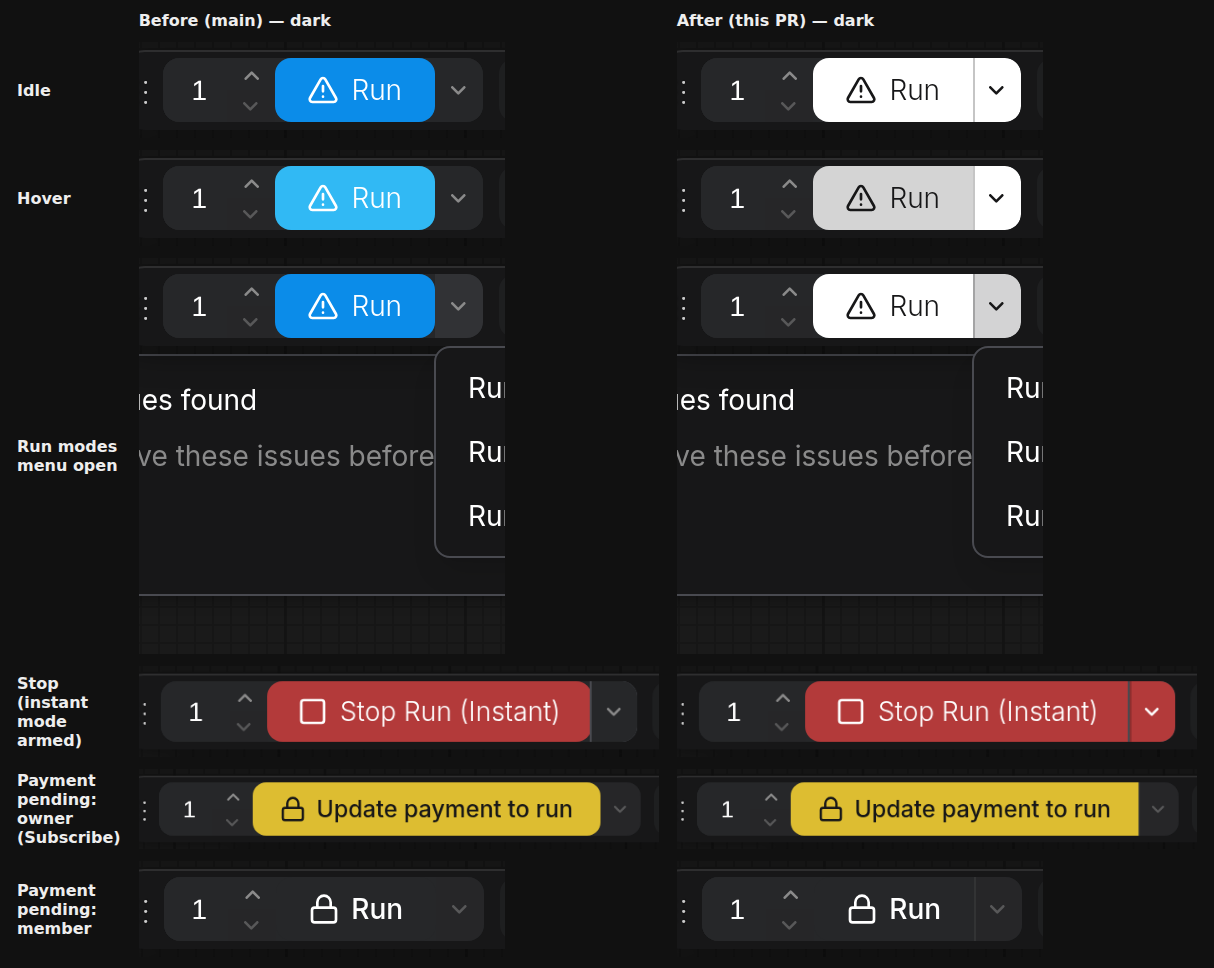 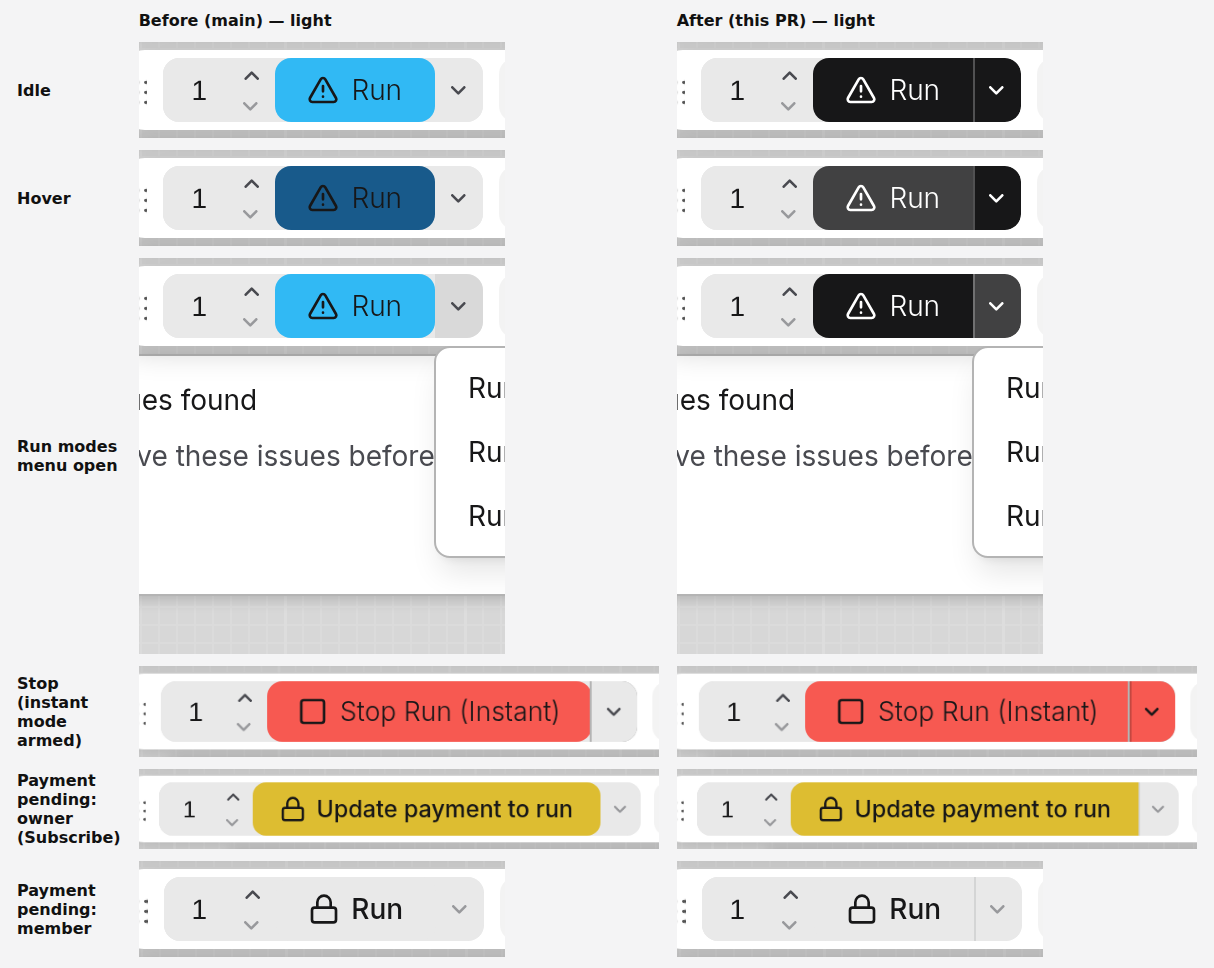 App mode (welcome chip + Run): 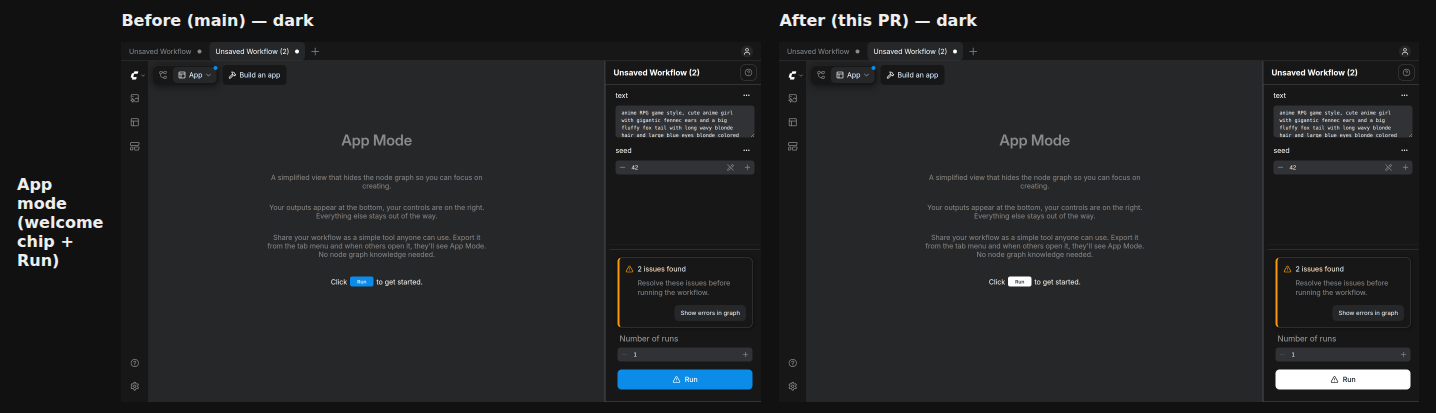 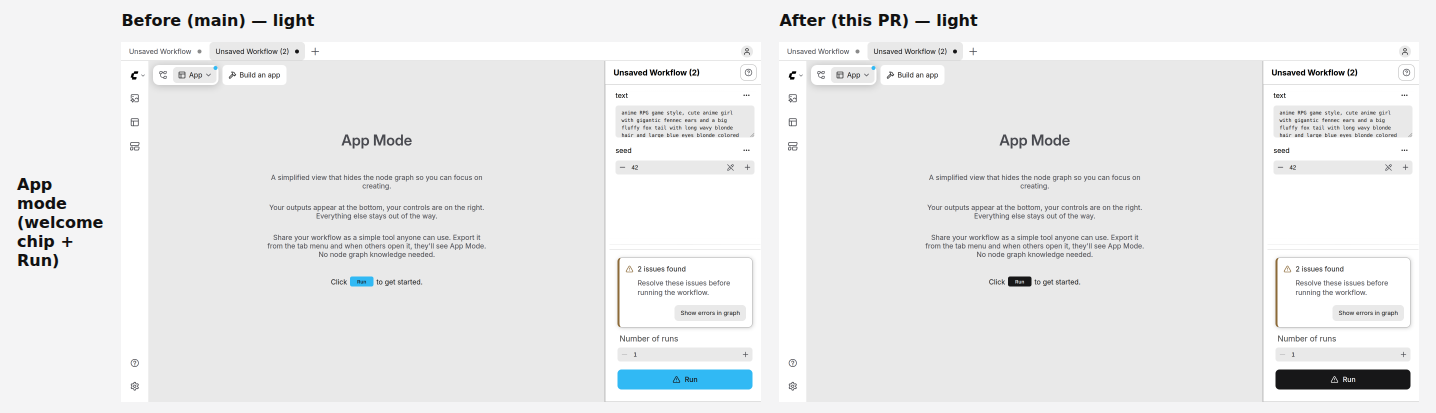 35 Playwright baselines were regenerated. All of them are full-page or full-canvas captures that include the floating actionbar (publish dialog breakpoints, Vue node canvas specs, zoom/group/error specs, mobile baselines, cloud agent replay and others). In each, Run changes from blue to inverted, the chevron changes from grey to inverted with the new divider, and Run's right corners are square. The mobile-chrome baselines `mobile-empty-canvas` and `mobile-default-workflow` also differ in the active tab's shade, and `vue-nodes-paned-with-touch` in widget-text anti-aliasing. This PR doesn't touch tabs or widgets, and CI passes against the current render. --- _Generated by [Claude Code](https://claude.ai/code)_ --------- Co-authored-by: Claude <noreply@anthropic.com> Co-authored-by: github-actions <github-actions@github.com>
…jected (PM-1995) (#20377)

*PR Created by the Glary-Bot Agent*

---

## Problem

With the agent panel open and a CRDT document bound, typing or pasting
into a prompt node can be rejected and not saved. Closing the panel
makes the failure disappear (PM-1995).

## Root cause

A prompt node in modern templates is often a subgraph instance with a
promoted widget. A subgraph instance's type is a definition UUID, so the
pinned catalog does not describe it and the document stores promoted
values as one opaque positional array. `docOpMinter` minted a named
`set_widget`, which the applier rejects with `opaque_widgets`.

## Fix

This carrier is now intentionally limited to the PM-1995 promoted-write
fix and its regression coverage.

`promotedHostWrite()` mints schema Amendment A15's positional payload
for a promoted widget on a top-level subgraph host. `value_index` comes
from the live widget-backed input order. The bound document is consulted
only as a fail-closed veto: its stored value count and declared
promoted-name order must agree before the minter emits the write. A
refused write is dropped before enqueue so it cannot poison unrelated
operations in the same batch.

The app-context/billing refactor and the user-facing
promote/demote/reorder refusal policy previously carried in this PR have
been removed. They require separate review and are not part of this
hotfix.

## Verification

- 6 focused Vitest files: 204 tests passed.
- Cloud Playwright:
`browser_tests/tests/agent/agentSubgraphFollower.spec.ts`, 2 tests
passed. The first case visibly edits a promoted text widget with the
agent panel open and verifies the edit remains on canvas without
changing its sibling value.
- Targeted ESLint completed with zero errors; formatting passed for all
8 changed files.
- Diff against current `main`: 8 files, +704/-18.

The branch was rebuilt solely from commits already published on this PR;
no unpublished Glary-session changes were copied.

Fixes PM-1995

---------

Co-authored-by: Glary-Bot <glary-bot@users.noreply.github.com>
## Summary

Targets `main`; in the original stack it sat on #19088. Moves the
`ServerFeatureFlag` enum out of `useFeatureFlags.ts` into a leaf module
so `remoteConfig.ts` no longer imports the composable.

That single type-only import was the bridge that kept litegraph in the
app-wide import cycle: `remoteConfig → useFeatureFlags → api →
workflowSchema → LGraph`. Everything that reports errors (`reportError`,
`hostTelemetryEnabled`, `linkPresentationStore`,
`transferLinkPresentation`, and the litegraph canvas code that calls
them) rode that chain back into litegraph.

Measured with `pnpm lint:cycles` from #19085 (dependency-cruiser, type
edges included; not on `main` yet, applied locally) on top of #19088 in
the original stack:

| | before | after |
| --- | --- | --- |
| modules in any cycle | 949 | 816 |
| largest cycle | 905 | 618 |
| litegraph modules in the largest cycle | 117 | 0 |

Alone on current `main`: 1027 -> 884 cyclic modules, largest cycle 983
-> 677, 4562 -> 3382 cyclic edges, and no litegraph modules in the
largest cycle.

In the original stack, litegraph and its entity stores
(`widgetValueStore`, `layoutStore`, `nodeDataStore`,
`graphMetadataStore`, `previewExposureStore`, `core/graph/subgraph`,
`core/schemas`) formed their own 149-module cycle with no path to
`platform/`, `components/`, or `composables/`. That is the shape a
future graph-core package would need. On current `main` that cycle has
158 modules and includes `platform/nodeReplacement/cnrIdUtil.ts`, so it
is not yet separate from `platform/`.

Tracks FE-2769 / FE-3037.

## Changes

- New `src/platform/remoteConfig/serverFeatureFlag.ts` holding the enum
verbatim. No imports.
- `useFeatureFlags.ts`, `remoteConfig.ts`, `checkoutJourney.ts`,
`nodeReplacementStore.ts`, `useNodeImageUpload.ts`,
`useWidgetSelectActions.ts` and two tests import the enum from the leaf.
No re-export from `useFeatureFlags.ts`.
- `src/storybook/mocks/useFeatureFlags.ts` drops its hand-copied
duplicate of the enum; it existed only because of this coupling.
- `tools/test-recorder` flag discovery reads the enum from the leaf,
with a test against the real file; `docs/FEATURE_FLAGS.md` points at the
leaf.

## Review Focus

- No behavior change; the enum values are unchanged and nothing else
moved.
- The Storybook alias for `@/composables/useFeatureFlags` still points
at the mock; nothing imports `ServerFeatureFlag` through that alias any
more, so the mock only needs `useFeatureFlags`.

<!-- stack-table:start -->
## Stack

Import-cycle progress for FE-3037, measured with `pnpm lint:cycles`
(dependency-cruiser on `src`).

### Standalone PRs targeting `main`

Each is one commit on current `main` and can merge on its own. Numbers
are that PR alone against `origin/main` (1027 cyclic modules, largest
cycle 983, 4562 cyclic edges).

| PR | Base | Change | Cyclic modules | Largest cycle | Cyclic edges |
| --- | --- | --- | --- | --- | --- |
| **#19089** (this PR) | **`main`** | **`ServerFeatureFlag` enum to a
leaf module** | **1027 -> 884** | **983 -> 677** | **4562 -> 3382** |
| #19094 | `main` | Empty-workflow dialog out of `appModeStore` | 1027
-> 1026 | 983 -> 982 | 4562 -> 4558 |
| #19109 | `main` | Mask editor menu item into `Comfy.MaskEditor`
extension | 1027 -> 1027 | 983 -> 983 | 4562 -> 4562 |
| #19112 | `main` | `PositionConfig` and layer editor dialog key to leaf
modules | 1027 -> 1027 | 983 -> 983 | 4562 -> 4558 |
| #19122 | `main` | `settingStore` off `scripts/app`; `$el` to a leaf |
1027 -> 1025 | 983 -> 981 | 4562 -> 4552 |
| #19124 | `main` | `MissingNodeType` to the nodeReplacement leaf | 1027
-> 1027 | 983 -> 983 | 4562 -> 4555 |
| #19125 | `main` | Blueprint node defs owned by `nodeDefStore` | 1027
-> 1027 | 983 -> 983 | 4562 -> 4561 |
| #19127 | `main` | Thumbnail and minimap data from explicit inputs |
1027 -> 1027 | 983 -> 983 | 4562 -> 4561 |

All eight together on `main`, plus #19091, #19107, #19108, #19111,
#19116 and #19113 (checked locally; those six are not retargeted yet):
630 cyclic modules, largest cycle 412, 2476 cyclic edges.

### Remaining stack

Bottom to top, with current bases. Numbers are from the original 26-PR
stack, each PR against its parent at the time, on the older `main` the
stack forked from (967 cyclic modules then). They have not been
remeasured since the eight PRs above left the stack. Where the base
changed, the parent the numbers were measured on is in parentheses.

#19091, #19107, #19111, #19113 and #19131 still carry the old commits of
the PRs they were moved off (#19131 carries #19122, #19124, #19125 and
#19127), so their GitHub diffs are wider than one PR until the stack is
rebased.

| PR | Base | Change | Cyclic modules | Largest cycle |
| --- | --- | --- | --- | --- |
| #19085 | `main` | Import-cycle baseline check (`pnpm lint:cycles`) |
967 (baseline) | 923 (baseline) |
| #19088 | #19085 | Split litegraph `interfaces.ts` into leaf types |
967 -> 949 | 923 -> 905 |
| #19091 | #19088 (measured on #19089) | Register core sidebar tabs
outside `sidebarTabStore` | 816 -> 669 | 618 -> 465 |
| #19092 | #19091 | Load extensions from bootstrap, not
`extensionService` | 669 -> 580 | 465 -> 371 |
| #19093 | #19092 | Split `scripts/widgets.ts` registry, types, helpers
| 580 -> 566 | 371 -> 357 |
| #19107 | #19093 (measured on #19094) | Register settings dialog from
the app shell | 558 -> 509 | 349 -> 297 |
| #19108 | #19107 | Register asset browser modal from the app shell |
509 -> 496 | 297 -> 284 |
| #19111 | #19108 (measured on #19109) | Register core bottom panel tabs
from GraphView | 484 -> 476 | 272 -> 264 |
| #19113 | #19111 (measured on #19112) | Model library asset-browser
routing onto the sidebar tab | 471 -> 467 | 257 -> 253 |
| #19116 | #19113 | Progress text previews out of `executionStore` | 467
-> 464 | 253 -> 250 |
| #19118 | #19116 | Inject the api auth provider from `main.ts` | 464 ->
447 | 250 -> 233 |
| #19121 | #19118 | Install workspace api credentials from `main.ts` |
447 -> 428 | 233 -> 214 |
| #19131 | #19121 (measured on #19127) | Feature dialogs out of
`dialogService` | 400 -> 391 | 181 -> 172 |
| #19143 | #19131 | Invert `scripts/app` behind `useApp()` | 391 -> 352
| 172 -> 149 |
| #19148 | #19143 | Billing rails announce refreshes; dialogs above the
facade | 352 -> 324 | 149 (baseline) |
| #19153 | #19148 | `types/comfy`, `comfyWorkflow`, dialog/workflow
contracts as leaves | 324 -> 293 | 149 (baseline) |
| #19186 | #19153 | Workbench cycles: `openManager` onto
`useManagerDialog`, agent leaves | 293 -> 259 | 149 (baseline) |
| #19189 | #19186 | Thirteen small app cycles: ui, nodeDef, auth
dialogs, menu, and more | 259 -> 211 | 149 (baseline) |
<!-- stack-table:end -->

---------

Co-authored-by: Amp <amp@ampcode.com>
## Before
<img width="348" height="80" alt="image"
src="https://github.com/user-attachments/assets/2269009b-af7a-42bd-9082-85cc8fadfa42"
/>

## After
<img width="269" height="76" alt="image"
src="https://github.com/user-attachments/assets/5c8b1ceb-8901-4fa3-bd45-d9b42bd51d6c"
/>
…p's account session (#20383)

## Summary

When Comfy Desktop shares its account session through
`__comfyDesktop2.Auth`
([Comfy-Org/Comfy-Desktop#1657](Comfy-Org/Comfy-Desktop#1657)),
the Desktop-hosted local ComfyUI view uses it instead of Firebase:
- the Desktop account becomes the signed-in identity
- its access token becomes the credential for partner nodes
(`auth_token_comfy_org`) and API calls
- "Sign in" runs Desktop's browser sign-in

SSO users have no Firebase account, so this is how they sign in and run
partner nodes in Desktop local installs (FE-3267, DESK2-163; scope
Desktop + Cloud, decided Oct 6).

### Why

An SSO user opening a Desktop local install gets the Firebase sign-in
dialog, which they can't use: their org's domain is refused on Firebase,
and nothing Firebase proves counts as SSO. Partner nodes then have no
credential.

### How

- `platform/auth/desktopHost/desktopHostSession.ts` holds the host
session. It goes active only when Desktop answers something other than
`disabled`. It follows `onChanged` pushes, and stops if Desktop turns
sharing off.
- `authStore`: while the host session is active, these all read from
Desktop instead of Firebase, the web session or a stored API key:
  - `isAuthenticated`, `userId`, `userEmail`, `currentUserIdentity`
  - `getIdToken` and the user/workspace header and token getters
- `dialogService.showSignInDialog` starts Desktop's sign-in instead of
the Firebase dialog. That covers every "sign in" entry point.
- `useCurrentUser`: a Desktop account outranks a stored API key, as a
Firebase login already does.
- `main.ts` starts the host session before mount, only off Cloud and
only when the bridge exists.
- The bridge types are mirrored locally. The pinned
`@comfyorg/comfyui-desktop-bridge-types` (0.2.0) predates `Auth`; switch
once 0.4.0 publishes from Comfy-Desktop#1657.

**Gating:** nothing changes unless all of these hold:
1. it is not a Cloud build,
2. the Desktop bridge exposes `Auth` (older Desktop builds don't),
3. Desktop answers other than `disabled`. Desktop serves only its own
loopback ComfyUI view, behind the ops flag
`desktop_embedded_oauth_session`, which is off by default.

No backend change: comfy-api and ingest already accept the Desktop OAuth
token (`comfy-cloud` audience).

### Plan position

| # | Piece | Repo | Status |
|---|---|---|---|
| 1 | Cloud web SSO (UI-1 to UI-7) | ComfyUI_frontend | Merged |
| 2 | Desktop shares its session (`__comfyDesktop2.Auth`, ops flag) |
Comfy-Desktop #1657 | In review |
| **3** | **Hosted local view uses the Desktop session (this PR)** |
**ComfyUI_frontend** | **This PR** |
| 4 | Switch to published bridge types 0.4.0 | ComfyUI_frontend | After
#1657 publishes |
| 5 | Web local "Sign in with browser" (FE-3099) | ComfyUI_frontend +
cloud | Out of scope (Oct 6) |

```mermaid
flowchart LR
  A["Cloud web SSO<br>merged"] --> B["Desktop #1657<br>session bridge"]
  B --> C["This PR<br>hosted view uses it"]:::me
  C --> D["Bridge types 0.4.0<br>swap local mirror"]
  C -.-> E["Web local FE-3099<br>later"]
  classDef me fill:#fdf0dc,stroke:#c77700
```

## Verification

- `pnpm test:unit
src/platform/auth/desktopHost/desktopHostSession.test.ts`: covers
  - disabled and bridge failure stay inactive
  - signed in gives the account and token
  - signed out gives no token
  - pushes for sign-out and disable
  - sign-in result
- `pnpm test:unit src/stores/authStore.test.ts`: the local distribution
block checks that, with the host session active:
- the Desktop account outranks the Firebase user and a stored API key on
every getter
  - signed out yields no credential
  - `disabled` keeps the Firebase user
- `pnpm test:unit src/composables/auth/useCurrentUser.test.ts`: the
Desktop account outranks a stored key.

### AS IS / TO BE

_Screenshots to follow (Desktop dev build with the ops flag on, signed
in through SSO)._

## Activation gate

`desktop_embedded_oauth_session` stays **off** until Cloud has the
narrow execution-token exchange (workspace, job, operations, expiry;
BE-998 follow-up). Until then, this PR is scaffolding: the bridge serves
an exact-workspace credential (`getWorkspaceToken`) and a separate
user-identity token (`getIdentityToken`). With the flag off, nothing
changes for users.

## Summary
The layer panel renders before loadImages ran, and loadImages was what
added the background fill, so the panel read the kind of a first layer
that did not exist yet and the Create Layered Image editor stayed blank.

Add the background when the session is created instead, so every reader
of the first layer can rely on it being there.
## Summary

The post-tour nudge now opens next to the sidebar Templates button, with
a ring on the button and the tour pointer. Before this change, the nudge
was pinned to the bottom-right corner, so on Cloud it covered the prompt
box of the docked Agent panel. The card itself (image, close button,
copy, "Not now", "Explore templates") and its telemetry do not change.

Decisions from the [Slack
thread](https://comfy-organization.slack.com/archives/C0A8Z4U7Y1K/p1791324987721749):
- With a right sidebar, the card opens on the left of the button, toward
the canvas. The Agent panel is always outside the sidebar.
- The card waits, and then shows, in these cases:
  - The Templates button is not rendered (builder mode, focus mode).
  - Agent node selection hides the sidebar.
  - A sidebar panel is open.
  - Another tour runs.
- The window is narrower than the `md` breakpoint, the same rule the
tour and Getting Started use.
- Before the card shows, it scrolls the Templates button into view,
because the sidebar scrolls on short windows.
- A click outside the card closes it, the same as "Not now". Escape also
closes it.
- `useCoachmarkTarget` now resets its position when the card unmounts.
Thus a card that comes back does not paint at its old coordinates for
one frame.

## Verification

- Unit: 753 tests in 51 files pass
(`src/renderer/extensions/firstRunTour`, `src/platform/onboarding`,
`src/components/sidebar`, `src/platform/updates`). Each new wait rule,
the side choice, the scroll and the position reset have a test. When I
removed each one in turn, a test failed.
- e2e: `gettingStartedTour.spec.ts` passes 7/7 in the `cloud` project
against a local cloud build. The extended nudge test fails against a
main build.
- QA screenshots: see the QA comment.

---------

Co-authored-by: bymyself <cbyrne@comfy.org>
## Summary

Adds dependency-cruiser and `pnpm deps:audit` to report import cycles in
`src/` for auditing and tracking. Unlike #19085, there is no baseline
file, no ratchet, and no CI step: `no-circular` is a `warn` rule, so the
command always exits 0.

- `.dependency-cruiser.json`: resolves through `tsconfig.json` paths,
parses `.vue`, skips test/spec/story files, does not follow
`node_modules`. It is JSON rather than `.ts` because knip's and fallow's
built-in dependency-cruiser plugins only detect
`.dependency-cruiser.{js,cjs,mjs,json}`; this way neither tool needs a
manual entry or ignore.
- No root `@vue/compiler-sfc`: dependency-cruiser resolves it through
pnpm's hoisted `.pnpm/node_modules` (a direct dependency of `vue`).
`depcruise --info` shows `✔ @vue/compiler-sfc` and `✔ .vue`, and the
audit output is identical with or without the root dependency.
- dependency-cruiser's `no-circular` reports one representative edge per
cycle, chosen in DFS order. The count is useful for spotting trends but
is not stable enough to gate on.

Tracks FE-2769 / FE-3037.

## Verification

- `pnpm deps:audit` on current `main`: exit 0, `3116 dependency
violations (0 errors, 3116 warnings). 2618 modules, 15788 dependencies
cruised.` Takes about 23 s.
- `pnpm knip` and `pnpm fallow audit --changed-since origin/main` are
clean with no dependency-cruiser entries in either config.

---------

Co-authored-by: github-actions[bot] <41898282+github-actions[bot]@users.noreply.github.com>

Rework the missingMediaScan to query for specific missing assets instead
of searching over all assets

NOTE: As a known regression, on non `assetsEnabled` local, a missing
`[output]` annotated asset will no longer get marked as missing. I do
not believe keeping the paging logic around to handle such an edge-case
justifiable.
…et (#20464)

*PR Created by the Glary-Bot Agent*

---

## Summary

Follow-up to #20377 that adds two regression tests suggested in
@dante01yoon's approving review (comments 4212057264 and 4212057277).
#20377 was already in the merge queue, so its branch can't be updated.
This PR stacks on its head (`b5b0f3dcbd`). Until #20377 merges, the diff
also shows #20377's own changes; after it merges, only the two test
commits are left. No production code changes.

- **Count guard:** new cases `refuses a document whose stored array
{outnumbers, undercounts} its matching promoted names`. They use real
`seedPromotedHost(['first','second','extra'])` and
`seedPromotedHost(['only'])` documents whose promoted names match the
live host, so the `valueCount === liveNames.length` check in
`documentAcceptsLiveIndex` is the only thing that refuses the write. The
existing table row changed count and names together, so it couldn't
isolate this check.
- **Lifetime drift budget:** new case `reports a drifted host once
across interleaved ordinary flushes`. It puts real source widget writes
(41, then 42) between the drifted keystrokes. Those flushes clear the
per-flush `reported` set, so only the lifetime `reportedDrift` set keeps
the drift report count at 1.

## Verification

- `vitest run src/workbench/extensions/agent/crdt/docOpMinter.test.ts`:
72/72 passed. `vue-tsc` and oxfmt/oxlint are clean. The pre-push knip
and fallow audit found no issues.
- I broke the production code on purpose and checked which tests failed;
the source was restored afterwards. Each change failed only its own
test:

| Change to production code | Tests that failed |
| --- | --- |
| Removed the count check | "outnumbers" and "undercounts" |
| `===` changed to `>=` | "outnumbers" only |
| `===` changed to `<=` | "undercounts" only |
| `reportedDrift` changed to `reported` | the new interleaved test only
(2 reports instead of 1) |

---------

Co-authored-by: Glary-Bot <glary-bot@users.noreply.github.com>
…20468)

## Summary

An OAuth sign-in (Comfy Desktop, MCP clients) that goes through SSO
lands on a JSON 404 instead of the consent page, so a first-time SSO
user can never finish signing in. SSO now returns to
`/cloud/oauth/consent`, the consent path the server serves as a page.

- Fixes FE-3298

**Why:** a person with no Cloud session who picks Continue with SSO
during an OAuth sign-in is stuck on `{"code":"NOT_FOUND"}`. This blocks
the Oct 15 internal Desktop SSO test, since every first sign-in takes
this path. With an existing Cloud session the SSO step is skipped, which
is why it went unnoticed.

**Root cause:** `resolveSsoReturnTo` (added in #20217) resolves the
pending consent by route name, which gives `/oauth/consent`. That route
only exists inside the SPA. The SSO callback is a full page load, and
the server answers `/oauth/consent` with a 404 on testcloud and prod.
Only `/cloud/oauth/consent` is served as a page; the SPA then redirects
it to `/oauth/consent`.

| Path | testcloud | prod |
|---|---|---|
| `/oauth/consent` | 404 JSON | 404 JSON |
| `/cloud/oauth/consent` | 200 HTML | 200 HTML |

**How:** one helper, `toSsoReturnPath`, maps `/oauth/consent` to
`/cloud/oauth/consent` (query kept) for every SSO return:
- `resolveSsoReturnTo`: the login/signup pages' Continue with SSO and
the post-Firebase `sso_required` handoff.
- `SsoRequiredDialogContent`: its fallback to the current route, so a
refusal raised on the consent page itself (e.g. by the consent route's
session setup or a re-mint) no longer returns to the 404.

The legacy redirect route now notes that SSO depends on it, so it isn't
removed before BE-4146 serves `/oauth/consent`.

**Every OAuth sign-in path** (context from #14006 and #15026):

| Path into consent | Navigation | Before | After |
|---|---|---|---|
| Signed in: `/oauth/authorize` → 302 `/cloud/oauth/consent` | full
load, then SPA redirect | ok | ok (untouched) |
| Signed out, Firebase sign-in on `/cloud/login?oauth_request_id=` | SPA
`router.push` by name | ok | ok (untouched) |
| Signed out, Continue with SSO on login or signup | SSO callback full
load | **404** | ok |
| Firebase sign-in refused with `sso_required` on the login page | SSO
callback full load | **404** | ok |
| SSO error, retry with the id kept in storage | SSO callback full load
| **404** | ok |
| `sso_required` dialog raised on the consent page | SSO callback full
load | **404** | ok |
| Legacy `/login` (#15026) | SPA redirect to `cloud-login`, query kept |
ok | ok (untouched) |

## Plan position

| PR | Scope | State |
|---|---|---|
| #20217 | `sso_enabled` flag, SSO sign-in (introduced the bug) | merged
|
| #20383 | Desktop local signs in with the Desktop session | in review |
| **this PR** | **SSO returns to a served consent path** | **open** |
| FE-3297 | Workspace switching under Desktop host auth | follow-up |

```mermaid
flowchart LR
  A["#20217 SSO sign-in"] --> C["this PR: consent return fix"]
  B["#20383 Desktop host session"] --> D["Oct 15 internal test"]
  C --> D
  D --> E["FE-3297 workspace switch"]
  style C fill:#f5c518,color:#000
```

## Verification

- **Unit tests:** `CloudLoginView.test.ts` pinned the broken
`/oauth/consent` return in three cases.
  - With the old source, those three fail.
- With this change, all 65 tests in `CloudLoginView.test.ts` and
`onboardingCloudRoutes.test.ts` pass.
- **E2E:** none added. The flow needs a real IdP and a server-side SSO
callback, which the Playwright mocks don't cover; the unit test pins the
`returnTo` value the server receives.
- **Manual (before merge):** on the PR preview against testcloud, signed
out:
  1. Start a Desktop sign-in.
  2. Pick Continue with SSO and sign in as `ssotest1@example.com`.
  3. Confirm the consent page loads and Desktop finishes signing in.

### AS IS

Signed out, Continue with SSO during a Desktop sign-in returns to
`/oauth/consent`, which the server answers with a JSON 404.

<img
src="https://github.com/user-attachments/assets/8e878603-73b4-4cf7-90c9-9b92731f82ea"
width="700">

### TO BE

SSO returns to `/cloud/oauth/consent`; after the IdP the same flow
reaches the consent page. Verified on testcloud Oct 7; the token
exchange completed (`sign_in_provider: saml.workos`, `client_id:
comfy-desktop`).

<img
src="https://github.com/user-attachments/assets/ed1f542f-bbc3-49fb-aca6-63d935dcb3b1"
width="700">

<details><summary>Steps</summary>

<img
src="https://github.com/user-attachments/assets/84791e5f-d90c-4428-85df-f5a00a81df74"
width="700">
<img
src="https://github.com/user-attachments/assets/0f03a210-2d6f-48dc-8fd9-12eb6299f0a8"
width="700">

</details>
## Summary

Targets `main`; in the original stack it sat on #19122. Tracks FE-2769 /
FE-3037.

`src/types/comfy.ts` is inside the app cycle (litegraph barrel,
`ComfyExtension`). `MissingNodeType` lived there, so the missing-node
scan, error catalog, right-side-panel error groups and telemetry
grouping all joined the cycle to read one type alias. The alias already
depended on `NodeReplacement` from the `nodeReplacement` leaf; it now
lives next to it.

Import cycles in the original stack, on top of #19122: 417 -> 411 cyclic
modules, largest SCC 203 -> 197. Alone on current `main`: cyclic modules
and largest SCC unchanged (1027, 983), 4562 -> 4555 cyclic edges.

## Changes

- `MissingNodeType` moves from `src/types/comfy.ts` to
`src/platform/nodeReplacement/types.ts`, unchanged.
- Importers read it from `@/platform/nodeReplacement/types`; `comfy.ts`
imports it for the `ComfyExtension.beforeConfigureGraph` /
`afterConfigureGraph` hooks. No re-export is left behind.

## Review Focus

- Type-only move, no runtime change. `MissingNodeType` was not part of
the `src/types/index.ts` public barrel, so the extension-facing surface
is unchanged.

<!-- stack-table:start -->
## Stack

Import-cycle progress for FE-3037, measured with `pnpm lint:cycles`
(dependency-cruiser on `src`).

### Standalone PRs targeting `main`

Each is one commit on current `main` and can merge on its own. Numbers
are that PR alone against `origin/main` (1027 cyclic modules, largest
cycle 983, 4562 cyclic edges).

| PR | Base | Change | Cyclic modules | Largest cycle | Cyclic edges |
| --- | --- | --- | --- | --- | --- |
| #19089 | `main` | `ServerFeatureFlag` enum to a leaf module | 1027 ->
884 | 983 -> 677 | 4562 -> 3382 |
| #19094 | `main` | Empty-workflow dialog out of `appModeStore` | 1027
-> 1026 | 983 -> 982 | 4562 -> 4558 |
| #19109 | `main` | Mask editor menu item into `Comfy.MaskEditor`
extension | 1027 -> 1027 | 983 -> 983 | 4562 -> 4562 |
| #19112 | `main` | `PositionConfig` and layer editor dialog key to leaf
modules | 1027 -> 1027 | 983 -> 983 | 4562 -> 4558 |
| #19122 | `main` | `settingStore` off `scripts/app`; `$el` to a leaf |
1027 -> 1025 | 983 -> 981 | 4562 -> 4552 |
| **#19124** (this PR) | **`main`** | **`MissingNodeType` to the
nodeReplacement leaf** | **1027 -> 1027** | **983 -> 983** | **4562 ->
4555** |
| #19125 | `main` | Blueprint node defs owned by `nodeDefStore` | 1027
-> 1027 | 983 -> 983 | 4562 -> 4561 |
| #19127 | `main` | Thumbnail and minimap data from explicit inputs |
1027 -> 1027 | 983 -> 983 | 4562 -> 4561 |

All eight together on `main`, plus #19091, #19107, #19108, #19111,
#19116 and #19113 (checked locally; those six are not retargeted yet):
630 cyclic modules, largest cycle 412, 2476 cyclic edges.

### Remaining stack

Bottom to top, with current bases. Numbers are from the original 26-PR
stack, each PR against its parent at the time, on the older `main` the
stack forked from (967 cyclic modules then). They have not been
remeasured since the eight PRs above left the stack. Where the base
changed, the parent the numbers were measured on is in parentheses.

#19091, #19107, #19111, #19113 and #19131 still carry the old commits of
the PRs they were moved off (#19131 carries #19122, #19124, #19125 and
#19127), so their GitHub diffs are wider than one PR until the stack is
rebased.

| PR | Base | Change | Cyclic modules | Largest cycle |
| --- | --- | --- | --- | --- |
| #19085 | `main` | Import-cycle baseline check (`pnpm lint:cycles`) |
967 (baseline) | 923 (baseline) |
| #19088 | #19085 | Split litegraph `interfaces.ts` into leaf types |
967 -> 949 | 923 -> 905 |
| #19091 | #19088 (measured on #19089) | Register core sidebar tabs
outside `sidebarTabStore` | 816 -> 669 | 618 -> 465 |
| #19092 | #19091 | Load extensions from bootstrap, not
`extensionService` | 669 -> 580 | 465 -> 371 |
| #19093 | #19092 | Split `scripts/widgets.ts` registry, types, helpers
| 580 -> 566 | 371 -> 357 |
| #19107 | #19093 (measured on #19094) | Register settings dialog from
the app shell | 558 -> 509 | 349 -> 297 |
| #19108 | #19107 | Register asset browser modal from the app shell |
509 -> 496 | 297 -> 284 |
| #19111 | #19108 (measured on #19109) | Register core bottom panel tabs
from GraphView | 484 -> 476 | 272 -> 264 |
| #19113 | #19111 (measured on #19112) | Model library asset-browser
routing onto the sidebar tab | 471 -> 467 | 257 -> 253 |
| #19116 | #19113 | Progress text previews out of `executionStore` | 467
-> 464 | 253 -> 250 |
| #19118 | #19116 | Inject the api auth provider from `main.ts` | 464 ->
447 | 250 -> 233 |
| #19121 | #19118 | Install workspace api credentials from `main.ts` |
447 -> 428 | 233 -> 214 |
| #19131 | #19121 (measured on #19127) | Feature dialogs out of
`dialogService` | 400 -> 391 | 181 -> 172 |
| #19143 | #19131 | Invert `scripts/app` behind `useApp()` | 391 -> 352
| 172 -> 149 |
| #19148 | #19143 | Billing rails announce refreshes; dialogs above the
facade | 352 -> 324 | 149 (baseline) |
| #19153 | #19148 | `types/comfy`, `comfyWorkflow`, dialog/workflow
contracts as leaves | 324 -> 293 | 149 (baseline) |
| #19186 | #19153 | Workbench cycles: `openManager` onto
`useManagerDialog`, agent leaves | 293 -> 259 | 149 (baseline) |
| #19189 | #19186 | Thirteen small app cycles: ui, nodeDef, auth
dialogs, menu, and more | 259 -> 211 | 149 (baseline) |
<!-- stack-table:end -->

---------

Co-authored-by: Amp <amp@ampcode.com>

june-bump
temporarily deployed
to
website-approval
October 13, 2026 02:15 — with  GitHub Actions
Inactive
GitHub Actions
Inactive
…16352) ## Summary Replace the remaining PrimeVue dialog and simple-component usage with the Reka/shadcn-vue design system, keeping the global dialog service contract. ## Changes - **What**: Migrates global and node-search dialogs, skeletons, button stragglers, and the single knob consumer. Reduces the PrimeVue import allowlist from 46 to 23 files. - **What**: `DialogComponentProps` is a closed type listing only the fields `GlobalDialog` reads. The inert `renderer: 'reka'` option, `unstyled`, `position`, and the PrimeVue maximize/hide callbacks are gone. No internal caller or public custom-node code found by GitHub code search passes them; the documented extension API (`extensionManager.dialog.prompt`/`confirm`) is unchanged. - **What**: `rekaPrimeVueBridge` is renamed to `dialogDismissGuards` and drops the `.p-*` overlay selectors, because no PrimeVue overlay component remains. - **What**: Confirm dialogs settle once: repeated activation no longer calls `onConfirm` again. - **What**: The knob moves into the design system as `ui/knob/Knob.vue` (stories and tests, `defineModel`); `InputKnob` forwards `disabled` to it. `Skeleton` is back to the shadcn shape (`data-slot`, class only); callers size it with Tailwind classes instead of PrimeVue `width`/`height` props. - **What**: Every dialog is modal. `GlobalDialog` drops the `modal` and `dismissOnFocusOutside` options; Settings, Manager, the legacy pricing dialog and the folder customization dialog were non-modal only for PrimeVue overlays. `ui/dialog/Dialog.vue` now forwards props with `useForwardPropsEmits`, which fixes an omitted `modal` being boolean-cast to `false` (node search, its filter dialog, the secret and skill-pack forms and video help were silently non-modal). `DialogOverlay` is the plain Reka overlay again. `SearchableSingleSelect` wraps its content in a `FocusScope`, as `MultiSelectContent` already does, so it takes focus inside a modal dialog. - **What**: Escape is derived from the active dialog's `closable`; the `closeOnEscape` option and `updateCloseOnEscapeStates` are gone. `dismissableMask` is renamed `dismissOnPointerDownOutside` after the Reka event. `useOverlayChildStyle` and the `contentStyle` threading through the asset and manager dialogs are removed; the `ui/` selects already lift themselves above the modal. - **What**: The canvas toolbar is a plain flex container again, so it keeps the shared floating-panel radius; `ButtonGroup`'s `rounded-md` had overridden it. The design-system `Skeleton` carries `data-slot="skeleton"`, which the billing e2e uses to detect loading. - **What**: Dialog styling lives in the design system instead of callers. `contentClass`, `headerClass`, `bodyClass`, `footerClass` and `overlayClass` are gone. A **headless** dialog's component is the whole panel (surface, width, close button) and `GlobalDialog` gives it a transparent shell that hugs it; about 25 workspace, billing and agent panels already worked this way through a copied `SELF_STYLED` class. A **framed** dialog uses the standard card (`rounded-2xl border-border-default`) at a `size`: `sm`/`md`/`lg`/`xl`, `fit` (hug the content) or `full` (editors: 90vw × 90vh, inset-aware). `flush` replaces the three padding overrides for dialogs whose header, body and footer components pad themselves (confirm, the small layout dialogs, model upload, mask and layer editors). `BaseModalLayout` paints its own card and owns the large sizes (Settings, Templates and Publish at `md`; Manager, model selector and asset browser at `lg`, keeping #18605's 3000px step). The mask editor e2e finds the dialog by its key instead of the `.mask-editor-dialog` hook class. - **What**: Toasts sit on the toast dock's fixed layer above every dialog, whatever opened first; before, a dialog opened after a toast covered it. While a modal dialog is open the toast column moves to the top of the window, into the scrim margin above the dialog, so it no longer covers the close button (WCAG 2.4.11 Focus Not Obscured: notifications that appear on their own must not hide the focused control). - **What**: `DialogContent` focuses a descendant marked `autofocus` on open, as the native `<dialog>` does; `GlobalDialog`'s copy of that logic is removed. Node search uses it instead of focusing its input on mount, and drops its inner `FocusScope`: once node search became modal, Reka's trapped scope (whose mutation observer runs even while paused) pulled focus off the input on the first re-render, so Enter and the arrow keys stopped working. - **Breaking (TypeScript only, accepted)**: `DialogComponentProps` no longer accepts PrimeVue-era options (`pt`, `unstyled`, `position`, `renderer`, `closeOnEscape`, `modal`, `dismissOnFocusOutside`, `contentClass`, `headerClass`, `bodyClass`, `footerClass`, `overlayClass`, arbitrary keys) and renames `dismissableMask` to `dismissOnPointerDownOutside`. TypeScript callers that pass them now get a type error. `GlobalDialog` already ignored the PrimeVue-only keys at runtime; a JavaScript caller passing `closeOnEscape`, `modal`, `dismissOnFocusOutside`, `dismissableMask` or one of the class options now loses that behavior silently (Escape follows `closable`, every dialog is modal, outside clicks do not dismiss). The search below found no such caller. This follows the no-compat-without-verified-usage rule. Evidence: GitHub code search outside this repo (`gh search code` for `dialogComponentProps`, `showExtensionDialog`, `showLayoutDialog`, `extensionManager.dialog`, `unstyled dialogComponentProps`) found no custom node passing dialog props. The only matches were copies of this repo's own `dialogStore.ts`/`dialogService.ts` and calls to `extensionManager.dialog.prompt`/`confirm` (Comfy-Org/docs `javascript_dialog.mdx`, ComfyUI-React-Extension-Template, ComfyUI-Manager, AlekPet, comfyui-deploy, ComfyUI-iTools) and `showErrorDialog` (VideoHelperSuite). None of them pass `dialogComponentProps`, and this PR leaves those signatures unchanged. - **Breaking (extension DOM, accepted)**: every dialog is modal, so while one is open the page outside it takes no pointer input. An extension that appends its own UI to `document.body` from inside a dialog gets no clicks until that dialog closes. Native `<dialog>` elements opened with `showModal()` are the exception: they take pointer input again, so rgthree-comfy's settings dialog, opened from its row in Settings, works on the first click. The mask editor no longer carries the `mask-editor-dialog` class, which cg-image-filter and Comfyui_LG_Tools use to find it. No compatibility shim is added for either; the supported path is `extensionManager.dialog` (`prompt`, `confirm`, `showExtensionDialog`), whose dialogs stack with the open one. ## Review Focus Global dialog stacking, dismissal, maximize behavior, nested overlay z-index, and node-search focus, dismissal, and placement. ## Screenshots Main on the left, this PR on the right. Each dialog is opened through the same opener on both builds, 1280×720 at 2×, against a local ComfyUI backend, and clipped to the dialog. Cloud-only panels (workspace, billing, pricing, SSO) render on the OSS build without account data, so some show empty or error states. Where an opener is gated on the cloud build or a feature flag, the component is opened through `dialogStore` with each build's own dialog props. <details> <summary>Toast over an open dialog</summary> A toast now stays above every dialog whatever opened first. While a modal dialog is open, the toast moves into the margin above the dialog instead of covering its close button. Settings open, then a toast arrives:  Toast shown, then Settings opens. On main the dialog covers the toast:  </details> <details> <summary>Framed dialogs (standard card)</summary> Framed dialogs use the design-system card: `rounded-2xl` and `border-border-default` instead of `rounded-lg` and `border-border-subtle`. Sign-in and update password size to their content with `size: 'fit'`. Prompt (`extensionManager.dialog.prompt`):  Confirm (`extensionManager.dialog.confirm`):  Error dialog:  Sign in:  Update password:  Billing coming soon (`size: 'sm'`; main narrowed it to 360px):  Typeform survey (the form itself is blocked offline on both):  Customize folder (node library), now a modal dialog:  </details> <details> <summary>Sectioned dialogs (<code>flush</code>)</summary> Dialogs whose header, body and footer components pad themselves use `flush` instead of zeroing padding with `headerClass`, `bodyClass` and `footerClass`. Confirm dialog with sections (`showConfirmDialog`). Width follows the standard `md` size: 576px instead of 512px:  Edit keybinding (small layout):  Node pack conflicts (small layout):  Import failed (small layout):  </details> <details> <summary>Editors (<code>full</code> size)</summary> `full` is the editor size: 90vw × 90vh, inset-aware. Mask editor:  Layer editor (maximized; the header border and padding now live in its header component):  3D viewer frame (placeholder content), now 90% of the screen instead of 80%:  </details> <details> <summary>Headless panels</summary> These components draw their own card. `headless` now gives them a transparent shell that hugs the panel, replacing the `SELF_STYLED` and 360px class strings the callers used to pass. They should look the same. Partner nodes sign-in:  Create workspace:  Delete workspace:  Leave workspace:  Invite members:  Invite link invalid:  Revoke invite:  Top up credits:  Insufficient credits (member):  Subscription paused:  Subscription inactive (member):  Cancel subscription:  SSO required:  Clear queue history:  Deploy to Comfy API:  Cloud notification:  Open shared workflow:  Share workflow:  Manager survey:  Builder: empty workflow:  </details> <details> <summary>Pricing dialogs</summary> The pricing surface (`bg-secondary-background` and its custom shadow) moves from the caller's `contentClass` onto each pricing component's root. The legacy workspace table is now modal; its popover stays keyboard-reachable. Legacy pricing:  Legacy workspace pricing:  Unified pricing:  </details> <details> <summary>Large layouts (<code>BaseModalLayout</code>)</summary> `BaseModalLayout` paints its own card and owns the large sizes: Settings, Templates and Publish use `md`; Manager, the model selector and the asset browser use `lg`. Settings:  Templates:  Manager:  Publish:  Model selector:  Asset browser:  </details> <details> <summary>Node search</summary> On main, node search is a PrimeVue dialog; it is now a modal Reka dialog. At this viewport, both versions keep main's position and width. Node search v2 (default):  Node search v1 (legacy):  </details> <details> <summary>Canvas toolbar</summary> The toolbar is a plain flex container again, so it keeps the shared floating-panel radius. Canvas toolbar:  </details> --------- Co-authored-by: Amp <amp@ampcode.com> Co-authored-by: github-actions <github-actions@github.com>
june-bump
temporarily deployed
to
website-approval
October 13, 2026 02:53 — with
GitHub Actions
Inactive
GitHub Actions
Inactive
june-bump
temporarily deployed
to
website-approval
October 13, 2026 03:03 — with
GitHub Actions
Inactive
GitHub Actions
Inactive
## Summary

Make shared Load3D thumbnail generation cancellable, bounded, and safe
to reuse from Agent reply previews.

## Changes

- **What**: Bound thumbnail outcomes and abandoned-work admission,
forward deadline cancellation to model-data requests, dispose replaced
viewer resources (including the per-mode materials a PLY rebuild
replaces), and preserve safe clone/texture ownership and quad face sizes
on cloned geometry. Agent reply previews skip offscreen rendering for
model URLs without a `filename` query, which the Load3D loader cannot
resolve.
- **Breaking**: None.
- **Dependencies**: None.

## Review Focus

- Cancellation and queue-capacity recovery when a transfer or parser
does not cooperate.
- GPU ownership when copied viewer models replace independently cloned
geometry, materials, and textures.

## Validation

- 14 directly affected Vitest files: 555 tests passed.
- Targeted oxfmt, type-aware oxlint, ESLint, app typecheck, knip, and
changed-file fallow audit passed.
- No Playwright test added: the failure modes are offscreen timeout,
cancellation, and GPU-resource ownership boundaries that are
deterministically exercised below the browser level; an E2E would only
duplicate those assertions through mocked assets.

## Stack

1. #20033: telemetry URL redaction (merged)
2. This PR: bounded Load3D thumbnail lifecycle
3. #16430: Agent reply asset preview lifecycle and browser coverage

---------

Co-authored-by: Alexander Brown <drjkl@comfy.org>
…d trim the gallery to four cards
…all gallery cards on phones
june-bump
temporarily deployed
to
website-approval
October 13, 2026 04:37 — with
GitHub Actions
Inactive
GitHub Actions
Inactive
june-bump
temporarily deployed
to
website-approval
October 13, 2026 04:42 — with
GitHub Actions
Inactive
GitHub Actions
Inactive
…he /nvidia-rtx redirect to a built page
june-bump
temporarily deployed
to
website-approval
October 13, 2026 05:05 — with
GitHub Actions
Inactive
GitHub Actions
Inactive

…20897) | Before | After | |---|---| |  |  | Load Image now shows the preview the backend stores for an EXR instead of the "HDR image" placeholder: on Vue nodes for a freshly uploaded file, and when an EXR is re-opened in a workflow or picked from the dropdown. Previously the upload response's `asset.preview_id` was dropped and nothing looked the preview up. This needs Comfy-Org/ComfyUI#16898, which returns `preview_id` from `/upload/image` and attaches previews to EXR assets. Against a backend without it nothing changes. | | LOC changed | Files touched | Files added / deleted | Added / deleted / changed | |---|---|---|---|---| | Product | 202 (+131 / −71) | 9 | 1 / 0 | Functions: 7 / 1 / 11 | | Tests | 133 (+133 / −0) | 2 | 1 / 0 | Test cases: 3 / 0 / 0 | - The Vue picker sets the node's output with the upload response's `preview_id`. On mount and on a dropdown pick, it looks the file up by its asset record (`resolveWidgetValueAsset`, extracted from the missing-media scan) and uses that record's preview. - Re-uploading the same file on a Vue node remounts the preview image, so `node.imgs` stays populated and a preview that failed to load is retried. - Open Image and Save Image act on the EXR, not the preview it is shown as. Copy Image copies the preview pixels. - On the classic canvas, an image whose URL carries a `preview_id` (for example an executed EXR output) shows its stored preview instead of the raw file, which the browser can't decode. - The sun badge on HDR gallery thumbnails is removed. Known limitations - A file freshly uploaded to a classic-canvas Load Image (button, drag or paste) still shows nothing; tracked separately. - After a Clipspace paste in "all" mode on the canvas, Open/Save Image on the pasted node act on the preview rather than the EXR. - `.hdr` uploads still show the placeholder: the backend doesn't generate a preview for them. --------- Co-authored-by: Austin Mroz <austin@comfy.org>
…#20734)

## Summary

This is the first slice of #20599. It fixes the two config gaps that let
action versions drift apart, such as #17362 bumping
`actions/cache/restore` without `actions/cache/save`.

- `dependabot.yml`: the github-actions scan uses `directories: ['/',
'/.github/actions/*']`. With `directory: '/'`, Dependabot reads only
`.github/workflows/`, so the 21 composite actions never got updates. A
new `github-actions-major` group puts major bumps in one PR instead of
one PR per dependency name. Minor and patch updates stay in the existing
group.
- `.pinact.yaml`: allowlist refs change from fixed majors (`v5`, `v7`,
...) to `'v\d+'`. Without this, every Dependabot major bump of a
floating tag fails `validate-pins` until someone edits the allowlist by
hand. pinact full-matches `ref`, so `v6-beta` and `v6.1` are still
rejected. The trade-off is that the allowlist no longer pins which major
of these official actions is allowed. Dependabot and review now own
that.

The first grouped major PR after this lands will include
`suzuki-shunsuke/pinact-action` v1.3.1 → v3.0.0. That bump needs `fix:
'false'` added, because in v3 `skip_push: 'true'` alone no longer runs a
check. I'll send that, the drift check, and the action bumps as separate
follow-ups.

## Verification

I ran pinact 3.7.3 (`pinact run --check`, with a token):
- the branch passes;
- a floating `actions/cache/save@v6` fails under the old config and
passes under the new one;
- `@v6-beta` still fails.

`oxfmt` passes, and the YAML parses with `directories` set and no
`directory`.
…ro media outline

Adds opt-in model-launch options: a three-column gallery, overlay captions on square tiles, a full-span card at 3:1 that can open in a fullscreen dialog, and a grey outline around the hero media. Existing pages keep their defaults.
Cloud CTA opens the RTX video enhance template. Secondary CTA reads View docs. The before/after slider returns under the hero with the three node clips, followed by the full-width expandable pipeline screenshot stored in the site. Poster refreshed from the relabelled hero clip; the missing phone encode is no longer referenced.
june-bump
temporarily deployed
to
website-approval
October 13, 2026 17:00 — with
GitHub Actions
Inactive
GitHub Actions
Inactive
june-bump
temporarily deployed
to
website-approval
October 13, 2026 17:00 — with
GitHub Actions
Inactive
GitHub Actions
Inactive

|
Review the following changes in direct dependencies. Learn more about Socket for GitHub.
|


 github-actions
Bot
added
risk:unknown
and removed
risk:high
This was referenced Oct 27, 2026

This branch was previously deployed
This file contains hidden or bidirectional Unicode text that may be interpreted or compiled differently than what appears below. To review, open the file in an editor that reveals hidden Unicode characters.
Learn more about bidirectional Unicode characters
Sign up for free
to join this conversation on GitHub.
Already have an account?
Sign in to comment


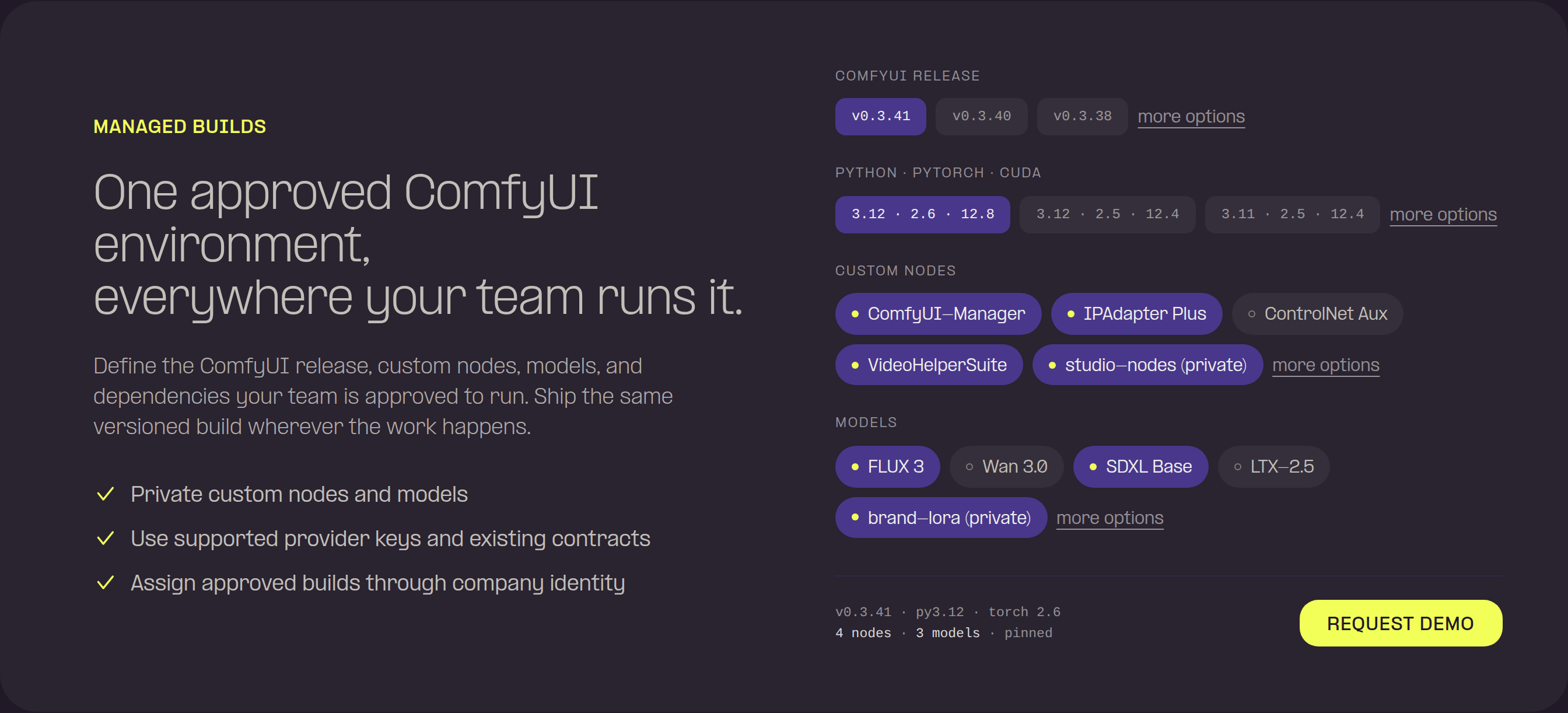
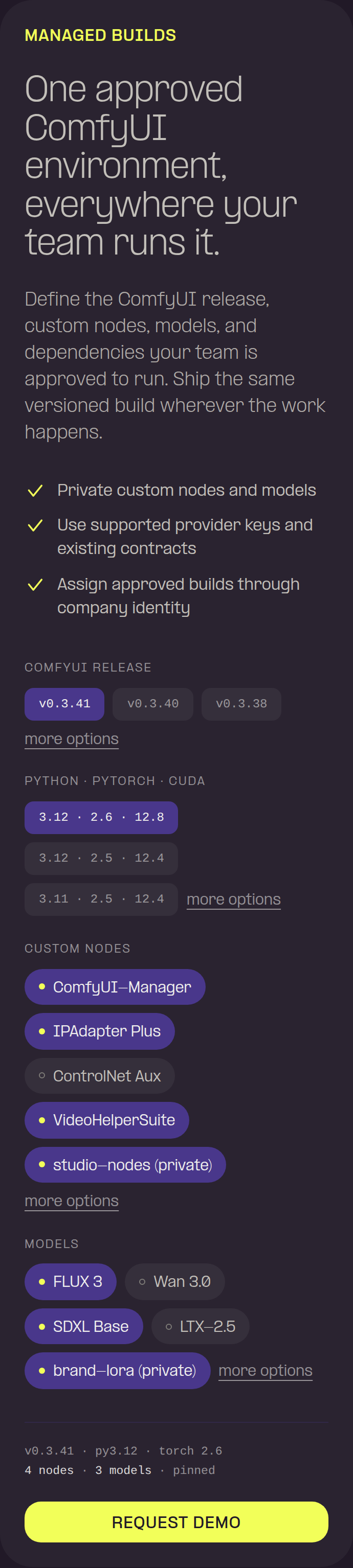
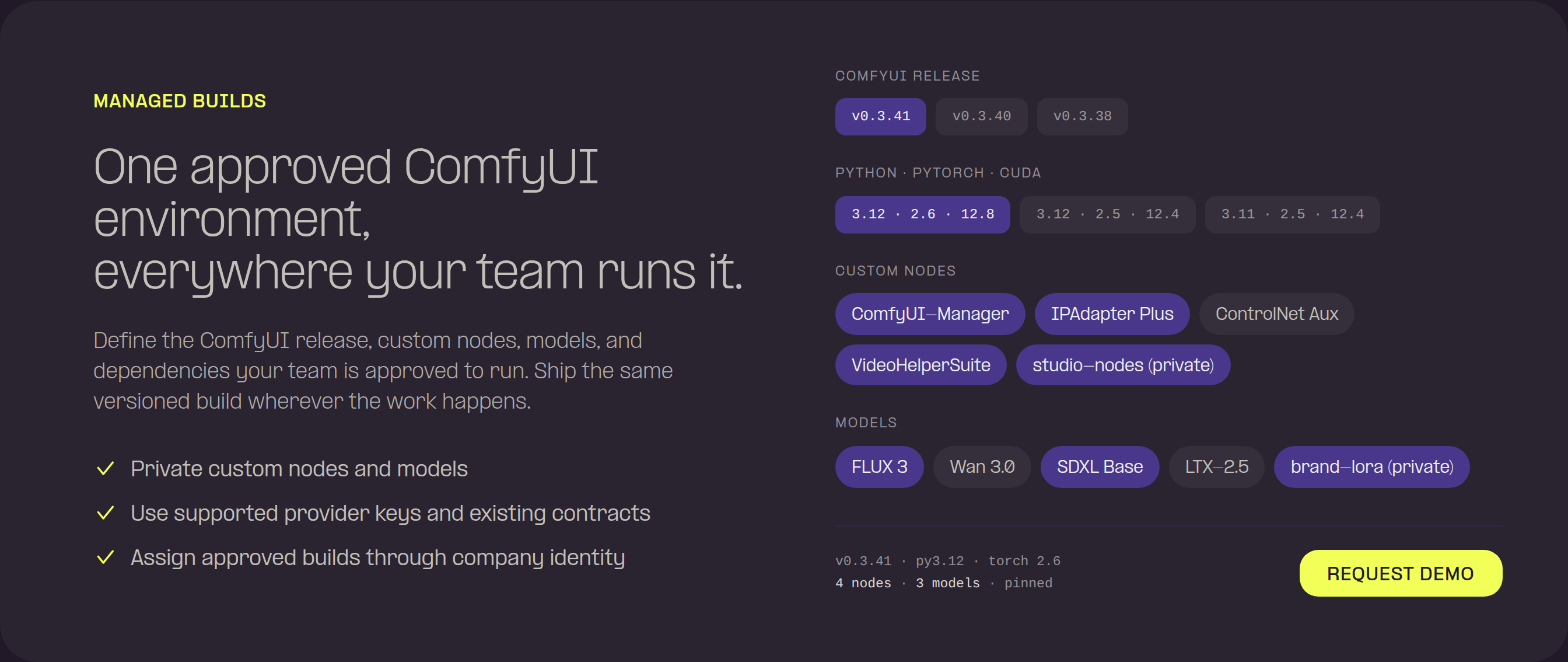
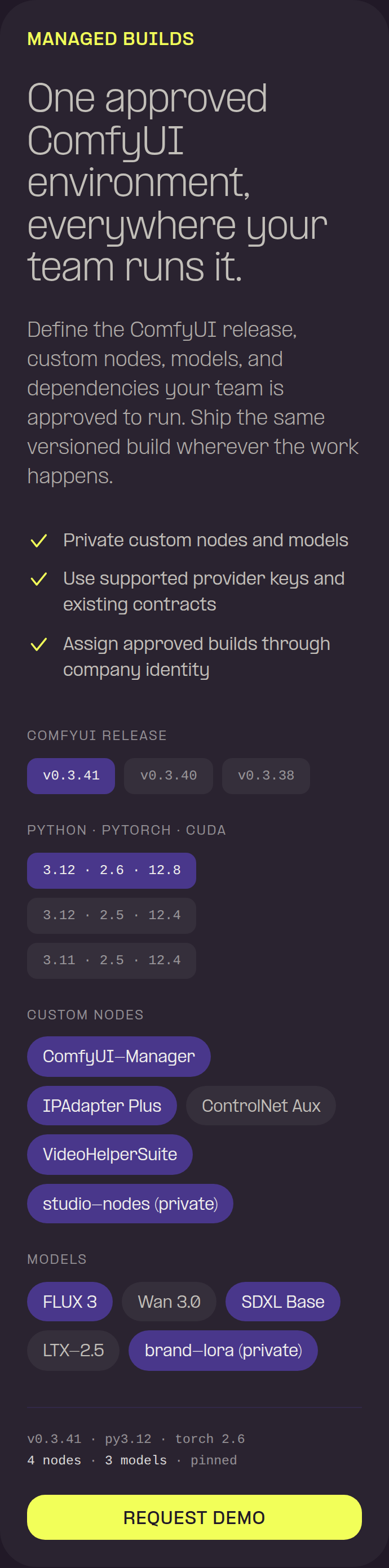






Add this suggestion to a batch that can be applied as a single commit.This suggestion is invalid because no changes were made to the code.Suggestions cannot be applied while the pull request is closed.Suggestions cannot be applied while viewing a subset of changes.Only one suggestion per line can be applied in a batch.Add this suggestion to a batch that can be applied as a single commit.Applying suggestions on deleted lines is not supported.You must change the existing code in this line in order to create a valid suggestion.Outdated suggestions cannot be applied.This suggestion has been applied or marked resolved.Suggestions cannot be applied from pending reviews.Suggestions cannot be applied on multi-line comments.Suggestions cannot be applied while the pull request is queued to merge.Suggestion cannot be applied right now. Please check back later.
Summary
Preview-only PR so the Vercel preview rebuilds with the copy review from Slack. Do not merge.
The base is the previous tip of the #19664 preview branch rather than main, because #19664 conflicts with main and GitHub does not run preview builds on conflicting PRs. The same commit is already on the #19664 branch.
Changes
/nvidia-rtx(en and zh-CN).Review Focus
Copy only. The Comfy Cloud CTA points at the generic cloud entry point until the combined workflow link exists.