


I design autonomous systems that finish what they start. The proof runs daily: a build factory I wrote specs, builds, adversarially reviews, and deploys small working projects — 29 of them, on 63 of its 87 days, most with a live demo — then updates this page itself.
streak 11 · avg rubric 4.25/5 · demos 17/17 serving · 35/64 independently verified
Latest project ship — day 064 · save-crystal
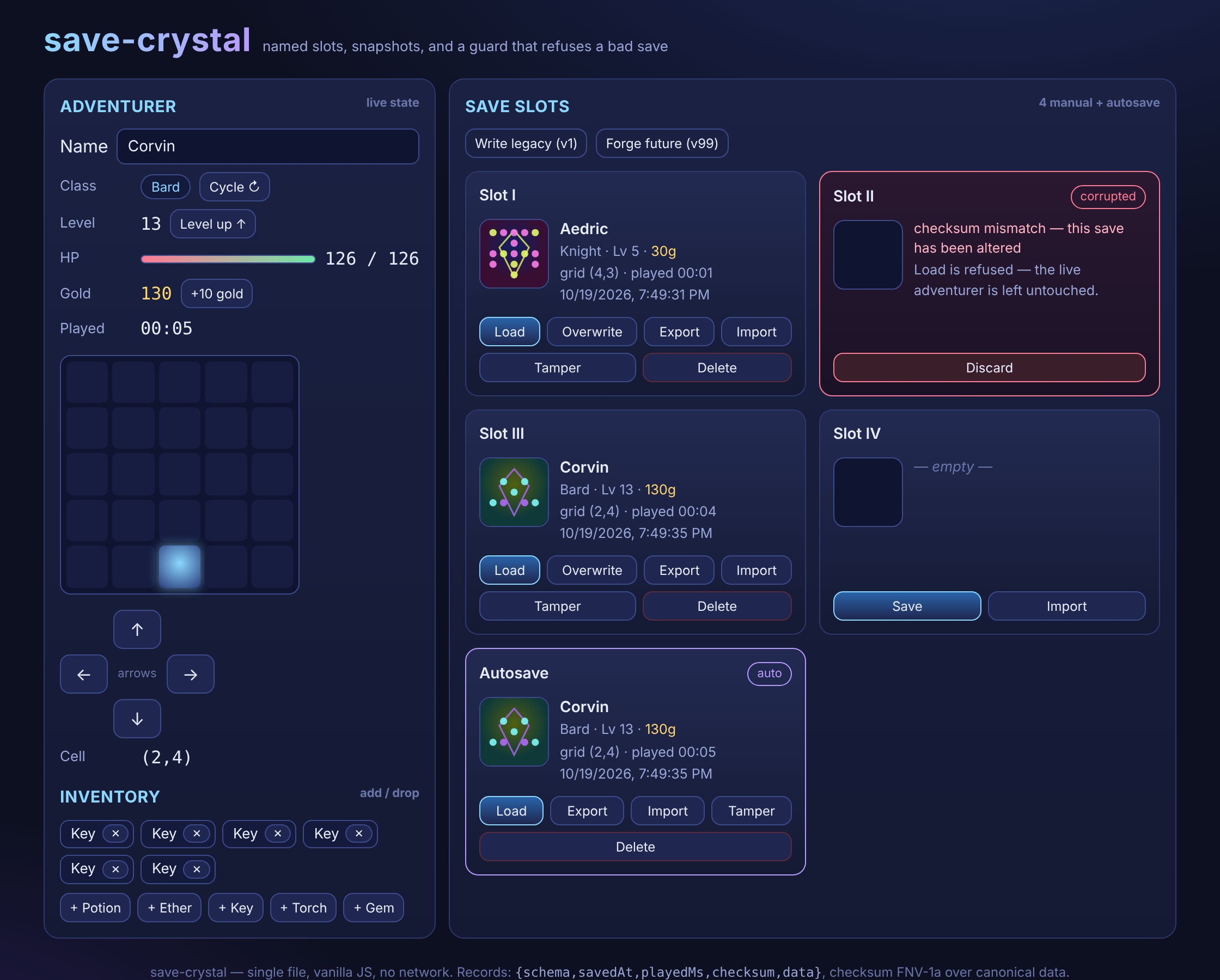
A save system for a 2D RPG — named slots, checksum-guarded snapshots, schema migration, and a corruption guard that refuses a bad save instead of loading garbage. web · vanilla JS, localStorage · rubric 4.75 — live demo · source
| build | what it does | stack | proof |
|---|---|---|---|
| pocket-inventory | A drag-and-drop RPG inventory — move items on a grid, equip them into typed slots, and watch Attack/Defense/Luck change, on phone or desktop | vanilla JS, inline SVG | demo · rubric 5.00 |
| save-crystal | A save system for a 2D RPG — named slots, checksum-guarded snapshots, schema migration, and a corruption guard that refuses a bad save instead of loading garbage | vanilla JS, localStorage | demo · rubric 4.75 |
| shop-keeper | Buy low and sell high across seeded market days, haggling each trade three pushes toward the fair price — grow 120 gold to 400 as supply and demand swing every price, and you are the only supply and demand | vanilla JS, zero deps | demo · rubric 4.75 |
| parley | A duel fought entirely in type — read the foe's telegraphed STRIKE/LUNGE/CRUSH and answer PARRY/DODGE/BRACE to negate-and-riposte or STRIKE to trade; a deterministic three-foe gauntlet, no board and no art | vanilla JS, zero deps | demo · rubric 4.75 |
| dungeon-sprout | Walk a seeded procedural dungeon in the dark — rooms and corridors grow from one number, fog of war reveals a disc as you move, a minimap fills in, and the layout exports as JSON | vanilla JS, canvas | demo · rubric 4.75 |
One row per repo — ranked by best rubric — the reaction lookup did not answer on this run. The sentence describes the repo's latest increment.
Every project starts as an issue. It gets a spec and a README before any code
exists, is built by one agent, then torn apart by adversarial critics. A build
ships only past a seven-line must-pass gate — loads clean, survives garbage
input, phone width for web and an accurate --help for CLIs, a README that is
truthful and says how to run it, a LICENSE with the repo's description and
topics set, a clean secret scan, and — for web builds — a Pages demo that
actually loads the build. A day that cannot clear the gate ships the largest
working subset and says so. The doctrine, rubric, and every daily sign-off are
public in factory-hub.
Maintained by the factory · dashboard · last updated day 064 (2026-10-19)