

The Flutter renderer for AI output.
Production-grade Markdown and LaTeX rendering for streaming Flutter AI interfaces.
Render rich assistant replies, math, code, tables, citations, images, and custom inline UI in one widget.


🌐 Website · 📖 Documentation · 🎮 Live Playground · 📦 pub.dev

- Built for AI output — Markdown, LaTeX, code blocks, tables, alerts, citations, images, task lists, and mixed rich content in one response.
- Streaming that stays fast — settled segments are reused while the live tail updates. At 12 KB, each update is 31× faster than in 1.2.1—or 74× faster with the lazy sliver. See the benchmarks.
- Production-level control — style sheets, Flutter theme extensions, component builders, callbacks, and custom components.
- Extensible inline UI — add
@mentions,#channels,:emoji:, issue references, and product-specific syntax without forking the renderer. - Designed for real-world edge cases — RTL, text scaling, selection, malformed Markdown, autolinks, nested content, reduced motion, Flutter web, and WASM.
| Rendering | Production experience | Extensibility | |||
|---|---|---|---|---|---|
| 📝 | Rich Markdown | ⚡ | Adaptive streaming | 🎨 | Component style sheet |
| ∑ | Inline and block LaTeX | 🚀 | Lazy sliver rendering | 🧱 | Structural builders |
| 💻 | Syntax-highlighted code | ♿ | Selection and text scaling | 🏷️ | Mentions, channels, and emoji |
| 📊 | Tables and aligned columns | 🌍 | RTL, web, and WASM | 🧩 | Custom components and scopes |
| 🔗 | Links, autolinks, and images | 🌓 | Theme-aware rendering | 👆 | Interaction callbacks |
| ☑️ | Lists, tasks, and citations | 🛡️ | Graceful malformed input | 📱 | Custom URL schemes |
Every image is one GptMarkdown widget in a light Material 3 theme. The only styling is softer table borders and compact checkboxes; the inline components are app-supplied builders. Click any of them for full size.
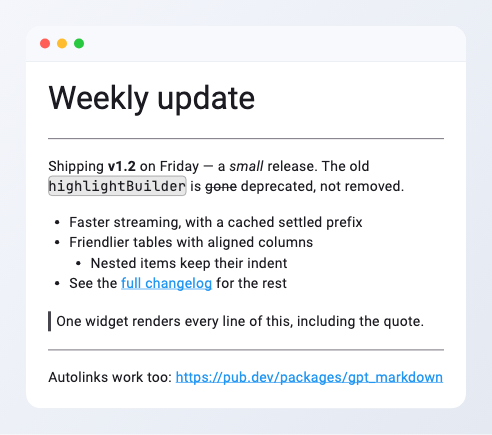 Rich text Headings, emphasis, lists, quotes, rules, autolinks. |
 LaTeX Inline and display equations, on the text baseline. |
 Tables Per-column alignment, Markdown inside cells. |
 Code Syntax highlighting, language labels, and copy controls. |
 Task lists Checkboxes, ordered and nested lists, citation tags. |
 Custom inline components Mentions, channels, status pills, file chips. #2959 stays text. |
flutter pub add gpt_markdownimport 'package:gpt_markdown/gpt_markdown.dart';
GptMarkdown(
reply,
onLinkTap: (url, title) => openUrl(url),
)The widget sizes itself to its content. Place it inside your preferred scrollable chat or document surface.
Rebuild GptMarkdown with the complete text received so far. Settled segments are reused while the changing tail updates.
GptMarkdown(
  streamedReply,
  animation: GptMarkdownAnimation.fade,
  blockAnimation: GptMarkdownBlockAnimation.fadeIn,
  isStreaming: stillGenerating,
  charactersPerSecond: 300,
)
The reveal adapts to incoming text, finishes when generation ends, and respects reduced-motion settings. See the streaming guide for animation modes and configuration.
For long responses and documents, use SliverGptMarkdown inside a
CustomScrollView. It creates spans and widgets only for the segments requested
by the viewport, including its cache extent. The regular GptMarkdown widget is
cheaper for short content and remains the option for character reveal. See the
rendering architecture guide.
GptMarkdown(
  r'''
## Revenue forecast

Projected growth: **18%**.

\[
R_{next} = R_{current} \times (1 + 0.18)
\]

- [x] Validate the assumptions
- [ ] Review the final forecast

Sources: [1] [2]
  ''',
  onSourceTagTap: (source) => openSource(source),
)
Use \( ... \) for inline LaTeX and \[ ... \] for block equations. Enable dollar-sign syntax with useDollarSignsForLatex: true. Code fences include syntax highlighting, language labels, and copy controls.
Wrap the renderer with SelectionArea when selectable output is needed:
SelectionArea(
  child: GptMarkdown(reply),
)Use style objects for appearance and builders when you need to replace structure.
GptMarkdown(
  reply,
  styleSheet: const GptMarkdownStyleSheet(
    blockQuote: BlockQuoteStyle(
      barWidth: 4,
      barColor: Colors.indigo,
    ),
    inlineCode: InlineCodeStyle(
      fontFamily: 'GeistMono',
      borderRadius: Radius.circular(6),
    ),
    codeBlock: CodeBlockStyle(
      borderRadius: Radius.circular(12),
      showCopyButton: true,
    ),
    table: TableStyle(
      cellPadding: EdgeInsets.all(10),
    ),
  ),
  onCodeCopy: (code) => trackCopy(code),
  onImageTap: (url) => openImage(url),
)
Set styles app-wide with GptMarkdownThemeData. Use builders such as codeBuilder, tableBuilder, and imageBuilder to replace components, or span-based builders for links, citations, and inline code. See customization.
Render mentions, channels, emoji, issue references, and other product syntax alongside Markdown:
GptMarkdown(
  reply,
  inlinePatterns: [
    InlinePattern.prefixed(
      prefix: '#',
      knownNames: channelNames,
      builder: (context, match, style) => WidgetSpan(
        alignment: PlaceholderAlignment.baseline,
        baseline: TextBaseline.alphabetic,
        child: ChannelChip(
          name: match.group(0)!.substring(1),
        ),
      ),
    ),
  ],
)
Only known channel names are matched, longest-first. Patterns exclude link labels by default; unrecognized tokens such as #2959 remain text.
Use blockComponents for custom blocks and inlineDirectives for payloads the parser must leave untouched. See custom components.
Upgrading? Passing components or inlineComponents, even an empty list, selects the deprecated legacy parser. Replace them to use the new pipeline. See the migration guide and changelog.
Bare URLs, www. hosts, emails, and angle autolinks work automatically. Add custom schemes with autolinkSchemes: const {'myapp'}, or disable autolinking with autolink: false. Explicit [label](url) links still work. See inline syntax.
| Guide | Covers |
|---|---|
| Getting started | Installation, syntax, taps, LaTeX, RTL, and selection |
| Customization | Style classes, themes, builders, and callbacks |
| Streaming | Pacing, performance, accessibility, and limitations |
| Rendering architecture | Extension registration, lazy rendering, and performance policies |
| Inline syntax | Autolinks, mentions, channels, and scopes |
| Custom components | Block and inline extensions |
GptMarkdown options |
Every constructor option and default |
| Benchmarks | Methodology, results, and limitations |
| Migration | What each release changes, newest first |
gpt_markdown is the open-source rendering foundation of Val, the live visual layer for AI agents.
Building an AI product that needs richer output than a text box? Request early access to Val.
Issues and pull requests are welcome on GitHub. If the package helps your project, consider giving it a like on pub.dev or a star on GitHub.
BSD 3-Clause — see LICENSE.