
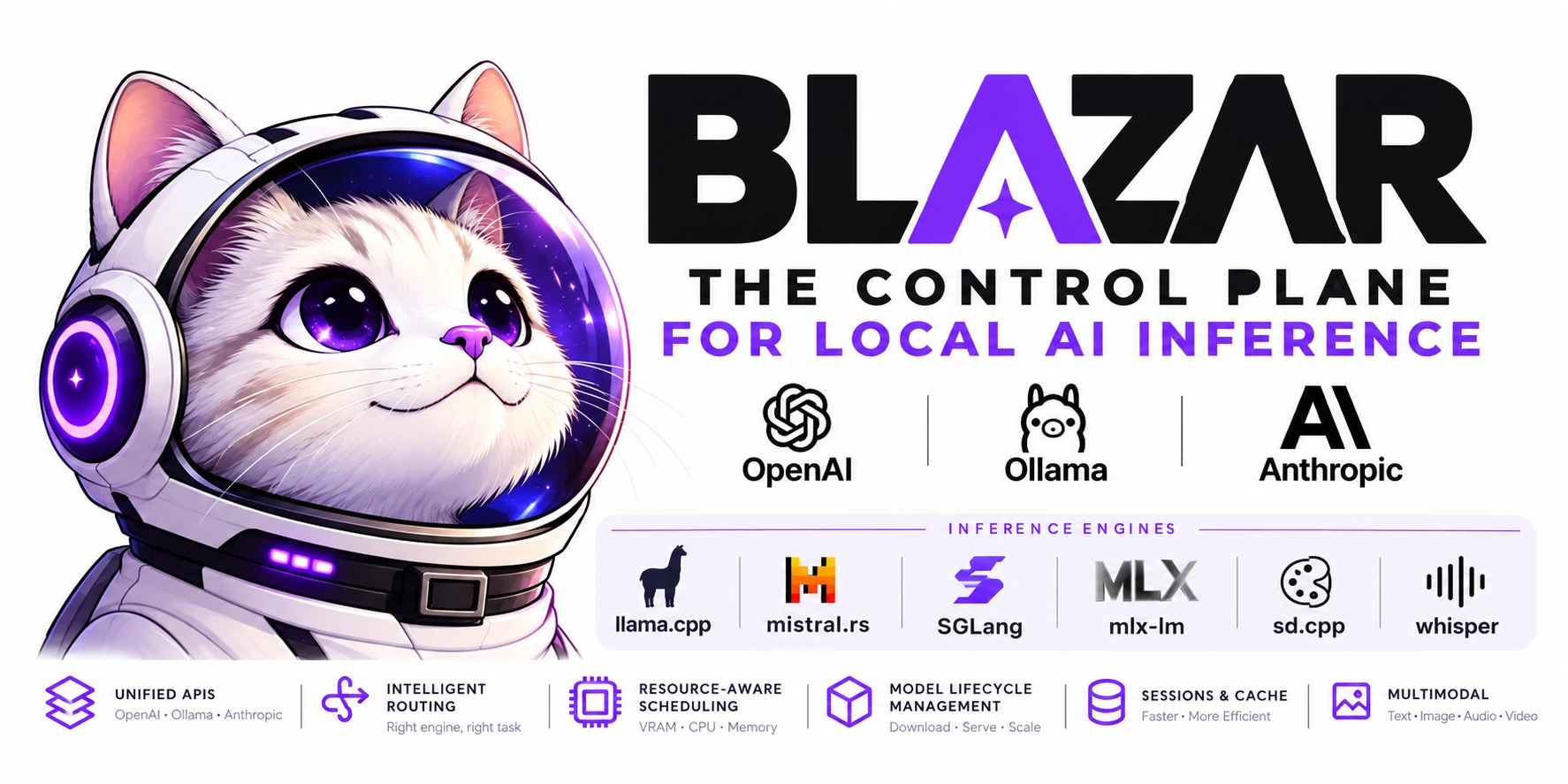
The control plane for local AI inference.
Unified OpenAI · Ollama · Anthropic gateway · Multi-engine serving · Resource-aware orchestration · Multimodal



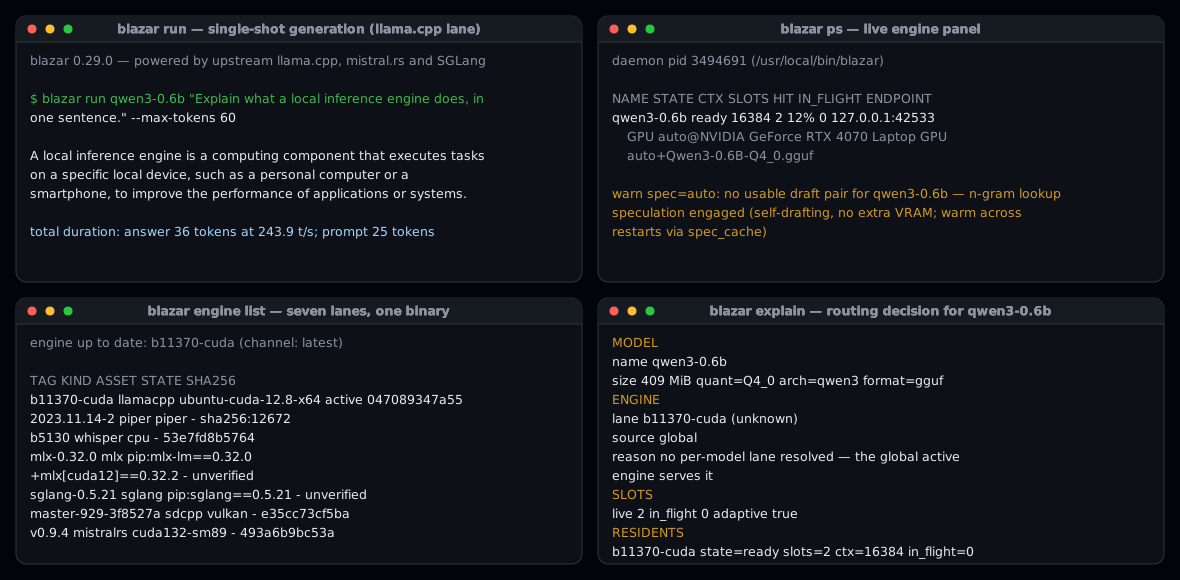
Live CLI session: single-shot generation, the engine panel with speculation state, the installed-lane inventory, and the routing decision for a model — all from one daemon.
Get started in 60 seconds · Why use Blazar · Benchmark evidence · API reference
Blazar is a local AI gateway and runtime orchestrator in one Rust binary. Applications talk to one endpoint; Blazar manages the model store, picks or pins the right inference engine, fits workloads to your hardware, and controls concurrency, lifecycle, and diagnostics.
Bring your client. Bring your model. Blazar handles the serving stack.
                           Applications
      ┌───────────────────────┬────────────────────────┐
      │                       │                        │
  OpenAI SDK            Ollama clients         Anthropic SDK
      │                       │                        │
      └───────────────────────┴────────────────────────┘
                              │
                              ▼
                    ┌───────────────────┐
                    │      BLAZAR       │
                    │───────────────────│
                    │ API gateway       │
                    │ Routing           │
                    │ Admission/queue   │
                    │ Model store       │
                    │ VRAM/KV fit       │
                    │ Sessions/cache    │
                    │ Diagnostics       │
                    │ Engine lifecycle  │
                    └─────────┬─────────┘
                              │
      ┌───────────┬───────────┴───────────┬───────────┐
      │           │           │           │           │
        llama.cpp  mistral.rs    SGLang        MLX
      │           │           │           │           │
      └────────────── Text / Embeddings ──────────────┘
                              │
                 ┌────────────┼─────────────┐
                 │            │             │
              sd.cpp       whisper.cpp     piper
               Images       Speech         TTS
               Video        to text
The engines still perform inference. Blazar is the control plane around them — it does not replace engines, train models, or require a hosted service.
| If you need | Blazar provides |
|---|---|
| Apps speaking OpenAI, Ollama, and Anthropic | All three dialects natively, one gateway |
| Different models on different runtimes | Capability-aware lanes across llama.cpp, mistral.rs, SGLang, MLX, sd.cpp, whisper.cpp, piper |
| GPU memory and context under control | VRAM/KV fit planning, slots, admission, co-residency, lifecycle |
| Long work that survives restarts | Durable jobs, request cancel/interrupt, restart-safe response chains (SQLite) |
| Engines that update without breaking | Side-by-side versioned installs, regression gates, rollback |
| Failures you can diagnose | doctor, why, watch, metrics, trace IDs, teaching errors |
| Models managed like software | Pull, import, inspect, pin, tune, snapshot, restore |
| Several machines as one pool | Capacity-aware federation: warm, replicate, route |
| Multimodal in one place | Text, embeddings, image (variations, upscale), video (Sora verbs), speech-to-text (word timestamps), TTS (wav/pcm + ffmpeg lossy), realtime voice |
| Production controls, locally | API keys, TLS, CORS, audit logging, PII scrubbing, OTLP |
curl --proto '=https' --tlsv1.2 -fsSL \
  https://raw.githubusercontent.com/santanu20/blazar/v0.29.0/scripts/install.sh \
| BLAZAR_REPO=santanu20/blazar shirm https://raw.githubusercontent.com/santanu20/blazar/v0.29.0/scripts/install.ps1 | iexAlso available: cargo binstall blazar for the prebuilt binary, cargo install blazar to compile it, or build from source.
The Blazar binary and inference engines are separate artifacts. The installer can bootstrap the default engine; manage it explicitly with blazar engine update. Set BLAZAR_INSTALL_ENGINE=0 to skip engine bootstrap.
blazar search qwen3 instruct                        # find models on Hugging Face
blazar pull qwen3-0.6b                              # registry shortname
blazar pull ggml-org/Qwen3-8B-GGUF:Q4_K_M           # Hugging Face GGUF
blazar import /path/to/model.gguf --name mymodel    # existing local file
blazar import --scan                                # list models reusable from ollama / HF cache / LM Studio
Pulls never re-download what is already on disk: an existing ollama store, the Hugging Face hub cache, and LM Studio models are checked first (size + sha256 byte-verified, then hardlinked) — a 10 GiB model already in ollama appears in blazar instantly at zero network cost.
blazar serve                # gateway on http://127.0.0.1:11435
blazar run qwen3-0.6b       # interactive REPL
curl http://127.0.0.1:11435/v1/chat/completions \
-H 'Content-Type: application/json' \
-d '{
"model": "qwen3-0.6b",
"messages": [{"role": "user", "content": "Explain local inference in one paragraph."}]
}'No application rewrite needed — point clients at Blazar's compatible surfaces.
| Client | Base URL | Surfaces |
|---|---|---|
| OpenAI SDK | http://127.0.0.1:11435/v1 |
/v1/chat/completions, /v1/completions, /v1/responses, /v1/embeddings, /v1/rerank, /v1/batches, /v1/files, /v1/audio/*, /v1/images/*, /v1/videos/* |
| Ollama clients | OLLAMA_HOST=http://127.0.0.1:11435 |
/api/chat, /api/generate, /api/tags, /api/ps, /api/pull, /api/embeddings, /api/embed, /api/rerank, model verbs /api/create, /api/copy, /api/delete, /api/push |
| Anthropic SDK | http://127.0.0.1:11435 |
/v1/messages, /v1/messages/batches |
| Blazar Python SDK | BLAZAR_URL=http://127.0.0.1:11435 |
chat + streaming + best_of/mcp tools, ps, explain, failover, realtime voice, Anthropic batches, metadata cards — zero dependencies (sdk/python) |
Beyond dialect compatibility: /v1/realtime voice, [[failover]] chains, the [[mcp]] tool catalog, completion metadata cards, and idle-sleep visibility — one line each in Features.
Blazar runs alongside an existing Ollama install, and can later serve on 11434 as a port-level replacement.
blazar launch <command>     # prepare env vars, then exec the command
blazar connect              # print the client-integration plan
blazar connect --write      # apply with backup; rolls back if the test request fails
blazar connect opencode --write --all-models   # agent-harness menu in one write
blazar connect pi --write                     # pi / oh-my-pi, same treatment
connect configures Codex, Claude Code, Continue, Cline, Open WebUI, opencode, and pi (oh my pi) to talk to Blazar — capability-driven model menus included (--all-models lists every certified chat model; the default pick follows the chat+tools > chat > uncertified ladder). Harnesses without a connect lane still work: point any OpenAI-compatible client at http://127.0.0.1:11435/v1, any Ollama client at the gateway root, or any Anthropic SDK client at http://127.0.0.1:11435. Every gateway-rendered error carries a stable machine-readable blazar_code (see docs/error-codes.md or GET /api/errors), so clients can branch on causes instead of parsing messages.
Any app that speaks OpenAI, Anthropic, or Ollama gets MCP tools through Blazar — the client needs zero MCP knowledge. You register MCP servers once — local stdio commands or remote Streamable HTTP endpoints — and Blazar injects their tools as mcp__<server>__<tool> and runs the whole call loop (tool dispatch, argument passing, result replay) on the server side.
# config.toml — register servers once (stdio command OR http url)
[[mcp]]
name = "fetch"
command = ["uvx", "mcp-server-fetch"]

[[mcp]]
name = "remote"
url = "http://mcp.internal:8808/mcp"

mcp_default = "all"   # optional: every request gets the catalog with no opt-in
# per-request opt-in (or set mcp_default above and skip the field entirely)
curl http://127.0.0.1:11435/v1/chat/completions -d '{
"model": "qwen3:8b", "mcp": "fetch", "stream": false,
"messages": [{"role": "user", "content": "fetch example.com and summarize"}]
}'The same "mcp" field (or x-blazar-mcp header) works on /api/chat and /v1/messages; the response carries x-blazar-mcp: rounds=N proving real tool executions. stream: false is required on mediated calls, "none" opts a request out when a default is set, and GET /api/mcp lists servers without spawning them. The Python SDK takes Client(...).chat(model, messages, mcp="all"). Config owners declare servers; keyed clients can only select among them — never add their own. → 7.SETUP.md
When local inference has outgrown "run one server for one model", Blazar is the next step — the table above is the short version, Features is the long one.
Architectural role, not a universal ranking:
| Approach | Best when | What Blazar adds |
|---|---|---|
| Direct engine server | One runtime, one model | Gateway compatibility, model ops, admission, routing, lifecycle, diagnostics |
| Ollama | Simple local model management | Multiple engine families, explicit routing, deeper resource planning, lifecycle controls |
| SGLang / vLLM-style runtime | High-throughput serving on one runtime | A higher-level control plane across heterogeneous runtimes |
| Custom scripts / many daemons | Bespoke infrastructure | One API, one config model, one operator workflow |
If you only need one model, one runtime, and one process, a direct engine server is simpler — Blazar is intentionally not necessary for that case.
| Engine | Role | Typical workloads |
|---|---|---|
| llama.cpp | Mainstream local text serving | GGUF and quantized local models |
| mistral.rs | Alternative text runtime | Supported GGUF and safetensors models |
| SGLang | Safetensors-oriented serving | AWQ, GPTQ, FP8 safetensors models |
| MLX | Apple-Silicon and CUDA-backed serving | MLX quantized model directories (mlx-community) |
| stable-diffusion.cpp | Media generation | Diffusion images and video |
| whisper.cpp | Speech recognition | Transcription and translation |
| piper | Offline speech synthesis | Local TTS voices |
Full lane inventory and channel policy: docs/engines.md. Routing follows model format and engine capability (the table's Workloads column is the format map). The default preserves single-active-engine behavior; per-model engine pins give deterministic placement. Curated capability lanes cover GGUF architectures the mainstream llama.cpp lane does not yet support.
Three native dialects with per-engine thinking management (effort mapping, <think> leak suppression), structured-output receipts (x-blazar-structured-output on every constrained response), Anthropic cache accounting (cache_read_input_tokens) and Batch API (/v1/messages/batches), completion metadata cards (update at POST /v1/chat/completions/{id}), Responses-API conversations (previous_response_id chains, background jobs), and engine passthrough utilities (/tokenize, /detokenize, /apply-template, /infill). → 4.API_SPEC.md
/v1/realtime WebSocket voice (whisper STT → chat → piper TTS); [[mcp]] tool catalog over stdio or Streamable HTTP — the gateway runs the tool loop for engines with no MCP support of their own, per-request opt-in or config-wide mcp_default (/api/mcp status); [[failover]] alias chains over ordered local/remote targets (anti-flap benching, pin/unpin at /api/failover); idle-sleep visibility (blazar_sleeping in /api/ps). → 7.SETUP.md
plan previews the run decision, run prints the daemon's real ready-card (--intent agent|batch|coding|reasoning|vision maps a workload class), config preset flips a posture, scorecard assembles the stored bench + certificate (never re-runs), autopilot recommends only real work (--apply runs it). Capability certificates gate admission on verified FAILs, with probe and refresh command. → 9.USAGE.md
fit previews VRAM/KV/slots/co-residency before download; bounded admission under saturation; adaptive slot reshape from live telemetry. Speculative decoding (MTP/EAGLE/draft pairs) with n-gram auto-fallback and closed-loop governors (spec_auto_manage, ubatch_auto) that park speculation when acceptance collapses; draft pairing is lane-aware (GGUF drafts to llama.cpp/mistral.rs, safetensors drafts to SGLang/MLX — never a mismatched or self-pair). → 6.BUSINESS_RULES.md · 10.SCIENTIFIC.md
A SQLite ledger survives restarts: durable jobs (events/cancel/artifacts, abandoned marking on crash), live request cards (GET /v1/requests, cancel/interrupt from another connection), restart-safe previous_response_id chains, and disk intelligence (storage, prune --orphans/--unused). → 4.API_SPEC.md
Strictly opt-in: without [[remotes]], nothing leaves the machine. Peers publish /api/capacity; picks prefer warm models, then queue wait, then free VRAM. warm, replicate, route manage placement; non-Blazar remotes degrade to pass-through peers. → 7.SETUP.md
Per-request best_of fan-out, validated parallel choices (n 1–8), cascade routing (cheap-first, escalates on decision-ladder failure), typed decision models (/v1/systemone). → 4.API_SPEC.md
Images (generations/edits/ESRGAN upscale), video generation, streaming transcription with Silero VAD, piper TTS, embeddings with late-chunking opt-in, rerankers served live from GGUF. CLI: blazar whisper, blazar tts. → 4.API_SPEC.md
session save/restore plus automatic KV session banking on graceful stop — the first request after a restart resumes with the prompt cache warm. Prefix-cache visibility, opt-in semantic cache, warm-on-pull. → 7.SETUP.md
Versioned side-by-side installs, SHA-256 verification, capability probing, regression gates with auto-rollback, engine use/rollback, per-kind upstream checks in doctor. → 7.SETUP.md
doctor (system/GPU/engines/models/channels, --fix), why trace explanations, explain effective-config card, model-doctor capability certificates, /api/capacity GPU census, /metrics, OTLP, audit JSONL, PII scrubbing. Engine silent degrades (e.g. a flash-attention KV-type fallback in the serving child) are detected and surfaced per-request — x-blazar-warnings headers, engine_slow_attn detections in why, and a live engine_degrades panel on /api/why. → 9.USAGE.md
/ui — zero-dependency console served by the daemon (TTFT/TPOT dashboard, models, engines, compute census, benches, jobs, sessions); read-only by construction. /api/fabric and /api/quantiles expose the same read models as JSON. → 4.API_SPEC.md
Loopback by default; optional scoped API keys (keys add/rotate), TLS, explicit CORS, DNS-rebinding hardening on loopback binds, audit logging, PII scrubbing, opt-in OTLP. → 7.SETUP.md
Two committed campaigns, full receipts in BENCHMARK.md: the perf + matched-concurrency validation (RTX 4070 Laptop 8 GiB, i7-14650HX, Linux Mint 22.3, installed release binary — same engine build on both sides of every row) and the flagship campaign (Ollama concurrency reference lanes). Measured results from one configuration — evidence, not universal guarantees.
| Workload | Blazar | Reference | Interpretation |
|---|---|---|---|
| Single-stream decode | 41.07 t/s | 41.64 t/s direct engine | ~1.4% gateway overhead |
| Single-stream TTFT p50 / ITL p99 | 120 ms / 25.8 ms | 121 / 25.2 ms direct; 122 / 75.0 ms Ollama | parity with direct; ~3× lower tail than Ollama |
| Cached prefill | 7,494 t/s | 7,359 t/s direct | parity–better |
| Long-context hold (2k → 16k) | 41.1 → 40.6 t/s | 6,145 MiB peak vs Ollama 6,829 | −1.2% across the ladder, leaner memory |
| Cold start (page cache dropped) | 4.8 s | 4.6 s Ollama (warm daemon) | parity incl. full spawn |
| Idle wake | 2.4–3.5 s | 6.2 s Ollama | ~2× faster wake |
| Tool-call TTFT p50 | 117 ms | 285 ms Ollama | ~2.4× lower |
| Concurrent, matched slots, C=1 | 423.7 t/s | 373.3 t/s direct engine | 1.14× — parity-to-better (singleflight default-off) |
| Concurrent, matched slots, C=4 | 604.9 t/s | 594.7 t/s direct engine | 1.02× aggregate at load |
| Concurrent, matched slots, C=8 | 597.2 t/s | 605.8 t/s direct engine | 0.99× at saturation (was 0.72× before the serialization fix) |
| Concurrent throughput, C=4 | 104.8 t/s | 33.6 t/s Ollama lane | ~3.1× system throughput |
| Concurrent TTFT p99, C=4 | 554 ms | 15.9 s Ollama lane | Lower tail latency |
| Adaptive serving | 49 → 63 t/s | — | ~28% gain, 0 failed requests |
Concurrency rows above the Ollama block are the current-release ladder (8 × 64-token bodies, temp 0, identical child argv both sides; receipt bench-artifacts/20261031-benchmark-audit/gateway-overhead-ladder-after-fix.json).
Where the gateway can matter — scheduling, residency, cache, tail control, tools — Blazar leads Ollama by receipt:
| Surface | Blazar | Ollama | Margin |
|---|---|---|---|
| ITL p99 (tail smoothness) | 25.8 ms | 75.0 ms | ~3× |
| Idle wake | 2.4–3.5 s | 6.2 s | ~2× |
| Tool-call TTFT p50 | 117 ms | 285 ms | ~2.4× |
| TTFT p99 under load, C=4 | 554 ms | 15.9 s | ~28× |
| Cached-path TTFT | ~0.4 s | 6.1–6.5 s | ~15× |
| Throughput under load, C=4 | 104.8 t/s | 33.6 t/s | ~3.1× |
The two parity rows in the table above are physics, not lost ground: single-stream TTFT is the same engine doing prefill in every lane (the relay adds ~0 ms), and cold start is disk-bandwidth-bound model loading — where Ollama's 4.6 s reference even ran on a warm daemon while Blazar's 4.8 s included the full gateway boot.
The matched-concurrency rows pin the gateway child to the direct lane's own slot count, isolating orchestration cost from slot-capacity differences; the default lane (slots=4, unified 64k KV) legitimately trades decode speed for context capacity on an 8 GiB card. Campaigns measure more than tokens/s: prefill, saturation, cache reuse, tool-call and structured-output quality, cold starts, scheduling, lifecycle, and media lanes — per-campaign environments and dates are recorded with each receipt in BENCHMARK.md. Reproduce with blazar bench <model> or python3 scripts/bench_matrix.py --blazar-bin target/release/blazar --md BENCHMARK.md.
Config lives at ~/.config/blazar/config.toml; prefer the CLI for routine changes.
blazar config defaults | list | get <key> | set <key> <value> | unset <key>| Area | Examples |
|---|---|
| Serving | host, port, default_ctx, slots, max_loaded_models |
| Memory / quality | cache_type, kv_unified, ctx_extend |
| Scheduling | singleflight, adaptive_slots, admission, priorities |
| Speculation | spec, draft selection, n-gram lookup |
| Routing | engine_routing, per-model overrides, replicas |
| Access | keys, TLS, CORS, remotes |
| Observability | audit_log, pii_scrub, otlp_endpoint |
| Media | diffusion tuning, RPC, audio-lane timeouts |
blazar config defaults is the authoritative live reference. Authentication is optional for a default local deployment.
| Task | Command |
|---|---|
| Start gateway | blazar serve |
| Run a model | blazar run <model> |
| Run with a workload posture | blazar run <model> --intent agent |
| One-shot decision scoring | blazar classify <model> "text" --labels safe,unsafe |
| Preview a model before running | blazar plan <model> |
| One-page perf + quality card | blazar scorecard <model> |
| One-word config posture | blazar config preset balanced |
| Observe → recommend per model | blazar autopilot, blazar autopilot --apply |
| Pull / import models | blazar pull <target>, blazar import <file> --name <name> |
| Reuse models from other runtimes | blazar import --scan (lists ollama / HF cache / LM Studio models; blazar pull links them byte-verified, no re-download) |
| Inspect models | blazar list, blazar show <model>, blazar ps |
| Stop / remove | blazar stop (daemon), blazar rm <model> |
| Quantize / attach projector | blazar quantize <model> <out-quant>, blazar mmproj <model> <mmproj.gguf path> |
| Tune generation speed | blazar tune <model>, blazar bench <model> (results stored as engine-tagged receipts — doctor flags models whose receipts predate the active engine) |
| Launch an AI CLI | blazar launch <command> |
| Connect AI clients | blazar connect --write (Claude Code, Codex, Continue, Cline, Open WebUI, opencode, pi) |
| Explain serving config | blazar explain <model> |
| Certify capabilities | blazar model-doctor <model> |
| Check health / heal | blazar doctor, blazar doctor --fix, blazar why, blazar watch |
| Preview fit / co-residency | blazar fit <target>, blazar coreside |
| Manage engines | blazar engine update / list / use / rollback / install / build / prune |
| Federate | blazar warm, blazar replicate, blazar route |
| Sessions / LoRA | blazar session save/restore, blazar lora add/rm/list |
| Audio | blazar whisper <file>, blazar tts "<text>" |
| Disk | blazar storage, blazar prune --orphans/--unused |
| Keys / benchmark / snapshot | blazar keys ..., blazar bench <model>, blazar snapshot |
| Search / self-update | blazar search ..., blazar upgrade |
Full CLI surface: blazar --help. Complete route contract: docs/4.API_SPEC.md.
- Linux: x86_64, aarch64, armv7
- macOS: Intel and Apple Silicon
- Windows: x64 and ARM64
cargo install blazarWith cargo-binstall the same crate name downloads the release binary instead of compiling:
cargo binstall blazarcargo install --path crates/blazar-cli # or, from a checkout:
sh scripts/install.sh --buildWindows: irm https://raw.githubusercontent.com/santanu20/blazar/main/scripts/install.ps1 -OutFile install.ps1; .\install.ps1 -Build
Package-manager integrations: Homebrew, Scoop, Winget.
Rust workspace with explicit boundaries; unsafe code denied by default; CI runs Clippy with warnings as failures plus formatting, tests, and installer checks.
crates/
├── blazar-core       config, model catalog, GGUF metadata, profiles,
│                     hardware, storage, domain logic
├── blazar-runtime    downloads, engines, supervisor, lifecycle,
│                     benchmarking, quantization, upgrades
├── blazar-gateway    HTTP APIs, translation, scheduling, sessions,
│                     cache, media, observability
└── blazar-cli        the `blazar` executable and interactive CLI
This README is the product entry point; depth lives in dedicated documents. The full series is also hosted at santanu20.github.io/blazar.
| Document | Purpose |
|---|---|
docs/1.SYSTEM_OVERVIEW.md |
Product shape and system overview |
docs/2.ARCHITECTURE.md |
Internal architecture and lifecycle |
docs/3.DATA_MODEL.md |
SQLite schema and invariants |
docs/4.API_SPEC.md |
Complete HTTP and CLI reference |
docs/6.BUSINESS_RULES.md |
Routing, admission, validation, eviction rules |
docs/7.SETUP.md |
Installation, deployment, configuration |
docs/8.DO_NOT_BREAK.md |
Maintainer invariants and compatibility rules |
docs/9.USAGE.md |
End-user workflows and troubleshooting |
docs/10.SCIENTIFIC.md |
VRAM/KV math, GGUF parsing, numerical methods |
BENCHMARK.md |
Benchmark methodology and results |
CHANGELOG.md |
Release history |
- Read
docs/8.DO_NOT_BREAK.md. - For architectural changes, read
docs/2.ARCHITECTURE.mdanddocs/6.BUSINESS_RULES.md. - Run the standard formatting, Clippy, test, and installer checks — the CI workflow is the source of truth.
Blazar is an orchestration layer built on upstream open-source projects:
- Inference runtimes: llama.cpp · mistral.rs · SGLang · MLX and mlx-lm · stable-diffusion.cpp · whisper.cpp · piper
- Models and architectures: Silero VAD (speech detection for streaming audio) · ModernBERT (the System One decision-model family rides ModernBERT-architecture GGUFs)
Those projects provide the inference runtimes. Model weights remain subject to their publishers' licenses and distribution terms.
Dual-licensed under MIT or Apache-2.0.