
Crispy is a modern graphical user interface to calculate core-level spectra using the semi-empirical multiplet approaches implemented in Quanty. The application provides tools to generate input files, submit calculations, and plot the resulting spectra.




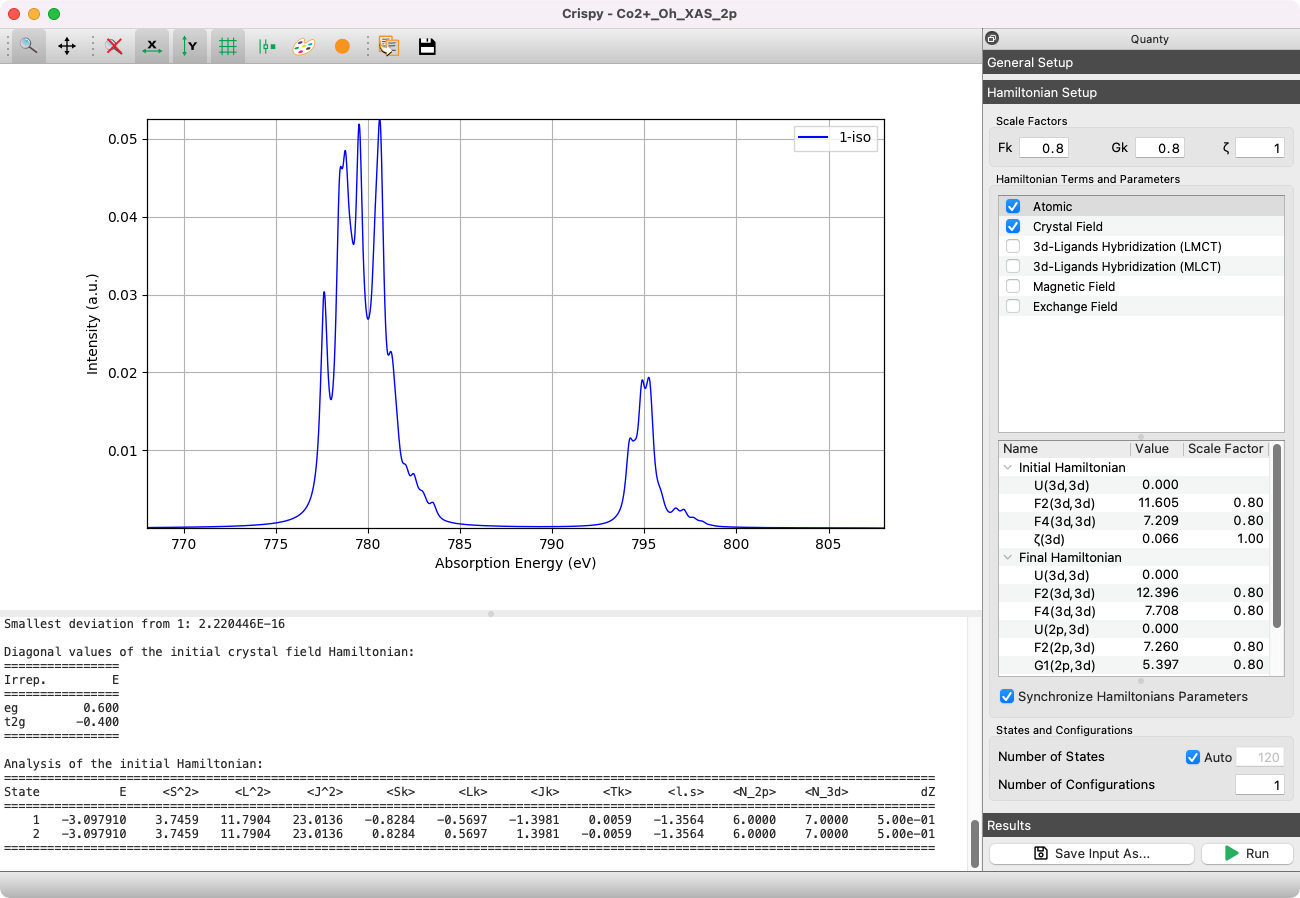
Download the application from the Downloads page. These applications include Python and Quanty. You do not need to install Python separately.
Windows (64-bit)
- Run the downloaded
.exeinstaller and follow its instructions. The installer removes the previous version, if present. - Start Crispy from the Start menu.
macOS (14 or later)
The application supports both Intel and Apple Silicon Macs.
- Open the downloaded
.dmgfile. - Drag Crispy into the Applications folder.
- Start Crispy from Applications.
Use pip on Linux, or for a Python installation on Windows or macOS. Install a 64-bit Python distribution, version 3.10 or later, with pip and venv. Python installers for Windows and macOS are available from python.org.
Create a virtual environment in a folder where you want to keep Crispy. This keeps its dependencies separate from other Python applications.
Linux and macOS
Open a terminal and run:
python3 -m venv .venv
source .venv/bin/activate
Windows
Open Command Prompt and run:
py -3 -m venv .venv
.venv\Scripts\activate.bat
With the environment active, install Crispy:
python -m pip install --upgrade pip
python -m pip install crispy
Start the application:
python -m crispyThe crispy command also starts the application when the environment is
active.
Activate the same environment when you open a new terminal.
For more information, see the Python Packaging guide.
To update a pip installation, activate its environment and run:
python -m pip install --upgrade crispyUse the development version to test changes from the main branch.
Activate the virtual environment described above, then install or update Crispy:
python -m pip install --upgrade --force-reinstall https://github.com/mretegan/crispy/tarball/mainThe --force-reinstall option installs the current code even when its
version number did not change.
Crispy includes Quanty executables for Windows, macOS, and Linux. Register on the Quanty website if you do not already have an account.
Crispy uses Quanty from PATH when available, otherwise it uses the bundled
executable.
To select another executable, open Quanty → Preferences and choose its path
in Quanty Executable.
Downloads are available from the Quanty download area.
Start the Windows application from the Start menu, or the macOS application from Applications. For a pip installation, activate its virtual environment, then run:
python -m crispyTo run Crispy on the ESRF compute cluster, see Launching Crispy.
If you use Crispy in your research, please cite it. Crispy is archived on Zenodo under the DOI 10.5281/zenodo.1008184, which resolves to the most recent release.
@software{retegan_crispy,
  author  = {Retegan, Marius},
  title   = {Crispy},
  version = {2026.2},
  year    = {2026},
  doi     = {10.5281/zenodo.1008184},
  url     = {https://crispy.esrf.fr},
}
The CITATION.cff file holds the full citation metadata. On GitHub, the Cite this repository button converts it to APA or BibTeX.
The source code of Crispy is licensed under the MIT license.