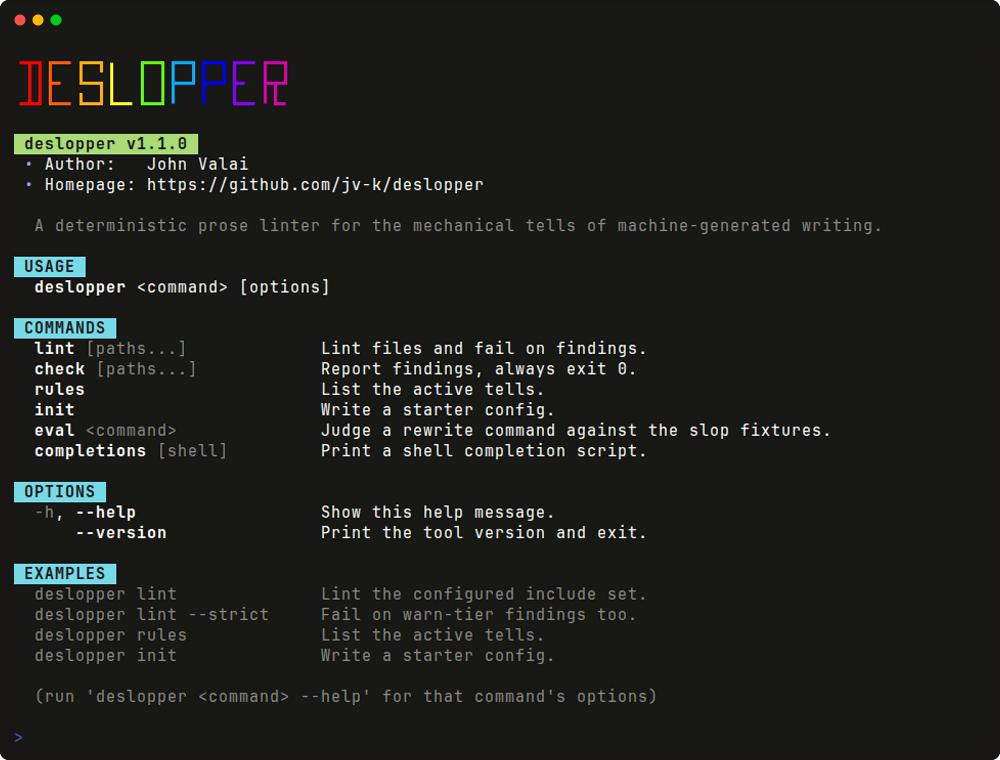


A deterministic prose linter for the mechanical tells of machine-generated writing. No model, no network: it runs in CI and pre-commit and fails the build on a banned tell.
Machine-generated prose has tells: the em-dash aside, the filler verb, the marketing
adjective, the not just X but Y padding, the throat-clearing opener, the G1/NG2 label
stapled to every item of a list. A model can rewrite them away, but that costs a model call
on every check and gives a different result each run.
deslopper catches the mechanical tells with plain patterns, so the check is free, instant,
and identical every time. That makes it safe as a gate in CI and pre-commit, where a model
pass does not belong. Use it for the deterministic floor, and leave the model rewrite for
the judgement a regex cannot make.
Vale and proselint check spelling, house style, and readability. deslopper has a narrower scope: it detects the tells of machine-generated writing. It ships as a single Python package with no dependencies, and its checks are deterministic, so the same input always produces the same findings. If you already run a style linter, deslopper complements it rather than replacing it.
deslopper needs no runtime dependencies beyond Python 3.9+. It is published to PyPI and to a Homebrew tap on each tagged release.
Run it straight from PyPI with uv:
uvx deslopper lint
or with pipx:
pipx run deslopper lint
Install it with pipx:
pipx install deslopper
with plain pip:
pip install deslopper
or from the Homebrew tap:
brew install jv-k/tap/deslopper
Pin a version in CI for reproducible builds:
uvx deslopper@0.2.0 lint --format github
The repo ships a skill in skills/deslopper/ for coding agents that follow the skills convention, such as Claude Code.
Install it with the skills CLI:
npx skills add jv-k/deslopper
Or copy skills/deslopper/ into ~/.claude/skills/ to have it in every project, or into
a repo's .claude/skills/ for that repo alone.
The skill activates when the agent writes or edits Markdown or MDX, or when you ask it to
de-slop existing text. On activation the agent runs deslopper rules to load the live
tell list, so it follows your config and presets, writes within those rules, and lints the
files it touched before finishing. Error-tier findings are fixed and re-linted until
clean. Warn-tier findings are fixed only when the rewrite is clearly better, and are
otherwise reported to you. The skill is the model-side complement to the CI gate, and the
gate stays the deterministic floor.
deslopper lint  [PATHS...] [--strict] [--config P] [--format text|github|json]
deslopper check [PATHS...] [--config P]   # report only, exits 0 on findings
deslopper rules [--config P]              # list the active tells
deslopper init                            # write a starter config
deslopper eval 'COMMAND' [--keep]         # judge a rewrite command, see below
deslopper completions [bash|zsh|fish]     # print a completion script for your shell
With no paths, deslopper lints the configured Markdown and MDX globs, through git ls-files
in a work tree or a filesystem walk otherwise.
Tab completion comes from deslopper completions, which detects your shell from $SHELL
when you leave the argument off. Run deslopper completions --help for where each shell
expects the script. Homebrew installs the bash, zsh, and fish completions automatically,
so this command is only needed for the pip, pipx, and uv installs.
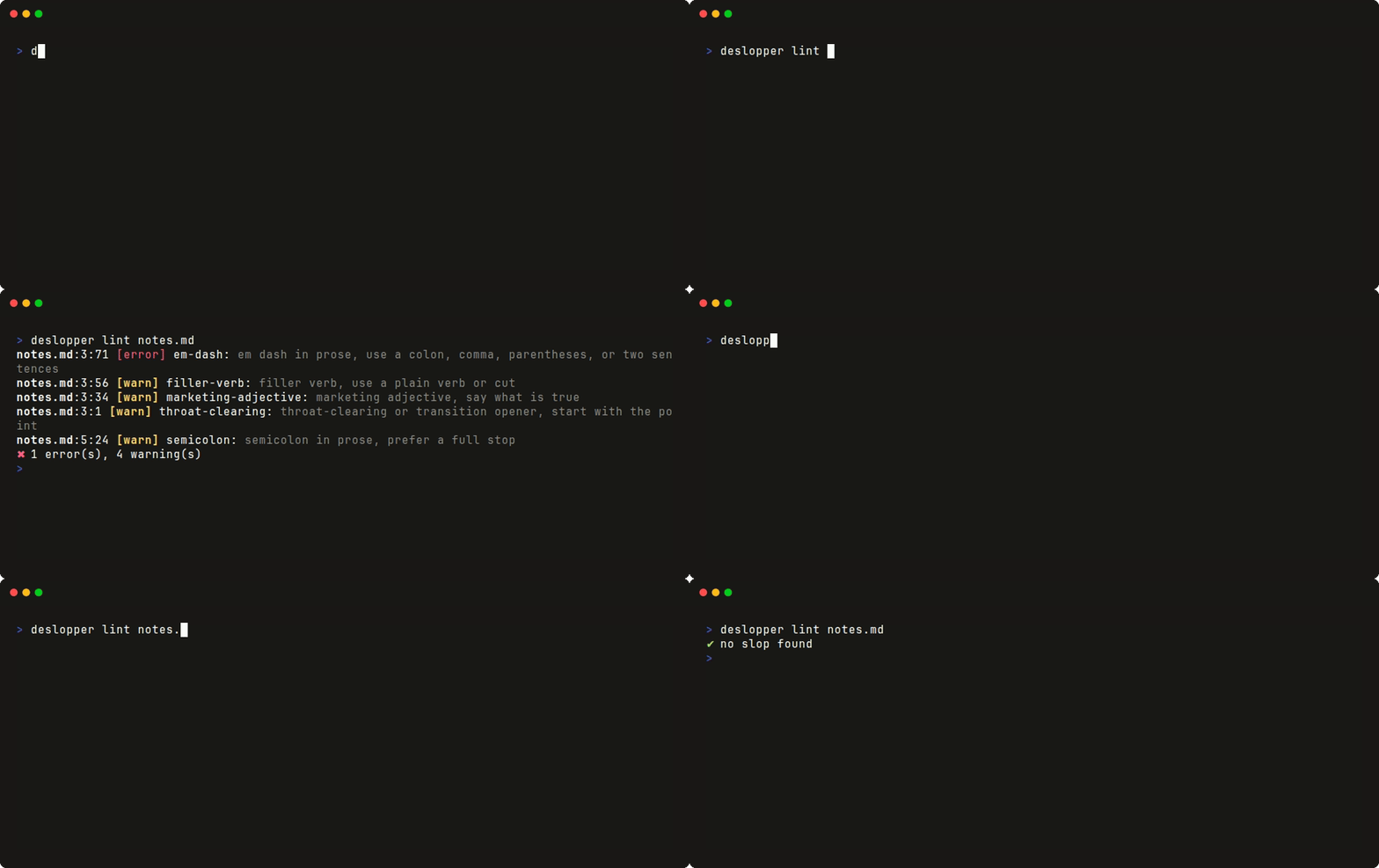
Output is coloured on a terminal and plain when piped. NO_COLOR turns styling off
everywhere, FORCE_COLOR=1 turns it on without a terminal, and the github and json
formats are never styled.
The error tier (em dashes, the section sign, middle-dot separators) fails the run. The warn
tier prints but passes unless you add --strict. Exit codes: 0 clean, 1 a failing-tier
finding or an unreadable file, 2 a usage or configuration error.
The recommended preset ships these, one row per tell with an example of the prose it
catches. The em dash, section sign, and middle dot are caught in prose and also when
spelled as HTML entities. The table is generated from the preset by
scripts/readme_tells.py and pinned by tests, including one that checks each example
fires its tell, and deslopper rules prints the live list for whatever config is active.
❌ error, fails the run. --strict.
| Tell | Tier | Example | Message |
|---|---|---|---|
em-dash |
❌ | A quick fix — just restart. |
em dash in prose, use a colon, comma, parentheses, or two sentences |
section-sign |
❌ | See § 4.2 for details. |
section sign, write 'section' |
middle-dot |
❌ | fast · simple · tested |
middle dot or bullet in prose, join the items with a comma or plain words |
bold-bullet-lead |
- **Blazing speed** builds finish in seconds |
bolded bullet lead, reserve bold for a rare callout not a per-item label | |
id-label-lead |
- FR-1 The app shall sync. |
id label on a list item, number the list plainly | |
semicolon |
It compiles; it ships. |
semicolon in prose, prefer a full stop | |
not-just-x-but-y |
not just fast but correct |
"not just X but Y" padding, make the point once | |
filler-verb |
This leverages the cache. |
filler verb, use a plain verb or cut | |
marketing-adjective |
a seamless, robust workflow |
marketing adjective, say what is true | |
throat-clearing |
It's worth noting that tests pass. |
throat-clearing or transition opener, start with the point | |
vague-intensifier |
significantly faster |
vague intensifier with no number behind it | |
emoji |
Done ✅ |
emoji or decorative checkmark in body text |
deslopper lint --format json prints one object for tooling:
{
  "findings": [
    {
      "path": "docs/guide.md",
      "line": 6,
      "col": 27,
      "tier": "warn",
      "name": "semicolon",
      "message": "semicolon in prose, prefer a full stop"
    }
  ],
  "unreadable": [],
  "summary": { "errors": 0, "warnings": 1, "unreadable": 0 }
}
The package ships JSON Schemas for both sides of the contract: output.schema.json for this object and config.schema.json for the config file.
The linter is the deterministic floor. The rewrite that clears a backlog is a model pass,
and deslopper eval tests whether yours works: it seeds a temporary sandbox with slop
fixtures that trip every tell in the recommended preset, runs your rewrite command over the
sandbox, and judges the result.
deslopper eval 'my-rewrite {dir}'
deslopper eval ./scripts/deslop.sh    # the sandbox path is appended when {dir} is absent
Two judges rule on the outcome. Efficacy lints the rewritten fixtures: zero error-tier findings is the hard gate, and the warn count must land strictly below the raw baseline, which leaves the model some room without letting it tread water. Preservation extracts a digest of the protected content (fenced code and front matter verbatim, the heading outline, table rows, link destinations) before and after the rewrite, and any difference fails the run. As a self-check, the raw fixtures are linted first: if they produce no errors the harness is broken and the run aborts before spending tokens.
Exit codes: 0 pass, 1 efficacy failure, 2 usage or configuration error, 3 preservation
failure, 4 broken harness or a rewrite command that exited nonzero. A failure names the
surviving findings by file and line. Pass --keep to keep the sandbox for inspection.
An eval run invokes your rewrite command for real, with the minutes and tokens that implies. Run it on demand when you change the rewrite prompt or model. It has no place as a per-commit or per-PR gate.
Run deslopper as a gate with GitHub Actions. Until it is on PyPI, install it from the public
repo. Switch to the pinned PyPI form (uvx deslopper@x.y.z ...) once it ships.
# .github/workflows/prose.yml
name: Prose
on: pull_request
permissions:
  contents: read
jobs:
  deslop:
    runs-on: ubuntu-latest
    steps:
      - uses: actions/checkout@v4
      - uses: astral-sh/setup-uv@v8.2.0
      - run: uvx --from git+https://github.com/jv-k/deslopper@main deslopper lint --format github
On a repo whose prose predates the rules, lint only the files changed in the PR, so the backlog does not block every commit:
- uses: actions/checkout@v4
  with:
    fetch-depth: 0
- uses: astral-sh/setup-uv@v8.2.0
- run: |
    files=$(git diff --name-only "origin/${{ github.base_ref }}...HEAD" -- '*.md' '*.markdown' '*.mdx')
    [ -z "$files" ] && exit 0
    uvx --from git+https://github.com/jv-k/deslopper@main deslopper lint --format github $files
For a local gate, run the same lint from pre-commit:
# .pre-commit-config.yaml
repos:
  - repo: local
    hooks:
      - id: deslopper
        name: deslopper
        entry: deslopper lint
        language: system
        types: [markdown]
        pass_filenames: false
The hook shells out to whichever deslopper is on your path, so install it first through
pipx or Homebrew. pass_filenames: false makes the hook lint the configured globs rather
than the staged paths, which keeps the local verdict identical to CI. Explicit paths are
linted as given, skipping the config excludes, so a staged-files hook would flag files
your config meant to leave alone.
Drop a deslopper.config.json to retune the bundled recommended rule set:
{
  "extends": ["deslopper:recommended"],
  "tells": {
    "disable": ["semicolon"],
    "override": { "filler-verb": { "tier": "error" } },
    "add": [
      { "name": "no-foo", "tier": "warn", "kind": "regex", "pattern": "foo", "message": "no foo" }
    ]
  }
}
A tell is keyed by its name and phase. Two tells can share a name across phases (the em-dash
entity form and literal form do), so target one with name@phase, for example
em-dash@pre-entity.
A tell has a tier, either error or warn and nothing else. Its phase, pre-entity
or post-entity, says when it scans relative to HTML-entity masking, and only a
pre-entity tell can catch a tic spelled as an entity. A scope of all reports every
match on a line, first stops after one. The kind picks the matcher: regex is the
default, and the bold-bullet and id-label kinds read their pattern's capture groups.
The match itself is either pattern, one regex, or words, a list of regex fragments
joined into a single boundaried alternation, so an entry like utili[sz]es? is a fragment
and not a literal string.
Fenced code, inline code, front matter, and HTML entities are masked before tells scan, so no tell fires inside them.
extends names the presets to build on, opted into as deslopper:<name>. recommended
is the only preset shipped today. The whole file is described by the
config schema.
Exempt an example from the lint with an HTML comment. The directive keyword keeps the
deslop-lint- prefix on purpose, so existing documents keep working:
<!-- deslop-lint-disable-line -->
<!-- deslop-lint-disable --> ... <!-- deslop-lint-enable -->
Add a tell, add a preset, or change the code. See CONTRIBUTING.md. Tells
live in src/deslopper/presets/recommended.json. A preset is a <name>.json file in
src/deslopper/presets/, opted into from a config as deslopper:<name>.
MIT.