
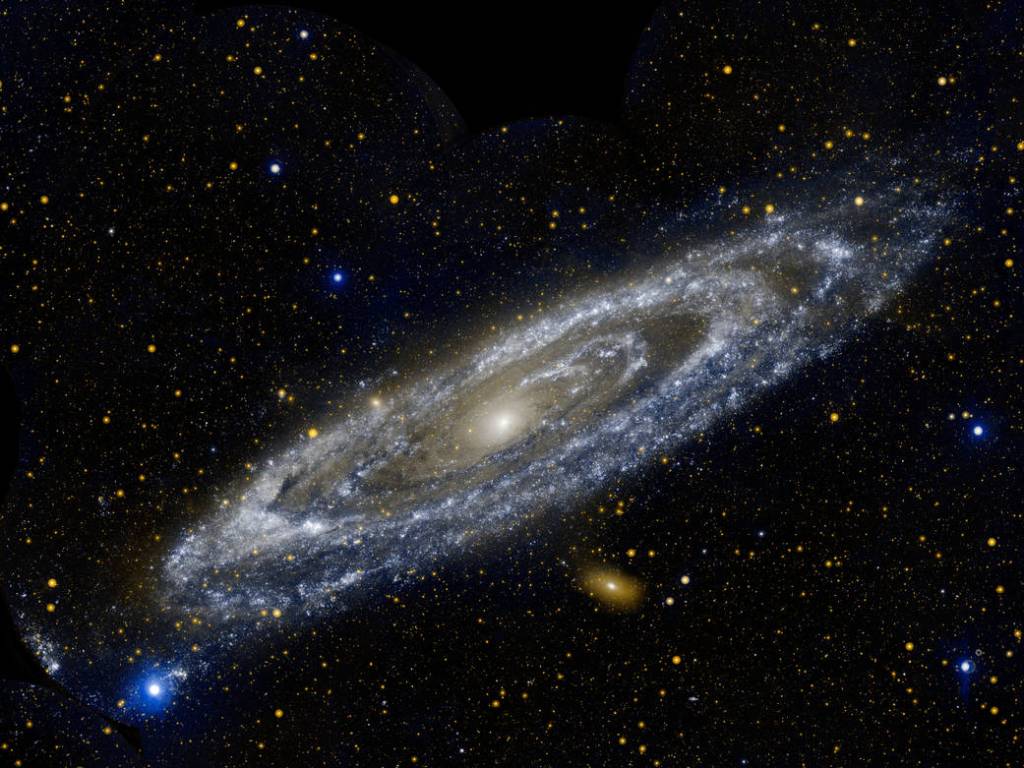
 Galaxy |
 Quasar |
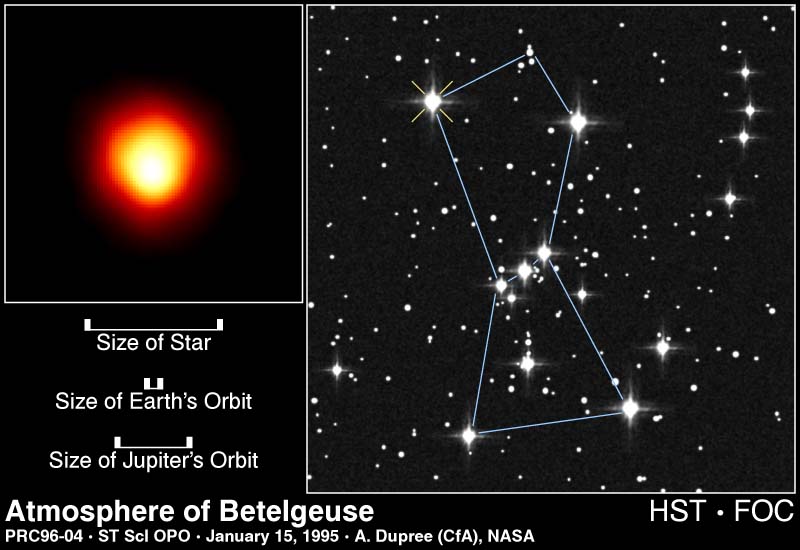 Star (Betelgeuse) |
Credit: NASA/ESA/Hubble. See README.md for sources.
A from-scratch (no scikit-learn) decision tree and bagging forest that classify SDSS17 sky survey observations into GALAXY, QSO (quasar), or STAR, built to be read and explained step by step, following Grokking Machine Learning ch. 9's own order: accuracy, Gini, entropy, information gain, recursive splitting, then everything built on top of a working tree.
uv sync   # or: pip install numpy pandas matplotlib ipywidgets jupyter
jupyter notebook stellar_classification.ipynb
The CSV is already in data/star_classification.csv. Run cells top to
bottom — the config path box in section 2 lets you point at a different
copy if needed.
stellar_metta/ |
stellar_python/ |
|
|---|---|---|
| contains | the three impurity measures (accuracy/gini/entropy) and their information gain, as MeTTa equations | everything else: the tree, the forest, grid search, plotting, I/O — plus a numpy-vectorized copy of the same impurity math |
| written for | one node at a time, read-as-algebra | thousands of candidate splits at once (real tree growth needs the speed) |
| run with | PeTTa | plain Python |
stellar_python/metta_bridge.py is the seam between them: it shells out to
PeTTa to evaluate stellar_metta/spliter.metta and info_gain.metta, so a
notebook cell can check that the hand-written MeTTa formulas and the
numpy-vectorized engine agree on the same numbers — not just assume the
translation was correct.
PeTTa is not bundled with this project. Set metta.petta_dir in
config.json to wherever your local PeTTa checkout lives (a sibling of
data/, same as this project's layout). Until it's found there,
metta_bridge.py transparently falls back to calling
impurity_engine.py/info_gain.py directly and prints a one-line notice —
the notebook runs end to end either way, but only exercises the real
.metta files with PeTTa in place. This has been verified against a real
PeTTa checkout: its own usage is sh run.sh <file.metta>, run from
anywhere, since run.sh resolves its own location from $0.
"metta": {
  "petta_dir": "PeTTa",
  "run_script": "run.sh",
  "metta_dir": "stellar_metta",
  "files": ["spliter.metta", "info_gain.metta"],
  "command_template": ["sh", "{petta_dir}/{run_script}", "{metta_file}"]
}
If your local PeTTa build expects a different invocation than
sh <petta_dir>/run.sh <metta_file>, edit command_template in
config.json — metta_bridge.py builds its subprocess call from that list
verbatim. One PeTTa quirk worth knowing if you extend the .metta files:
its grounded math has no bare log function, only a two-argument
log-math(Base, X, Out) predicate, which is why spliter.metta defines
log2 as (log-math 2 $x) rather than (/ (log $x) (log 2)).
stellar_metta/
  spliter.metta        gini/entropy/accuracy impurity, weighted average
  info_gain.metta       information gain for each of the three

stellar_python/
  impurity_engine.py    numpy-vectorized twin of spliter.metta
  info_gain.py           numpy-vectorized gain, used by the split search
  decision_nodes.py     node bookkeeping, vectorized split search,
                         recursive growth, 4 stopping criteria
  decision_tree.py      the public DecisionTreeClassifier
  tree_plot.py           text + matplotlib rendering, metrics in every node
  grid_search.py         hyperparameter search, permutation importance,
                         tree-vs-forest comparison
  regularization.py      LassoRegression (ISTA) — L1 diagnostic only
  ensemble.py             BaggingForest
  preprocessing.py, metrics.py, persistence.py
  metta_bridge.py         calls the .metta files via PeTTa, with a
                         Python fallback

config.json              single source of truth for one run: seed, columns,
                         split fractions, grids, MeTTa/image paths
stellar_classification.ipynb
data/star_classification.csv
models/                  saved pipeline (created by the notebook)
artifacts/tree_plots/    saved tree renderings (created by the notebook)
- Setup and cleaning — drop SDSS's
-9999sentinel rows; drop the nine survey/plate/ID columns (plate,MJD,fiber_ID,run_ID,rerun_ID,cam_col,field_ID,obj_ID,spec_obj_ID) since they record which telescope program found an object, not a physical property of it. - Part A — a small worked example. Whole-set impurity computed two
ways (numpy and MeTTa) and checked to agree; best single split under
each of the three criteria; three trees grown and plotted, one per
criterion; a 4-parameter grid search (
maxDepth,minSamplesLeaf,criterion,minInformationGain); permutation importance; a forest-vs-tree check (noisy at this size, on purpose — it's a rehearsal for Part B, not a real answer). - Part B — the full ~100k-row dataset. Correlation pruning and an L1
(Lasso, via ISTA) regression are both shown as diagnostics on the
magnitude bands' redundancy — neither is actually applied to the
feature set, since training on the full data is fast enough not to need
the reduction. Hyperparameter search on a 10k-row subsample (first
maxDepth/minSamplesLeaf/criterion, thenminInformationGainon its own, each visualized), then full training, then the tree-vs-forest keep/drop decision on real held-out data. - Evaluation — classification report, confusion matrix, and one-vs-rest ROC curves with AUC, for whichever model (tree or forest) the section 3 comparison kept.
- Save/reload and an interactive prediction widget (sliders for position, magnitudes, and redshift).
Earlier versions of this project predicted redshift from photometry
(a "Layer 1" regression) and fed that prediction to the classifier, to
avoid leaking the true spectroscopic redshift. This version removes that
step: true redshift is a direct input feature now. That's a
deliberate simplification, and it matters for interpreting the results —
redshift is close to deterministic for STAR (essentially zero) and a
strong signal for QSO vs. GALAXY, so accuracy is much higher here than
it would be with only position and magnitudes.
All three images are NASA/ESA Hubble Space Telescope releases (public domain / NASA image use policy): NGC 4258 (M106), quasar 3C 273, and Betelgeuse.