
Started because I wanted to run a dev cluster on my phone without destroying the battery.
A complete Kubernetes distribution in Rust, small enough to run where kubelet won't fit. A full, modular Kubernetes stack for real workloads on small devices.
not-k8s is a Kubernetes distribution in active development. It includes its
own API server (nodeapiserver), datastore (nodestore), scheduler
(nodescheduler), controller manager (nodecontroller), node agent
(nodelet), service proxy (nodeproxy), and bootstrap/update tool
(nodebootstrap). It targets compatibility with real Kubernetes workloads
while keeping resource usage low; upstream Kubernetes remains an explicit
comparison target.
Older Measured idle, no pods scheduled, 120s window, 3 replicates per agent:
| nodelet | upstream kubelet | gap | |
|---|---|---|---|
| x86_64 (CI) | ~15MB / ~0.08s CPU | ~81MB / ~0.85s CPU | 5.4x / 10.6x |
| ARM phone (Pixel 7, KVM) | 12.0MB / 0.436s CPU | 67.9MB / 8.031s CPU | 5.7x / 18.4x |
Some profiling results: both: x86_64, ARM phone.
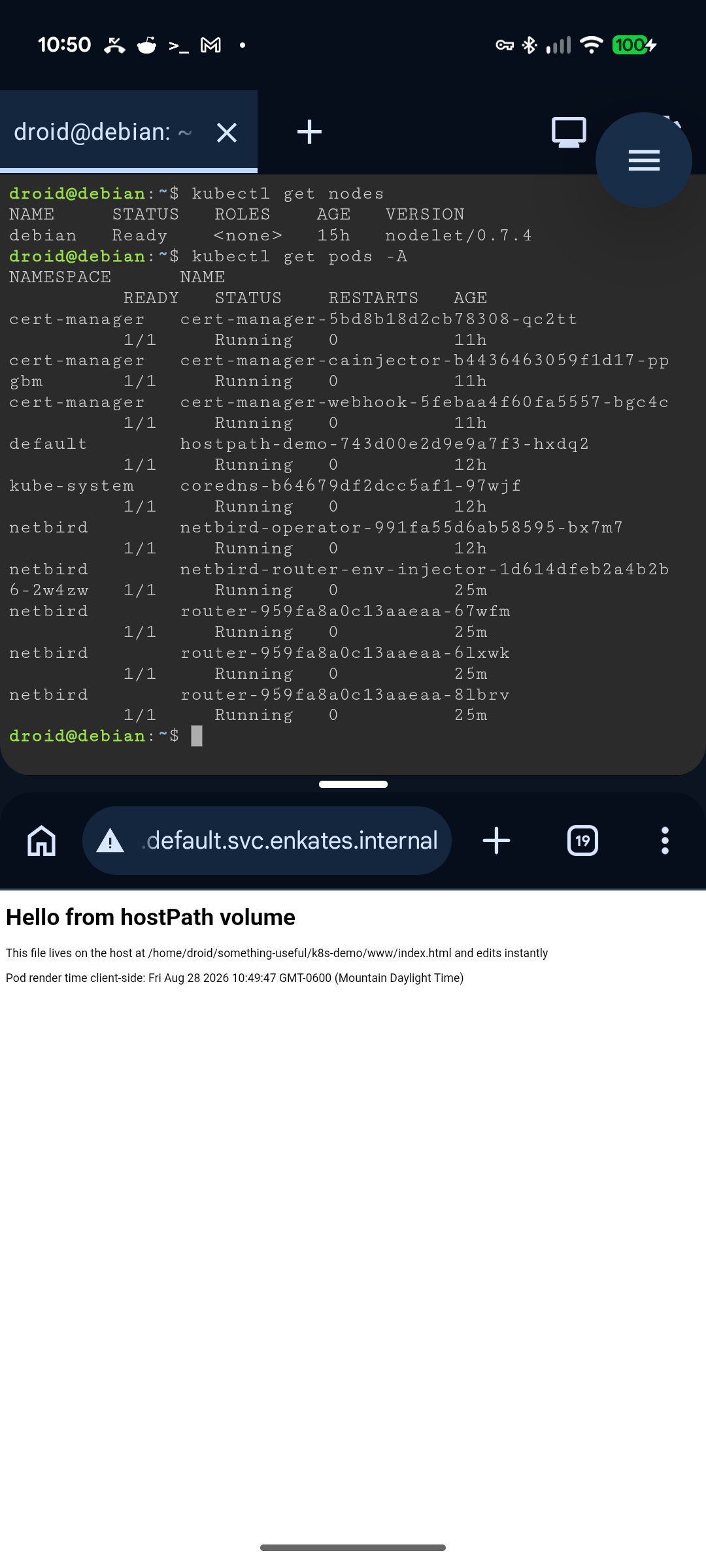
It's going to be something like
wget https://github.com/centerionware/not-k8s/releases/download/v0.8.0/notk8s-0.8.0-linux-aarch64-release
chmod +x notk8s-0.8.0-linux-aarch64-release
ln -s ./notk8s-0.8.0-linux-aarch64-release bootstrap
./bootstrap
This example downloads the v0.8.0 aarch64 release. The release tag includes
the v prefix, while the asset filename uses the bare version (0.8.0);
choose the matching architecture asset when installing on another platform.
The combined binary dispatches through argv[0], so the bootstrap symlink
and the component names use the same executable.
Common commands after downloading the release binary:
./bootstrap                         # install or update the stack (CRI is the default)
./bootstrap --without-cri           # opt out of containerd/CRI and use mock runtime
./bootstrap --release              # update from the latest published assets
./bootstrap --without-flannel      # use an external CNI and remember it on updates
./bootstrap --without-flannel --proxy=none
                                     # full single-node CP+worker for Cilium-style setups
./bootstrap --cluster-domain=cluster.example --cidr=10.44.0.0/16
                                     # customize service DNS and the IPv4 service range
./bootstrap --cidr6=fd00:44::/112  # add an IPv6 service range
./bootstrap --disable-dns           # omit CoreDNS and its nodelet DNS configuration
./bootstrap --worker --kubeconfig=/path/to/cluster.kubeconfig --proxy=none
                                     # nodelet; no local control plane, flannel, or proxy
./bootstrap --control-plane --join=https://cp-1:2379 --peer-url=https://cp-2:2380
                                     # add a nodestore control-plane member
./bootstrap --control-plane --join=https://cp-1:2379 --peer-url=https://cp-2:2380 \
  --advertise-address=192.0.2.12
                                     # advertise this apiserver's reachable IP
./bootstrap --remove-control-plane --join=https://cp-1:2379 --member-id=123
                                     # remove the member, then remove local CP services
./bootstrap --e2e                   # run bootstrap-native checks against the cluster
./bootstrap --e2e --only=node       # run one check by name substring
./bootstrap --e2e --shard=1/5       # run one CI shard (normally set by GitHub Actions)
--e2e does not install or restart anything. It uses $KUBECONFIG when set,
otherwise it discovers the admin kubeconfig written by nodebootstrap at
/etc/nodebootstrap/admin.kubeconfig (or NODEBOOTSTRAP_KUBECONFIG_DIR).
The bootstrap applet is the repository's e2e entrypoint: it uses the Rust
Kubernetes client directly and runs the registered cluster checks, including
node readiness, API-server compatibility, admission, CRDs, storage, CSI/DRA,
networking, streaming, and recovery cases. Use --only=<substring> while
iterating and --shard=N/5 for the CI shard layout.
The no-role invocation is the single-node convenience path: it installs both the control plane and node services. --worker is the multi-node path and requires an existing cluster kubeconfig; it installs only nodelet and nodeproxy. Pass --proxy=none when a CNI such as Cilium also replaces kube-proxy. Workers do not install flannel by default. --without-flannel does the same for a single-node bootstrap and persists that choice so later updates do not resurrect flannel.
--control-plane is an explicit nodestore-only control-plane join. The joining host must have the existing cluster PKI in its configured PKI directory and shared nodestore client credentials in NODEBOOTSTRAP_JOIN_CA_FILE, NODEBOOTSTRAP_JOIN_CERT_FILE, and NODEBOOTSTRAP_JOIN_KEY_FILE (or the corresponding NODESTORE_* variables). --join points at an existing nodestore endpoint; --peer-url is the new host's reachable https://HOST:2380 peer address. The join is added as a learner before the local service starts. The local member also needs NODESTORE_CERT_FILE/KEY_FILE/TRUSTED_CA_FILE and the corresponding NODESTORE_PEER_* triple for its server and raft peer identities. Removal requires --member-id and a different reachable member as --join; local data and PKI are retained after service removal.
--advertise-address=IP (or NODEBOOTSTRAP_ADVERTISE_ADDRESS) sets the
address passed to each local kube-apiserver and is retained for later updates.
Use the address reachable by the other control-plane nodes and by the cluster;
when omitted, single-node flannel bootstrap discovers the CNI bridge after the
initial startup.
There is no shell installer or shell e2e command in the current tree. Download
the combined notk8s binary, symlink it to bootstrap, and use the commands
above. Performance-only helpers remain temporarily for the profiling
migration.
The main branch contains the Rust API server and the rest of the control
plane and node components as one cohesive distribution. See
docs/APISERVER.md for the live compatibility checklist
and its explicit current-scope boundaries.
The workspace has extensive unit regression coverage and a bootstrap-native real-infrastructure e2e suite. The release gate runs the full unfiltered suite against a fresh cluster with no k3s installation.
Profiling guide: build and flamegraph all components on one runner, or compare selected components/whole stacks against Kubernetes or k3s without perf overhead. Branches and release tags are supported.
Each completed run publishes a README with embedded graphs and its source data
to profiling-results.
Stack profiles also include SVG flamegraphs and compressed raw profiling data.
ARCHITECTURE.md— Semi Deprecated- A lot of the docs suck
See CONTRIBUTING.md. Commit messages follow
Conventional Commits and are checked in
CI on every PR.
MIT OR Apache-2.0, at your option. See LICENSE-MIT and
LICENSE-APACHE.