

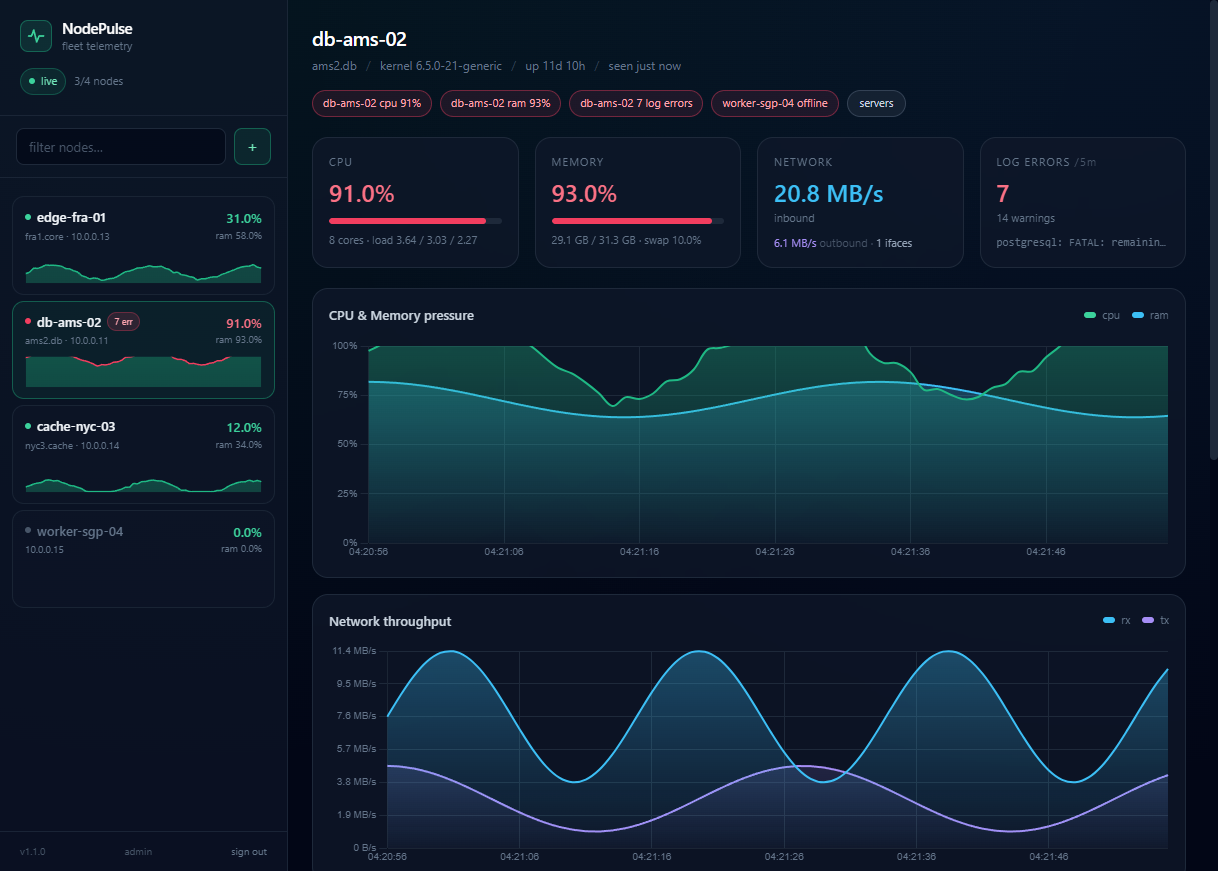
A lightweight, self-hosted, distributed infrastructure metrics and system log aggregator built in pure Go (standard library only). It enables real-time performance tracking and centralized log stream analysis for multiple dedicated Linux servers with a heavy focus on zero-allocation data piping, strict system security, and defensive memory constraints.
- Zero-Leaking Authentication: Implements a pure standard-library manual implementation of
PBKDF2-HMAC-SHA256with 210,000 iterations for password derivation. Account discovery mitigation is built intoVerifyUserto ensure constant-time comparison even for non-existent identities. - Production Session Lifecycle: Features 32-byte CSPRNG cryptographically secure session tokens managed via
HttpOnly,SameSite=Strict, and dynamicSecurecookie configurations alongside concurrent session garbage collection. - Defensive Web Security: Enforces strict anti-brute-force rate limiting (max 8 attempts per 5 minutes per IP) and strict double-submit validation requiring the
X-NP-CSRFrequest token header across all state-mutating API layers. - Atomic Persistent Store: Manages identities via declarative local store JSON files featuring
0600Linux permissions, implementing fully atomic disk writes via temporary files and system-level folder renames (temp + rename).
- Cryptographic Access Control: Replaces open self-registration with an explicit tokenized onboarding scheme (
<keyId>.<secret>). Secrets are hashed viaSHA-256for instant O(1) constant-time token comparison without roasting host CPU threads. - Anti-Spoofing Payload Validation: The main server ingestion router automatically overwrites payload
NodeIDfields with authenticated identities mapped directly from the access token key registry, preventing rogue agent data injections.
- Multi-Source Log Tails (Linux-Only): The agent implements non-blocking stream pipes utilizing direct
journalctl -f -o jsonsubprocess pooling (with localized unit-level filters) combined with standard filetailpolling (700ms interval). - Resilient File Rotation Trackers: Dynamically tracks system file rotations via low-level
os.SameFilepointer validation and auto-recovers truncation anomalies while handling partially written bytes. - Batching Optimization & Ring Memory Caps: Telemetry logs and error spikes are buffered using bounded 4096 channels and pushed down the wire in micro-batches every 2000ms, detached completely from the standard metric payload. The main hub restricts state bloating using bounded in-memory
Ring Buffers(capped at 500 rows per node), ensuring predictable heap dimensions.
- Embedded Monolithic Binary: Incorporates the reactive frontend direct into the compilation process via Go's native
//go:embeddirective. - Single-Page Analytics UI: Implements a custom low-overhead UI architecture powered by Tailwind CSS, AlpineJS, and ChartJS, updating continuously via persistent WebSockets with adaptive data-delta polling and auto-reconnect failbacks.
Since the core codebase does not rely on CGO, you can instantly cross-compile static binaries via PowerShell:
env:GOOS="linux"; env:GOARCH="amd64"
go build -o nodepulse-server ./cmd/server
go build -o nodepulse-agent ./cmd/agentMove the compiled server binary to /usr/local/bin/ and configure a hardened, sandboxed Systemd unit profile:
# /etc/systemd/system/nodepulse.service
[Unit]
Description=NodePulse Central Hub
After=network-online.target

[Service]
ExecStart=/usr/local/bin/nodepulse-server -addr 127.0.0.1:8080 -data /var/lib/nodepulse/nodepulse.json -secure-cookies
DynamicUser=yes
StateDirectory=nodepulse
Restart=always
NoNewPrivileges=yes
ProtectSystem=strict

[Install]
WantedBy=multi-user.target
Note: Extract the initial secure CSPRNG admin credentials via journalctl -u nodepulse on the first unit startup.
Deploy the lightweight metric tracker and system file tails to target hosts:
# /etc/systemd/system/nodepulse-agent.service
[Unit]
Description=NodePulse Metrics Agent
After=network-online.target

[Service]
ExecStart=/usr/local/bin/nodepulse-agent -server https://yourdomain.com -id prod-edge-01 -journal -log-level warn
Environment=NODEPULSE_TOKEN=<YOUR_ENROLLMENT_TOKEN_FROM_SERVER_UI>
Restart=always
RestartSec=5
NoNewPrivileges=yes
ProtectSystem=strict
# Required to grant the isolated agent full access to system systemd-journal streams:
SupplementaryGroups=systemd-journal

[Install]
WantedBy=multi-user.target- Log Retention: Kept strictly inside fixed in-memory ring-buffers to guarantee deterministic application behavior. TLS termination and static persistence constraints are deliberately delegated to specialized load-balancers (Nginx/HAProxy) in production.