
PyTorch implementation of Stacked Capsule Auto-Encoders [1].
Ported from official implementation with TensorFlow v1. The architecture of model and hyper-parameters are kept same. However, some parts are refactored for ease of use.
Please, open an issue for bugs and inconsistencies with original implementation.
# clone project
git clone https://github.com/bdsaglam/torch-scae

# install project
cd torch-scae
pip install -e .
It uses PyTorch Lightning for training and Hydra for configuration management.
# CPU
python -m torch_scae_experiments.mnist.train

# GPU
python -m torch_scae_experiments.mnist.train +trainer.accelerator=gpu +trainer.devices=1
You can customize model hyperparameters and training with Hydra syntax.
python -m torch_scae_experiments.mnist.train \
    data_loader.batch_size=32 \
    optimizer.learning_rate=1e-4 \
    model.n_part_caps=16 \
    trainer.max_steps=100000
Evaluate a checkpoint with linear probes and with k-means clustering plus bipartite matching, as in the paper:
python -m torch_scae_experiments.mnist.evaluate path/to/last.ckptUnsupervised classification accuracy (%) on the 40x40 MNIST test set after
300k steps with the default configuration, which follows the reference
run_mnist.sh (40 part capsules, 32 object capsules).
| LIN-MATCH | LIN-PRED | |
|---|---|---|
| Paper [1], Table 1 (5 runs) | 98.7 (0.35) | 99.0 (0.07) |
| This implementation, seed 42 | 98.6 | 98.9 |
| This implementation, seed 43 | 98.7 | 98.8 |
LIN-MATCH fits k-means with 10 clusters on the object capsule presences of the training set and matches clusters to labels; the table reports the posterior presences. LIN-PRED is the better of the two linear probes trained alongside the model. Training takes about 4 hours on an A100.
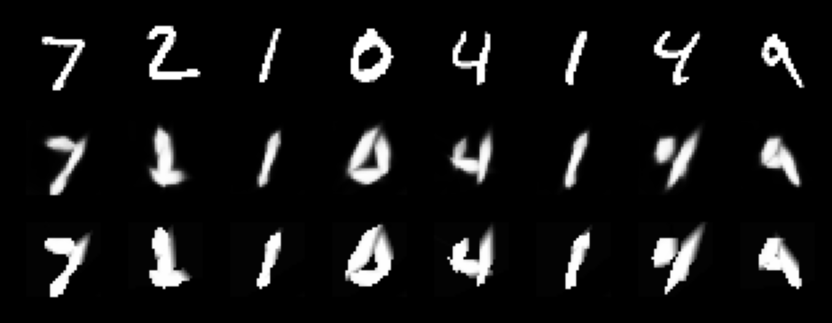
Fig 1. Rows: test images and their reconstructions
- Kosiorek, A. R., Sabour, S., Teh, Y. W., & Hinton, G. E. (2019). Stacked Capsule Autoencoders. NeurIPS. http://arxiv.org/abs/1906.06818