
Tiny semantic search DB in one file. Zero config. Instant prototyping.




EmbedDB is an ultra-lightweight vector database designed for rapid prototyping of semantic search and RAG applications. The entire implementation is contained in a single Python file with minimal dependencies.
- ⚡ 2-Minute Integration: From
pip installto working code in under 2 minutes - 📄 Single File: Entire implementation in one readable Python file (<500 lines)
- 🔍 Simple API: Just 7 intuitive commands to learn
- 🛠️ Zero Config: No accounts, API keys, or complex setup
- 💾 JSON Persistence: Simple file-based storage with human-readable format
- 🧩 Extensible: Easy to modify or extend for your specific needs
- 🤖 Optional Embeddings: Built-in text embedding support (when you need it)
Basic installation (vector storage only):
pip install embeddbWith built-in embedding support:
pip install embeddb[embeddings]That's it. No compilation. No complex dependencies.
EmbedDB is designed for simplicity. The entire API consists of just 7 intuitive commands:
db = EmbedDB(dimension=384)       # Create a database
db.add(id, vector, metadata)      # Add a vector (or use add_text for text input)
db.search(vector, top_k=5)        # Find similar vectors (or use search_text for text queries)
db.get(id)                        # Retrieve a vector
db.delete(id)                     # Remove a vector
db.save(filepath)                 # Persist to disk
db.load(filepath)                 # Load from disk
That's it. No complex configuration. No steep learning curve. Just install and start building.
Note: When vector embeddings are not provided (using
add_textorsearch_text), EmbedDB internally uses the all-MiniLM-L6-v2 embedding model.
| Feature | EmbedDB | FAISS | Pinecone/Weaviate/etc. |
|---|---|---|---|
| Installation | pip install embeddb |
Requires C++ compilation | Requires accounts, API keys |
| Setup time | < 2 minutes | 10-30 minutes | 30+ minutes |
| Dependencies | Just NumPy | BLAS, C++ toolchain | External services |
| Learning curve | Minimal (7 commands) | Steep (many index types) | Moderate to steep |
| Storage | Simple JSON files | Custom binary format | Cloud-hosted |
| Best for | Rapid prototyping | Production performance | Large-scale production |
| Metadata | Built-in JSON | Requires separate handling | Built-in |
| Coding style | Pure Python | C++ with Python bindings | Client/server |
While EmbedDB prioritizes ease of use over raw performance, it's still remarkably efficient for prototyping and small to medium-sized applications.
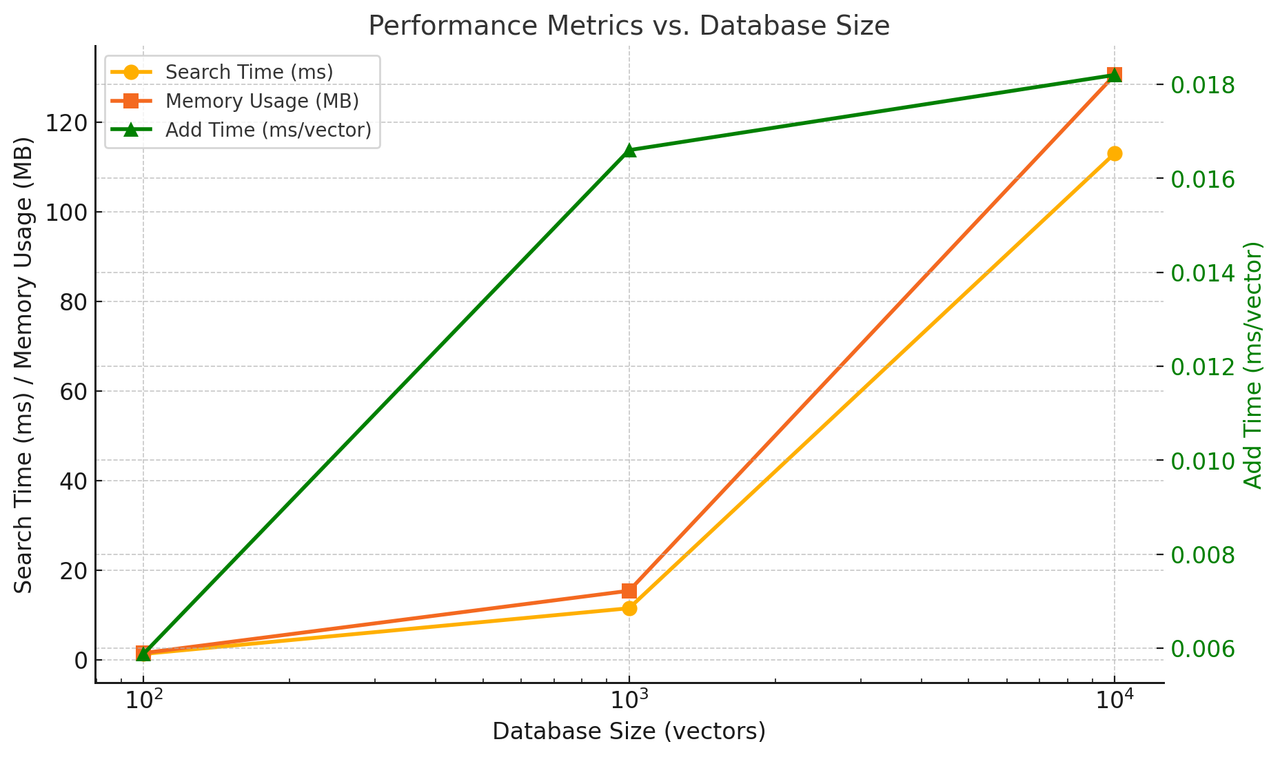
- Adding Vectors: Consistent performance regardless of database size (~0.017ms per vector)
- Search Performance: Linear scaling from 1ms at 100 vectors to ~110ms at 10,000 vectors
- Memory Efficiency: Linear memory growth with database size (2MB at 1,000 vectors, 130MB at 10,000 vectors)
| Database Size | Add (ms/vector) | Search (ms) | Memory (MB) |
|---|---|---|---|
| 100 vectors | 0.00588 | 1.3 | 1.5 |
| 1,000 vectors | 0.0166 | 11.5 | 15.4 |
| 10,000 vectors | 0.0182 | 113.0 | 130.5 |
Benchmark details: Tests performed on a modern system using 384-dimension vectors with small metadata.
- <1,000 vectors: Blazing fast with minimal memory footprint
- 1,000-10,000 vectors: Excellent performance for most prototyping needs
- 10,000-100,000 vectors: Suitable for medium-sized applications
- >100,000 vectors: Consider more specialized solutions like FAISS for production
from embeddb import EmbedDB

# Create a vector database
db = EmbedDB(dimension=384)  # Set to your embedding dimension

# Add vectors with metadata
db.add("doc1", [0.1, 0.2, ...], {"text": "EmbedDB is easy to use"})
db.add("doc2", [0.3, 0.1, ...], {"text": "Vector databases for everyone"})

# Search for similar vectors
results = db.search([0.2, 0.3, ...], top_k=2)
for result in results:
    print(f"Match: {result['metadata']['text']} (Score: {result['similarity']})")

# Save for later
db.save("my_database.json")

# Load back when needed
db = EmbedDB.load("my_database.json")from embeddb import EmbedDB
# Create a database with built-in embedding support
db = EmbedDB()
# Add documents with automatic embedding
db.add_text("doc1", "EmbedDB makes vector search easy")
db.add_text("doc2", "Semantic search finds related content")
# Search with a text query
results = db.search_text("How do I find similar documents?")
for result in results:
print(f"Match: {result['metadata']['text']}")Here's a complete Retrieval-Augmented Generation implementation in under 30 lines:
from embeddb import EmbedDB

# Initialize EmbedDB with built-in embedding support
db = EmbedDB()  # Uses all-MiniLM-L6-v2 under the hood

# Add some documents (automatic embedding)
documents = [
    "EmbedDB is a lightweight vector database for prototyping.",
    "Vector databases store embeddings for semantic search.",
    "RAG systems enhance LLMs with relevant document retrieval."
]

# Add documents to EmbedDB
for i, doc in enumerate(documents):
    db.add_text(f"doc{i}", doc)

# Perform a search with text query
query = "How can I use vector search in my project?"
results = db.search_text(query, top_k=2)

# Display results
print(f"Query: {query}")
print("Relevant documents:")
for i, result in enumerate(results):
print(f"{i+1}. {result['metadata']['text']} (Score: {result['similarity']:.4f})")Core Vector Database Functions:
# Create a database
db = EmbedDB(dimension=None)  # Dimension optional, set on first add

# Add a vector
db.add(id, vector, metadata)  # metadata can be any JSON-serializable object

# Search for similar vectors
results = db.search(query_vector, top_k=5)  # Returns list of {id, similarity, metadata}

# Get a vector by ID
vector, metadata = db.get(id)

# Delete a vector
db.delete(id)

# Save database to file
db.save(filepath)

# Load database from file
db = EmbedDB.load(filepath)

# Count vectors
count = db.count()
Text Embedding Functions (with embeddb[embeddings]):
# Generate embeddings for text
vector = db.embed_text(text)

# Add text directly (auto-generates embedding)
db.add_text(id, text, metadata=None)

# Search using text query
results = db.search_text(query_text, top_k=5)✅ Perfect for:
- Rapid prototyping of semantic search applications
- Learning and education about vector databases
- Small to medium-sized RAG implementations
- Projects where simplicity is more important than scale
- Quick demos and proofs of concept
❌ Not designed for:
- Production systems with millions of vectors
- High-throughput applications
- Advanced filtering and hybrid search
- Multi-user environments requiring access control
EmbedDB uses in-memory storage with cosine similarity for vector search. Vectors are automatically normalized on insertion for optimal similarity calculation. Persistence is handled through simple JSON serialization.
The optional text embedding functionality uses the all-MiniLM-L6-v2 model from sentence-transformers, which provides an excellent balance between size, speed, and quality for most prototyping needs.
The database has virtually no learning curve - if you know how to call functions in Python, you know how to use EmbedDB.
Contributions are welcome! The goal of this project is to remain extremely simple while being useful for developers. Before adding features, please consider whether they align with the project's minimalist philosophy.
MIT License
Made for developers who want to go from idea to prototype in minutes, not days.