Repository navigation
HIP Flash Next on gfx1151: results and approach of a complete branch, as a reference for the open series #1661
Description

We have a gfx1151 HIP path for Qwen3.8-Flash-Next that we measured and tested on an AMD Strix Halo (gfx1151) machine with 192 GiB of unified memory and ROCm 7.15. This issue records the results and the approach. A draft pull request will refer to it as a reference. It does not compete with the HIP Flash Next series that is open now.
Relation to the open HIP Flash Next work
These issues and pull requests are in the same area, and our branch touches many of the same files:
- issues: HIP Flash Next: WMMA sparse attention for prompt chunks on gfx11 #1597, HIP Flash Next: the loader requires the MTP head under
language_model.mtp, so oMLX checkpoints fail #1598, HIP Flash Next: a shared expert wider than the routed experts cannot load #1599, HIP: the prompt GEMM pays a group-32 scale and bias fold every K stage #1600, HIP: a 16/32-row routed-expert prompt tile for many-expert MoE (Flash Next) #1601, HIP Flash Next: the first request after load decodes at half speed #1602, HIP Flash Next: about 850 small kernels per verify round cost a fifth of decode #1603, HIP Flash Next: the prompt's n-gram gather is a single-threaded host copy #1606, Flash Next on HIP: which tensors an oQ checkpoint can narrow for bandwidth-bound decode #1617, HIP Flash Next on gfx1151: defaults for prompt step and MTP drafts #1649; - pull requests: hip flashnext: parallel n-gram gather, release weight pages after upload #1611, hip: load a shared expert wider than the routed experts beside the stack #1612, hip flashnext: take the MTP head's root from the index #1613, hip: decode router over the bf16 rows the checkpoint holds #1614, hip flashnext: random-access advice on the n-gram table mappings #1615, hip flashnext: WMMA sparse attention for prompt chunks (sparse=wmma) #1622, hip: an opt-in prompt GEMM tile that stages dequantized bf16 weights (dq=on) #1650, hip: 4096-row prompt chunks by default on the RDNA 3.5 iGPUs #1651, hip: a 64-row routed prompt tile for many-expert plans on gfx1151 #1658.
Areas that overlap, by topic:
- prompt GEMM tiles (dense and routed expert): HIP: the prompt GEMM pays a group-32 scale and bias fold every K stage #1600, HIP: a 16/32-row routed-expert prompt tile for many-expert MoE (Flash Next) #1601, hip: an opt-in prompt GEMM tile that stages dequantized bf16 weights (dq=on) #1650, hip: a 64-row routed prompt tile for many-expert plans on gfx1151 #1658;
- WMMA sparse attention for prompt chunks: HIP Flash Next: WMMA sparse attention for prompt chunks on gfx11 #1597, hip flashnext: WMMA sparse attention for prompt chunks (sparse=wmma) #1622;
- kernel count and host work in a verify round: HIP Flash Next: about 850 small kernels per verify round cost a fifth of decode #1603, hip: decode router over the bf16 rows the checkpoint holds #1614;
- prompt chunk and MTP draft defaults: HIP Flash Next on gfx1151: defaults for prompt step and MTP drafts #1649, hip: 4096-row prompt chunks by default on the RDNA 3.5 iGPUs #1651;
- loader and table handling: HIP Flash Next: the loader requires the MTP head under
language_model.mtp, so oMLX checkpoints fail #1598, HIP Flash Next: a shared expert wider than the routed experts cannot load #1599, HIP Flash Next: the first request after load decodes at half speed #1602, HIP Flash Next: the prompt's n-gram gather is a single-threaded host copy #1606, hip flashnext: parallel n-gram gather, release weight pages after upload #1611, hip: load a shared expert wider than the routed experts beside the stack #1612, hip flashnext: take the MTP head's root from the index #1613, hip flashnext: random-access advice on the n-gram table mappings #1615.
atc overlap finds textual conflicts with #1612, #1614, #1622, #1650, #1651 and #1658. #1613 and #1615 merge without conflicts.
We can split our work onto those pull requests, pair with their author, or review them, as the maintainers and the author prefer. We do not ask to replace that series.
Results of the fork's numerics=inexact path (not in #1667)
These numbers and charts were measured with the rounding-class kernels described below, under --policy numerics=inexact. #1667 no longer contains those kernels; its exact-path receipts will be posted there.
Served, greedy, thinking off, one stream, prompt cache off.
Checkpoint TensorFold/Qwen3.8-Flash-Next-MLX-4bit-MTP. --policy numerics=inexact. A 17,715-token coding prompt and 1,024 output tokens. Medians of 4 timed runs, with a fresh server for each arm.
| Measure | Value |
|---|---|
| prefill (cold) | 1,890 tok/s |
serial decode (--no-drafts) |
38.19 tok/s |
| Default MTP decode (engine default drafts) | 69.63 tok/s, 77.5 % of drafts accepted |
One more change (the next layer's expert down codes read on a side stream during one-row decode) adds +2.6 % to serial decode (38.24 / 38.32 to 39.24 / 39.30 tok/s on two seeds) with the same text. Default MTP and prefill do not change.
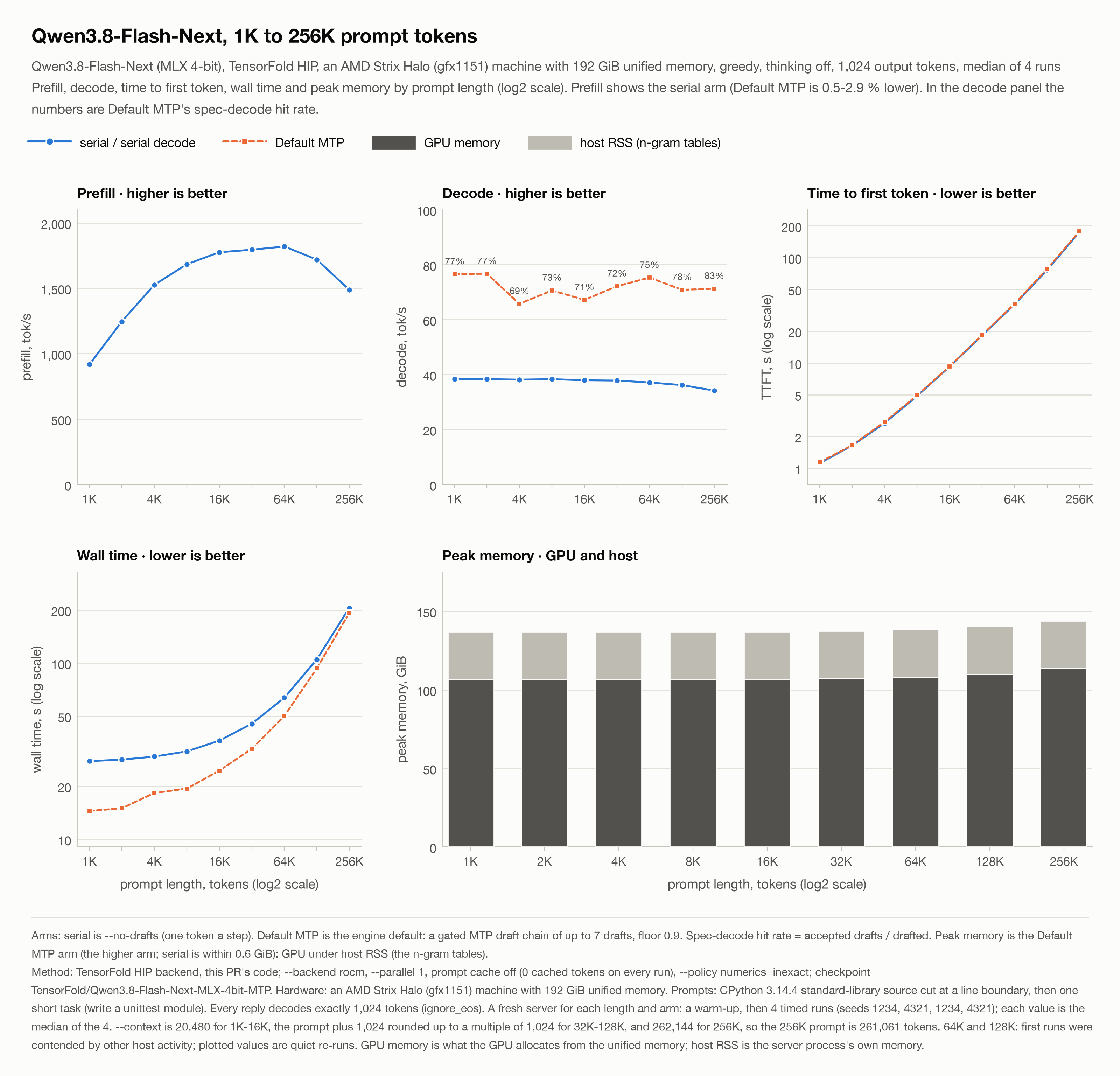
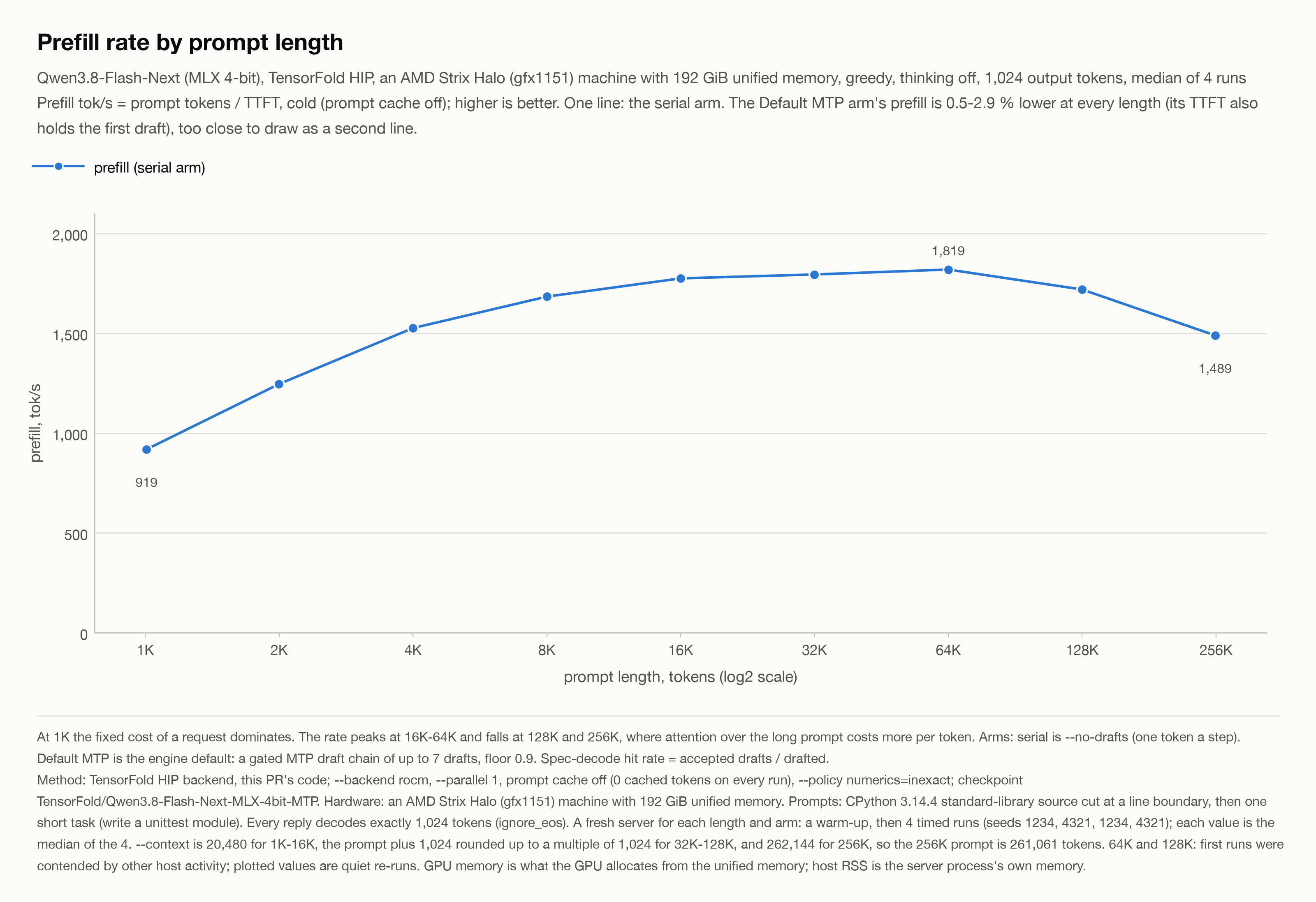
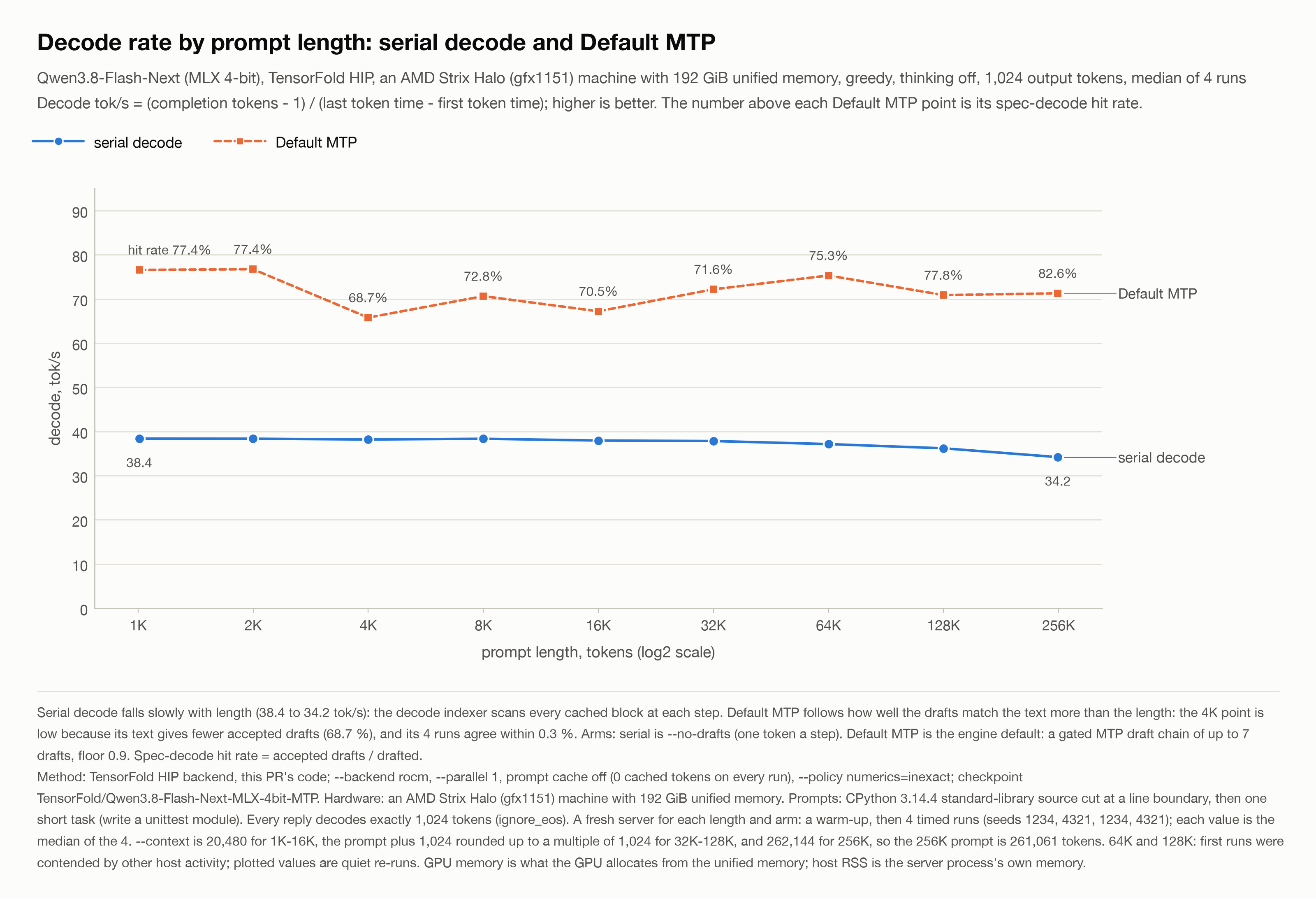
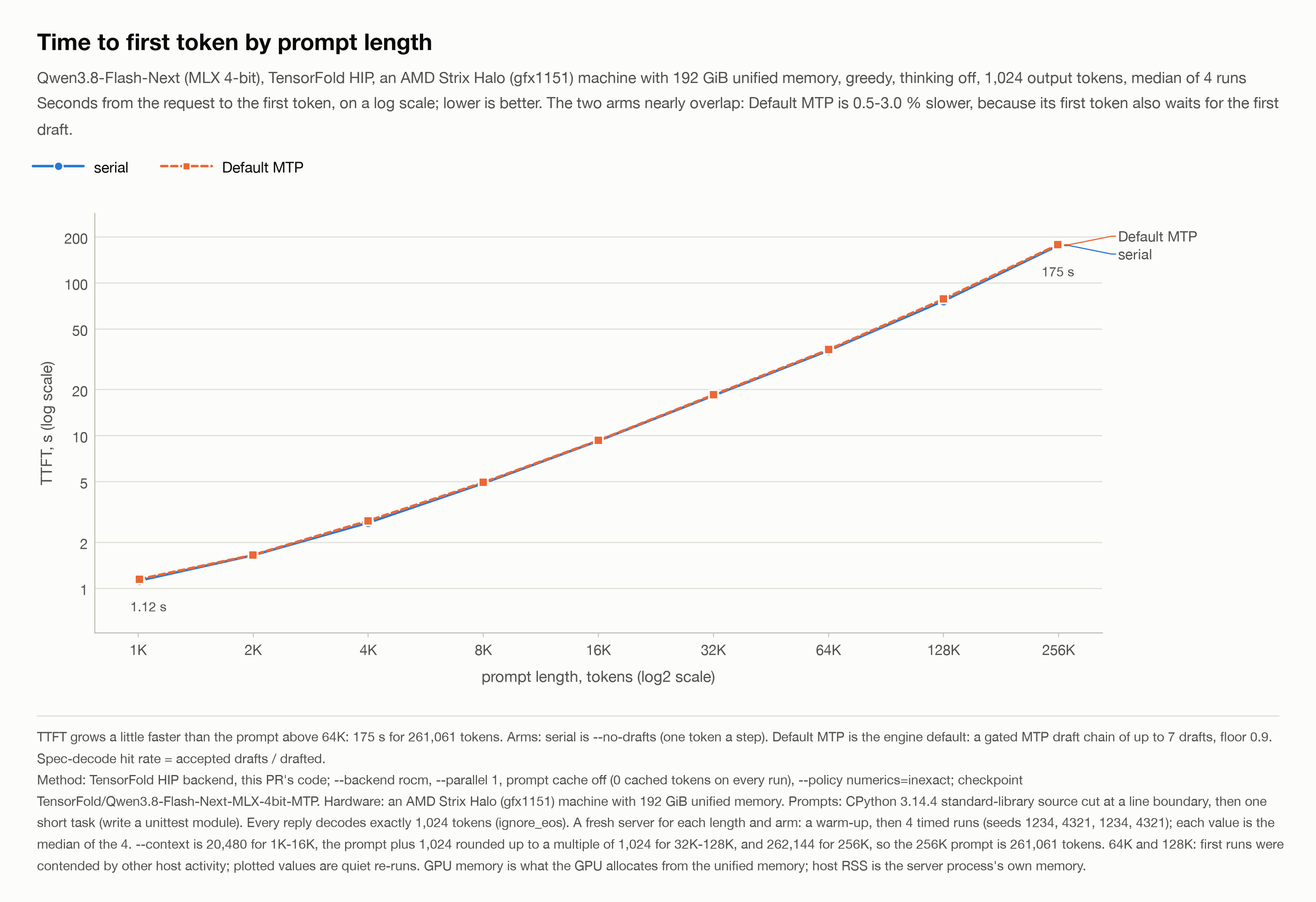
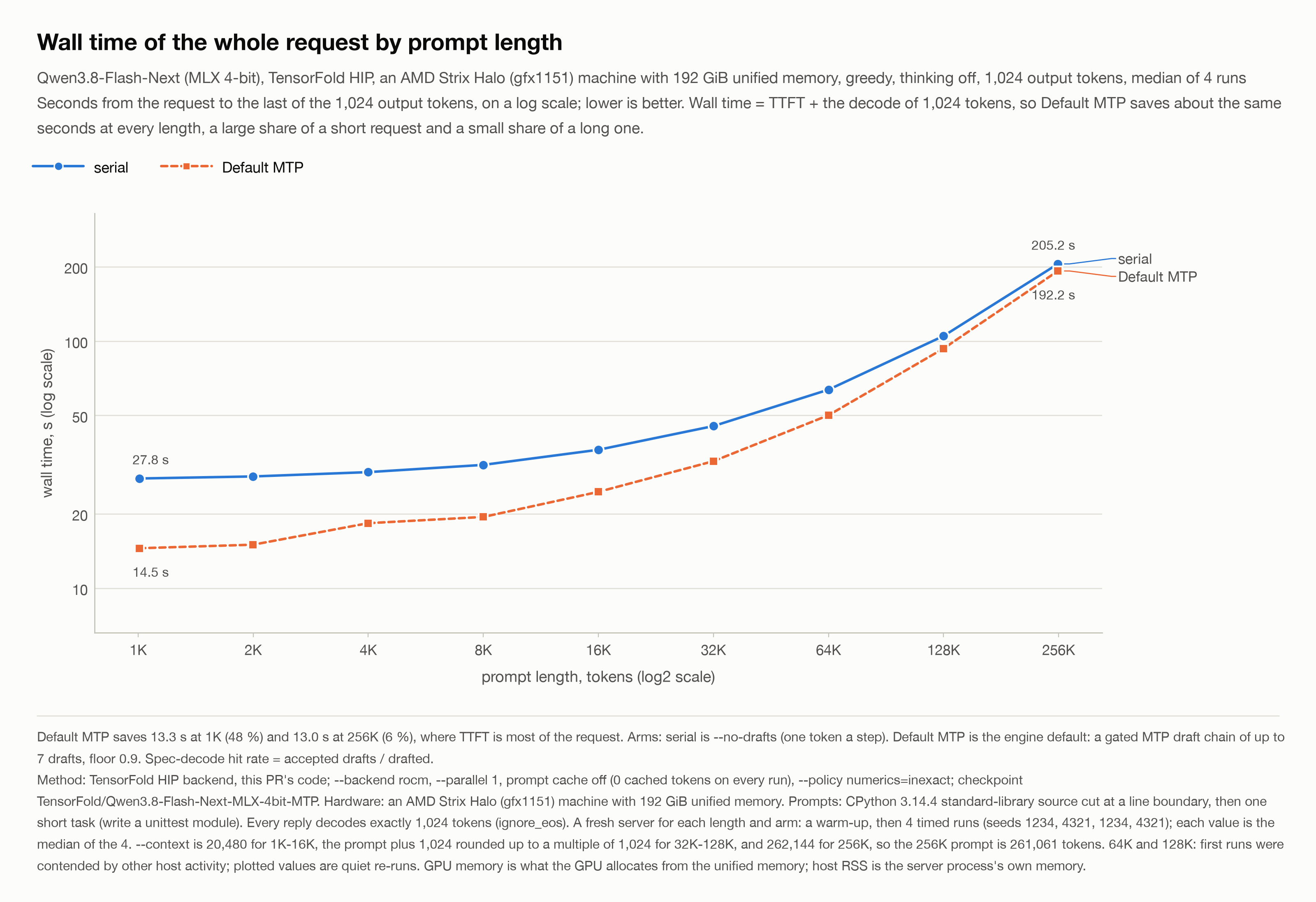
A prompt-length sweep (1,024 output tokens each) gives:
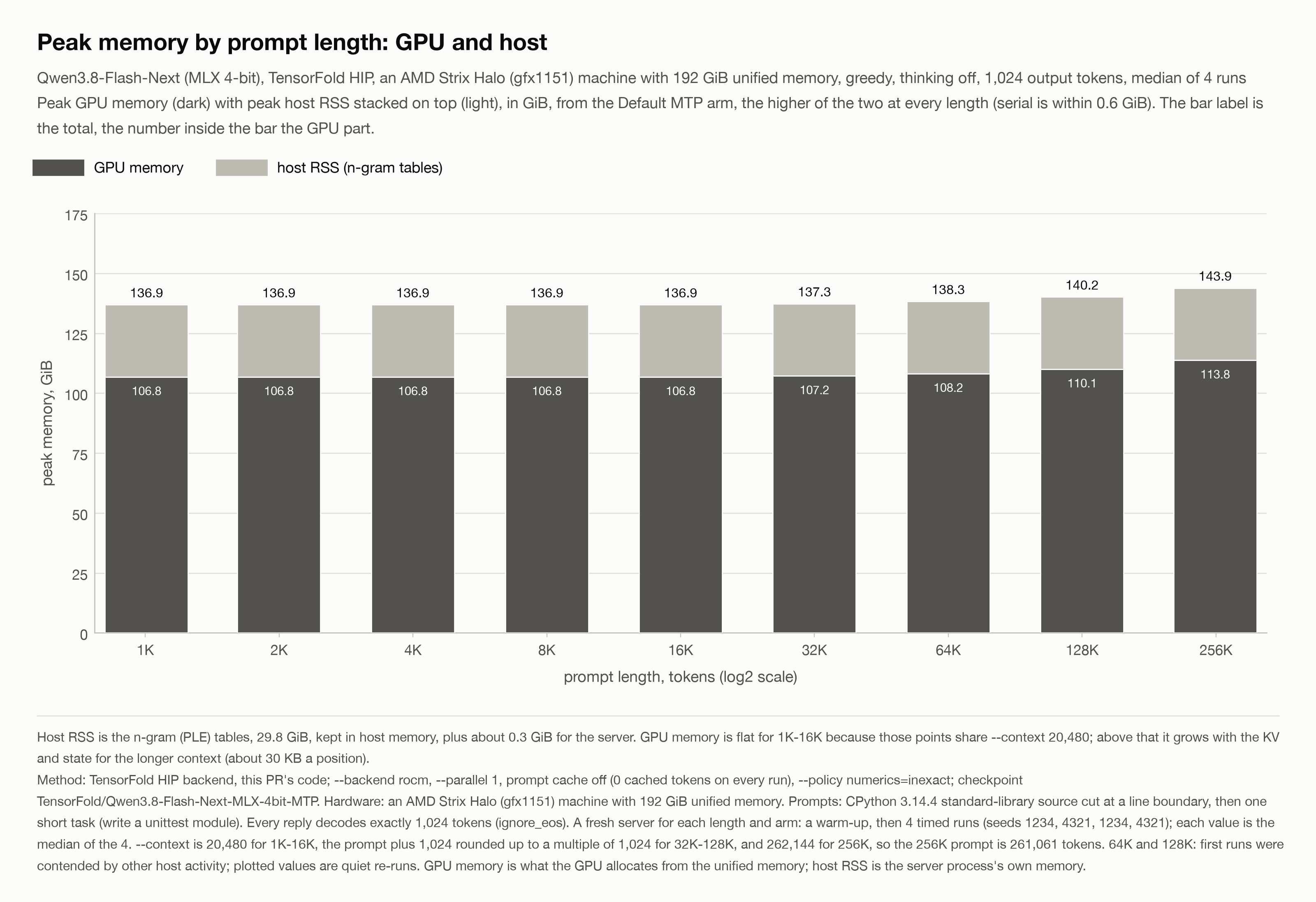
| Prompt tokens | prefill tok/s | serial decode tok/s | Default MTP decode tok/s | Default MTP hit rate | TTFT serial / MTP (s) | Wall time serial / MTP (s) | Peak memory (GiB, GPU + host) |
|---|---|---|---|---|---|---|---|
| 1,031 | 919.0 | 38.38 | 76.58 | 77.4 % | 1.12 / 1.15 | 27.78 / 14.50 | 136.9 (106.8 + 30.1) |
| 2,046 | 1,245.6 | 38.37 | 76.73 | 77.4 % | 1.64 / 1.65 | 28.31 / 14.99 | 136.9 (106.8 + 30.1) |
| 4,094 | 1,525.9 | 38.18 | 65.79 | 68.7 % | 2.68 / 2.76 | 29.47 / 18.31 | 136.9 (106.8 + 30.1) |
| 8,194 | 1,683.8 | 38.36 | 70.64 | 72.8 % | 4.87 / 4.93 | 31.53 / 19.41 | 136.9 (106.8 + 30.1) |
| 16,386 | 1,775.1 | 37.95 | 67.21 | 70.5 % | 9.23 / 9.28 | 36.30 / 24.52 | 136.9 (106.8 + 30.1) |
| 32,767 | 1,794.7 | 37.84 | 72.18 | 71.6 % | 18.26 / 18.47 | 45.27 / 32.63 | 137.3 (107.2 + 30.1) |
| 65,535 | 1,819.4 | 37.15 | 75.31 | 75.3 % | 36.02 / 36.51 | 63.56 / 50.09 | 138.3 (108.2 + 30.1) |
| 131,068 | 1,719.3 | 36.19 | 70.87 | 77.8 % | 76.23 / 78.25 | 104.84 / 93.28 | 140.2 (110.1 + 30.1) |
| 261,061 | 1,489.4 | 34.20 | 71.28 | 82.6 % | 175.28 / 177.80 | 205.19 / 192.15 | 143.9 (113.8 + 30.1) |
The first 64K and 128K runs were contended by other host activity; both points were re-measured on a quiet machine, and the table and charts show the re-runs. Default MTP decode follows the text's acceptance more than the length. Peak memory is the Default MTP arm (serial is within 0.6 GiB); host memory is the n-gram tables.
Findings on the rounding-class kernels (not proposed; to fix before any later proposal)
The fork's rounding-class kernels ran only under --policy numerics=inexact. They are not part of #1667, because they do
not meet CONTRIBUTING's rules:
- FP64 references. On identical input rows, every rounding-class kernel's error against an independent float64
reference is larger than the exact path's, in aggregate and in the worst column. Per change and projection class
(rms_rel inexact / exact; worst-column error inexact / exact):
| Change | Class | rms_rel | worst column |
|---|---|---|---|
| Sparse attention on the matrix cores, prompt rows | 24 q heads, 2 kv heads, d 256 | 1.3e-6 / 6.1e-8 | 7.4e-7 / 7.0e-8 |
| The same, decode and window rows | same | 1.6e-7 / 6.1e-8 | 1.1e-7 / 7.0e-8 |
| Prompt attention with p in bf16 once | same | 5.5e-4 / 6.0e-8 | 3.8e-4 / 7.4e-8 |
| Prompt DeltaNet in 32-token chunks (WY) | y and state, 6 shapes | about 5e-4 / 1e-7 | 2e-5 to 1.8e-4 / about 2e-8 |
| Prompt dense products, weights dequantized to bf16 | K 2560 and 6144 | 1.7e-3 / 2e-7 | 0.05 to 0.09 / 1e-5 to 3e-5 |
| Prompt expert down, bf16 weights | K 640 | 1.7e-3 / 9e-8 | 2.2e-2 / 1.4e-6 |
| Prompt expert gate+up, bf16 weights | K 2560 | 2.5e-3 to 4.1e-3 / 1.1e-3 to 1.6e-3 | 0.17 to 1.96 / 0.04 to 1.63 |
| Prompt MoE router on the bf16 dense tile | 513 x 2560 | 9.7e-7 / 2.3e-7 | 1.1e-5 / 2.5e-6 |
| Prompt indexer scores on the matrix cores | 4 heads x 128, fp32 q | 1.1e-3 / 3.5e-8 | 1.2e-3 / 6.8e-8 |
| The same, q already bf16 | 4 heads x 128 | 3.55e-8 / 3.45e-8 | 6.9e-8 / 6.9e-8 |
| HC gates, up and mix in one launch (reordered up sum) | K 320, N 10,240, 11 rows | equal bytes (0 of 28,160 outputs differ) | equal |
The one-launch HC up+mix wrote the chain's bytes on these rows, but its reordered sum does not guarantee that.
On decode rows the prompt-only changes run the exact kernels. All lines: fp64-references.txt.
- Teacher-forced fidelity (
numerics=exactagainstnumerics=inexact, 65,520 positions each):
| Corpus | top-1 agreement | differences | both margins <= 0.25 | PPL inexact / exact |
|---|---|---|---|---|
| wikitext-2 test | 95.75 % | 2,785 | 1,524 | 3.724347 / 3.723247 |
| CPython 3.13 lib | 99.38 % | 408 | 135 | 1.174939 / 1.175527 |
Every difference, with both runs' top-1 and top-2 logits and margins:
wikitext-2, CPython.
No tie policy is applied.
-
A lead: one large deviation. At wikitext position 4031 the exact path predicts the target with a margin of 10.1,
and the inexact path predicts another token (15.38 against 15.25). That is far beyond rounding noise and points to an
edge case in one of the rounding-class kernels; it is not bisected yet. -
The result depends on how the rows are grouped. Under
numerics=inexact, a turn resumed from 10,240 cached
tokens differed from a fresh run of the full prompt (6 rewind replies), and a sampled decoder changed while a long
prompt ran beside it. Both contracts hold undernumerics=exact. Two causes:- some rounding-class kernels are chosen by how many rows a launch holds, so the same row takes another arithmetic
path in a different batch; - the chunked (WY) DeltaNet scan computes each row relative to its 32-token chunk's start, so a row's bytes depend on
the prompt's chunk grid, and the row-by-row decode scan sums it another way.
- some rounding-class kernels are chosen by how many rows a launch holds, so the same row takes another arithmetic
-
Kernel contract gate 4 (sums). On the fork's inexact tip, gfx1151:
104 kernels: 97 pass gates 1-4, 7 fail.
Every failure is in the sums gate:affine_wmma_dense_inexact<2560>and<6144>,affine_wmma_moe_down_inexact<4>andaffine_wmma_router<2560>:
142x to 219x (router 11.4x) over the exact-sum bound, "not fp32 sums". The matrix cores' accumulation on gfx1151
is not an exact fp32 sum.tf_gdn_wy_prepandtf_gdn_wy_scan(y): 12,416x over the bound at k 128.tf_fn_idx_scores_mmaand the WY state: the stress inputs do not separate fp32 from fp16 sums (2.6x and 0.0x,
the gate needs 100x), so the gate cannot pass these as written.
Each of these must be fixed, and each change given its own gate here, before any of these kernels is proposed again.
Approach
- Prompt (in hip: Qwen3.8-Flash-Next on gfx1151, a reference branch for review (to be split) #1667, same bytes as the base path): WMMA tiles for the dense and routed-expert GEMMs, the DeltaNet prompt recurrence and its prework in fewer launches, the indexer at 4 lanes a score, a prompt's picks and route plan, the router tile.
- Prompt (fork only, rounding class, see Findings): the chunked (WY) DeltaNet scan, the matrix-core indexer scores and sparse attention tiles, bf16-dequantized prompt tiles.
- Decode and verify: a router with a fused top-k pick, fused small kernels in the verify round, and a side stream that reads the next experts' down codes.
- hip: Qwen3.8-Flash-Next on gfx1151, a reference branch for review (to be split) #1667 now holds only changes whose output bytes equal the base path's. The rounding-class kernels above stay on a fork branch.
The pull request gives the list of its changes, their contract registration and the test output.
🤖 Generated with Claude Code
Activity
davidtai commentedon Oct 30, 2026
/atc claim
davidtai commentedon Oct 30, 2026
/atc presence 91b908fde3df6360fb82da69f5b4047401f06ece36a9e73269b7ccd3d7898b9f
Findings on the fork's numerics=inexact kernels for ashhart#1661: FP6…
ashhart commentedon Oct 31, 2026
Thanks @davidtai for the full write-up, and for keeping #1667 to changes whose bytes equal the base path.
Your findings on the rounding-class kernels are useful as they stand: FP64 error per class, every top-1 difference
with margins, and the resumed and concurrent breaks under
numerics=inexact. Any of those that comes back later landsopt-in only, with its own gate. That includes the wikitext position 4031 lead and the batch-dependent paths fixed first.
Where #1667 overlaps @gilby's open PRs, please work it out per PR: review or pair on the ones that are further along,
and keep the rest in #1667. Small PRs, one change each, will review fastest.