

Deep learning pipeline for multi-class crop leaf disease classification using Convolutional Neural Networks (CNNs), built with TensorFlow/Keras and deployed via Streamlit for real-time inference.
The system includes:
• Structured data preprocessing & augmentation pipeline
• Custom CNN architecture with regularization for generalization
• Evaluation using precision, recall & confusion matrix analysis
• Exported model (.h5) integrated into a real-time Streamlit inference app
• Modular separation of training and deployment layers
This project simulates a real-world ML workflow — from dataset ingestion to deployable inference interface.
Early detection of crop diseases is critical for minimizing agricultural losses. Manual inspection is time-consuming and prone to error. This project builds a supervised image classification system capable of detecting crop leaf diseases from raw RGB images.
•	Image-based leaf disease dataset (train/test split)
•	Multi-class classification problem (Healthy + Disease classes)
•	Images resized and normalized for CNN input
•	Augmentation applied to reduce overfitting:
•	Rotation
•	Horizontal flip
•	Zoom
•	Shear
Custom CNN architecture built using Keras:
•	Convolutional layers (ReLU activation)
•	MaxPooling layers
•	Dropout regularization
•	Fully connected dense layers
•	Softmax output layer (multi-class classification)
Loss Function: Categorical Crossentropy
Optimizer: Adam
Evaluation Metrics:
•	Accuracy
•	Precision
•	Recall
•	Confusion Matrix
1.	Image preprocessing (resizing, normalization)
2.	Train/validation split
3.	Data augmentation pipeline
4.	Model training with early stopping
5.	Validation monitoring to prevent overfitting
6.	Final evaluation on hold-out test set
•	Training Accuracy: ~97%
•	Validation Accuracy: ~92%
•	Macro Precision: >90%
•	Macro Recall: >90%
Confusion matrix indicates minor misclassification between visually similar disease classes.
The model demonstrates strong generalization with limited overfitting due to augmentation and dropout regularization.
- Applied data augmentation (rotation, zoom, shear, flip)
- Dropout layers for regularization
- Early stopping based on validation loss
- Train / validation split monitoring
- Confusion matrix analysis for class overlap
- Precision & recall evaluation beyond raw accuracy
- Model exported to
.h5 - Lightweight inference pipeline
- Modular separation of:
- Training pipeline
- Model storage
- Streamlit inference interface
- Architecture compatible with transfer learning (ResNet / EfficientNet)
- Ready for REST API serving via FastAPI
- Extendable to edge deployment (TensorFlow Lite)
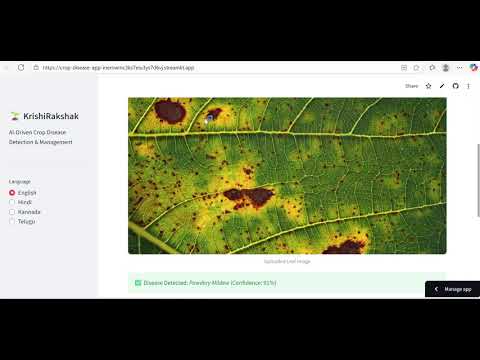
Model exported as .h5 and integrated into a Streamlit application for:
•	Real-time leaf image upload
•	Instant disease prediction
•	Confidence score display
This simulates a production inference pipeline.
•	Python 3.x
•	TensorFlow / Keras
•	OpenCV
•	NumPy / Pandas
•	Matplotlib / Seaborn
•	Streamlit
Clone the repository:
git clone https://github.com/akashcodes23/crop-disease-app.git
cd crop-disease-app
Install the dependencies:
pip install -r requirements.txt
Run the Streamlit application:
streamlit run app/app.py
Programming Language: Python Deep Learning: TensorFlow, Keras Data Processing: OpenCV, NumPy, Pandas Visualization: Matplotlib, Seaborn Frontend Prototype: Streamlit
├── data/                # Training & test datasets
├── notebooks/           # Model training & evaluation
├── models/              # Saved CNN models
├── app/                 # Streamlit inference app
├── requirements.txt
└── README.md• Data augmentation for robustness
• Regularization via Dropout
• Validation monitoring to prevent overfitting
• Modular separation (training vs inference)
• Deployable inference pipeline
-Healthy leaves are detected with near-perfect accuracy, showing the model’s reliability in differentiating diseased vs non-diseased samples.
-Disease A & Disease B show minor overlap (misclassifications), which is expected due to visual similarities in leaf patterns.
-Disease C is identified with high confidence and minimal confusion.
-The model demonstrates strong generalization, with most errors being between visually similar disease classes.
• Replace custom CNN with EfficientNet (transfer learning)
• Implement weighted loss for class imbalance handling
• Add MLflow for experiment tracking & model versioning
• Containerize using Docker
• Deploy as REST API using FastAPI
• Implement CI/CD for model updates
• Optimize inference latency for edge devices
Contributions are welcome! You can contribute by:
•	Adding new crop disease classes
•	Improving model accuracy
•	Enhancing the UI/UX
•	Integrating APIs or mobile deployment
•	Expanding datasets and preprocessing pipelines
Submit a Pull Request or open an Issue to get started.
This project is licensed under the MIT License — free to use, modify, and distribute with proper attribution.
This project demonstrates:
✔ End-to-end ML lifecycle implementation
✔ Data preprocessing & augmentation strategy
✔ Model evaluation beyond accuracy
✔ Regularization & overfitting control
✔ Deployment-ready inference system
✔ Modular ML architecture design
Designed to reflect real-world ML engineering workflows. Empowering farmers with AI-driven crop health diagnostics🌾