Local web UI for the pi coding agent. Pi Web reads your local pi session files and gives you a browser workspace for session browsing, real-time chat, model configuration, skill management, and project file preview.
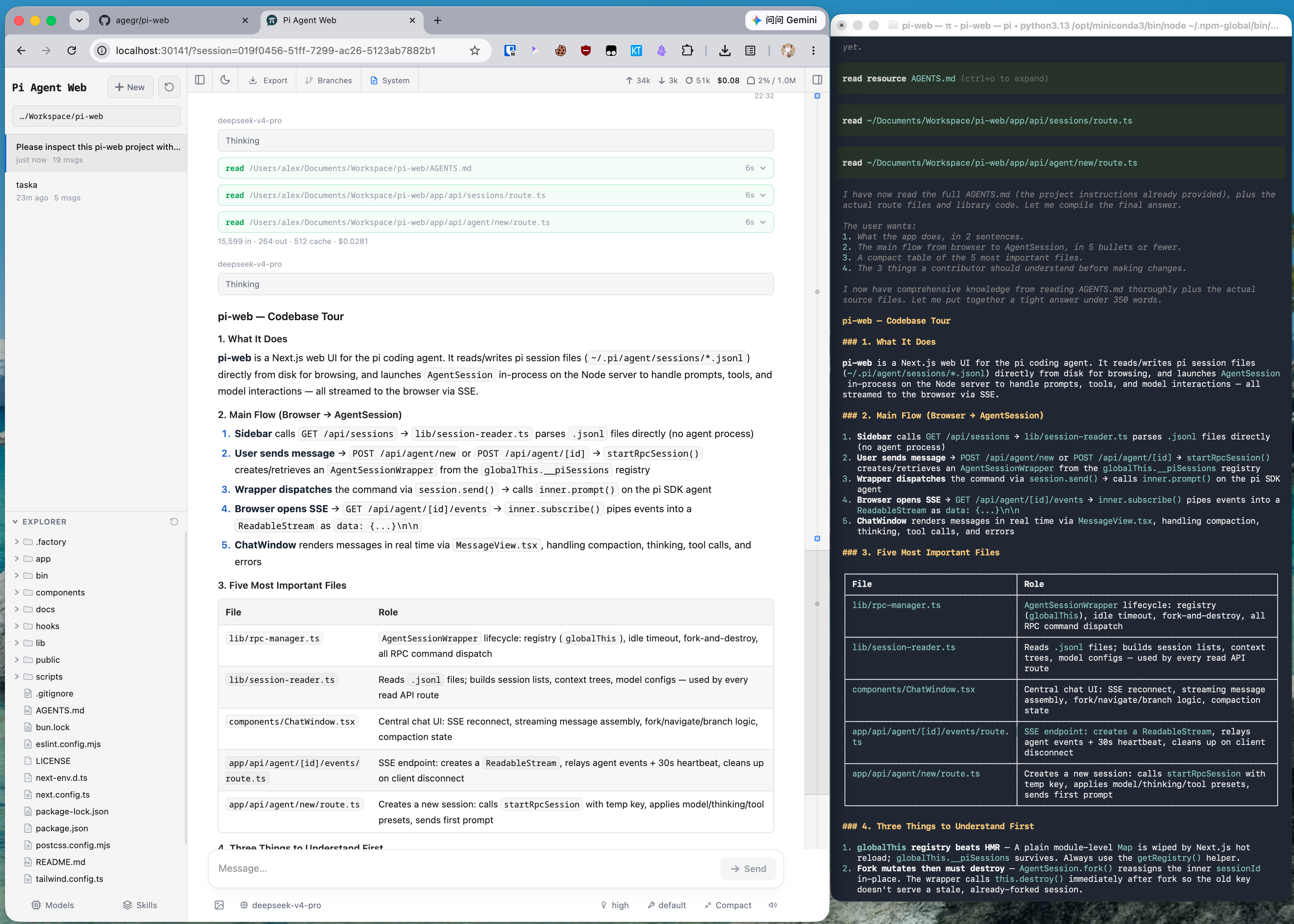
The same pi session in CLI and Pi Web: structured tool calls, readable Markdown, session browsing, and cleaner results.
Pi Web requires Node.js 22.19.0 or newer. Check your version with node --version.
Run without installing:
npx @agegr/pi-web@latestOr install globally:
npm install -g @agegr/pi-web
pi-web
Then open http://127.0.0.1:30141. The CLI will try to open the browser automatically after the server is ready. Pi Web listens on 127.0.0.1 by default.
Options:
pi-web --port 8080              # custom port
pi-web --hostname 0.0.0.0       # expose on a trusted network
pi-web -p 8080 -H 0.0.0.0       # combine options
pi-web --no-open                # do not open the browser automatically

PORT=8080 pi-web                # environment variable is also supported
PI_WEB_HOSTNAME=0.0.0.0 pi-web  # explicit network exposure
PI_WEB_ALLOWED_HOSTS=pi-web.internal pi-web  # allow an exact proxy/custom hostname
PI_WEB_PASSWORD='a-long-random-password' pi-web  # require Basic Auth (username: pi)
PI_WEB_NO_OPEN=1 pi-web         # useful when running as a background service
Set PI_WEB_PASSWORD to protect the web interface and every API endpoint with HTTP Basic Auth. The username is always pi. Leaving the variable unset or empty disables authentication.
Pi Web can invoke a high-privilege agent. Basic Auth does not encrypt the password in transit, so do not expose plain HTTP to the internet. Use HTTPS through a trusted reverse proxy or a trusted VPN for remote access.
API requests accept loopback names, IP literals, the selected bind hostname, and exact comma-separated names in PI_WEB_ALLOWED_HOSTS. Configure that variable when a trusted reverse proxy uses a different external hostname.
Pi Web reads the standard HTTP_PROXY, HTTPS_PROXY, and NO_PROXY environment variables for server-side model and API requests.
On macOS or Linux:
HTTP_PROXY=http://127.0.0.1:7890 \
HTTPS_PROXY=http://127.0.0.1:7890 \
NO_PROXY=localhost,127.0.0.1 \
npx @agegr/pi-web@latest
On Windows PowerShell:
$env:HTTP_PROXY = "http://127.0.0.1:7890"
$env:HTTPS_PROXY = "http://127.0.0.1:7890"
$env:NO_PROXY = "localhost,127.0.0.1"
npx @agegr/pi-web@latest- Pick work back up: browse previous pi conversations by project without digging through terminal history or session paths.
- Try different directions safely: continue from an earlier message or fork a session into a separate route.
- Work across branches: switch Git worktrees from the sidebar so new sessions and the Explorer follow the checkout you choose.
- Chat beside the project: browse files on the left and preview source, docs, images, audio, and PDFs on the right while the agent works.
- See session state clearly: context usage, cost, compaction state, and system prompt details are visible from the top bar.
- Configure less from the terminal: manage models, login/API keys, model tests, and skill switches from the web UI.
- Use the interface in your language: switch between the supported UI languages from the top bar.
- Data directory: Pi Web reads
~/.pi/agent/sessionsby default. SetPI_CODING_AGENT_DIRto point at another pi agent directory. - Session files: files are stored as
~/.pi/agent/sessions/<encoded-cwd>/<timestamp>_<uuid>.jsonl. - Model config: the Models panel reads and writes
models.jsonin the pi agent directory. Model lists and defaults come from pi's config. - File access: file browsing and preview are scoped to the selected project directory and working directories that appear in sessions.
- Git worktrees: see Worktrees in Pi Web for when the switcher appears, how new worktrees are created, and what removal does.
- Forks vs in-session branches: Fork creates a new
.jsonlfile. "Edit from here" creates another branch inside the same session file. - Internationalization: see Internationalization for using translations and adding languages or UI text.
npm install
npm run dev
The local dev server runs at http://127.0.0.1:30141.
Common checks:
node_modules/.bin/tsc --noEmit
npm run lint
Avoid running next build / npm run build during local development. It writes to .next/ and can interfere with the dev server; leave builds for release work.
app/
  api/
    agent/          # creates/drives AgentSession and exposes SSE events
    auth/           # OAuth and API key management
    cwd/browse/     # browsable server directory listing
    cwd/validate/   # custom working directory validation
    default-cwd/    # pi default working directory lookup
    files/          # file listing, reading, preview, and watching
    home/           # current user home directory
    models/         # available models, default model, thinking levels
    models-config/  # read/write models.json and test models
    sessions/       # session reads, rename, delete, context, HTML export
    skills/         # skill listing, search, install, enable/disable
components/
  AppShell.tsx        # main layout, URL state, top panels, file tabs
  SessionSidebar.tsx  # project selector, session tree, Explorer
  DirectoryPicker.tsx # browsable and editable working-directory picker
  ChatWindow.tsx      # messages, SSE, image drag/drop, minimap
  ChatInput.tsx       # input bar, model/tools/thinking/compact/slash controls
  MessageView.tsx     # message, thinking, tool call/result rendering
  ModelsConfig.tsx    # model and auth configuration panel
  SkillsConfig.tsx    # skill management panel
  FileExplorer.tsx    # file tree
  FileViewer.tsx      # source, diff, image, audio, PDF, DOCX preview
lib/
  directory-browser.ts # directory normalization and safe listing helpers
  http-dispatcher.ts  # HTTP(S) proxy setup for server-side fetch
  rpc-manager.ts      # AgentSessionWrapper lifecycle and global registry
  session-reader.ts   # parses .jsonl session files and branch contexts
  normalize.ts        # normalizes toolCall field names
  file-access.ts      # file read safety boundary
  file-paths.ts       # path encoding and relative path helpers
  markdown.ts         # Markdown/Mermaid/KaTeX plugin configuration
  pi-types.ts         # pi-related types
hooks/
  useAgentSession.ts  # session loading, command sending, SSE state machine
  useAudio.ts         # completion sound
  useDragDrop.ts      # image drag/drop
  useTheme.ts         # theme switching
bin/
  pi-web.js           # npm CLI entrypoint
instrumentation.ts    # initializes the server HTTP dispatcher