
A Python design exercise: Linux server resources as fluent, chainable objects.
ServerKit wraps host inspection (processes, memory, logs, disk, services, …) behind a Server facade, collection filters, and persisted workflows. It ships as a library and a small REPL — not as a production orchestration tool.


pip install "serverkit[rich]"
serverkit --version
Docs: User guide · Examples · PyPI
We wanted to practice object-oriented API design on a real domain: Linux server operations.
Most admin work is expressed as shell pipelines and one-off scripts. ServerKit asks a different question: what if processes, logs, and memory were typed collections with fluent filters and explicit terminal methods?
Goals
- Model host resources as composable objects, not string commands
- Keep local and remote behind the same facade (
Server/RemoteServer) - Persist multi-step checks as versioned JSON workflows
- Expose the SDK through a thin REPL for fast feedback
Non-goals
- Replacing Ansible, Fabric, Kubernetes, or production incident tooling
- Running arbitrary shell from an LLM (the optional AI layer routes to SDK calls only)
This repository is a portfolio piece demonstrating API shape, abstraction boundaries, and developer experience — not a claim to production-scale ops coverage.
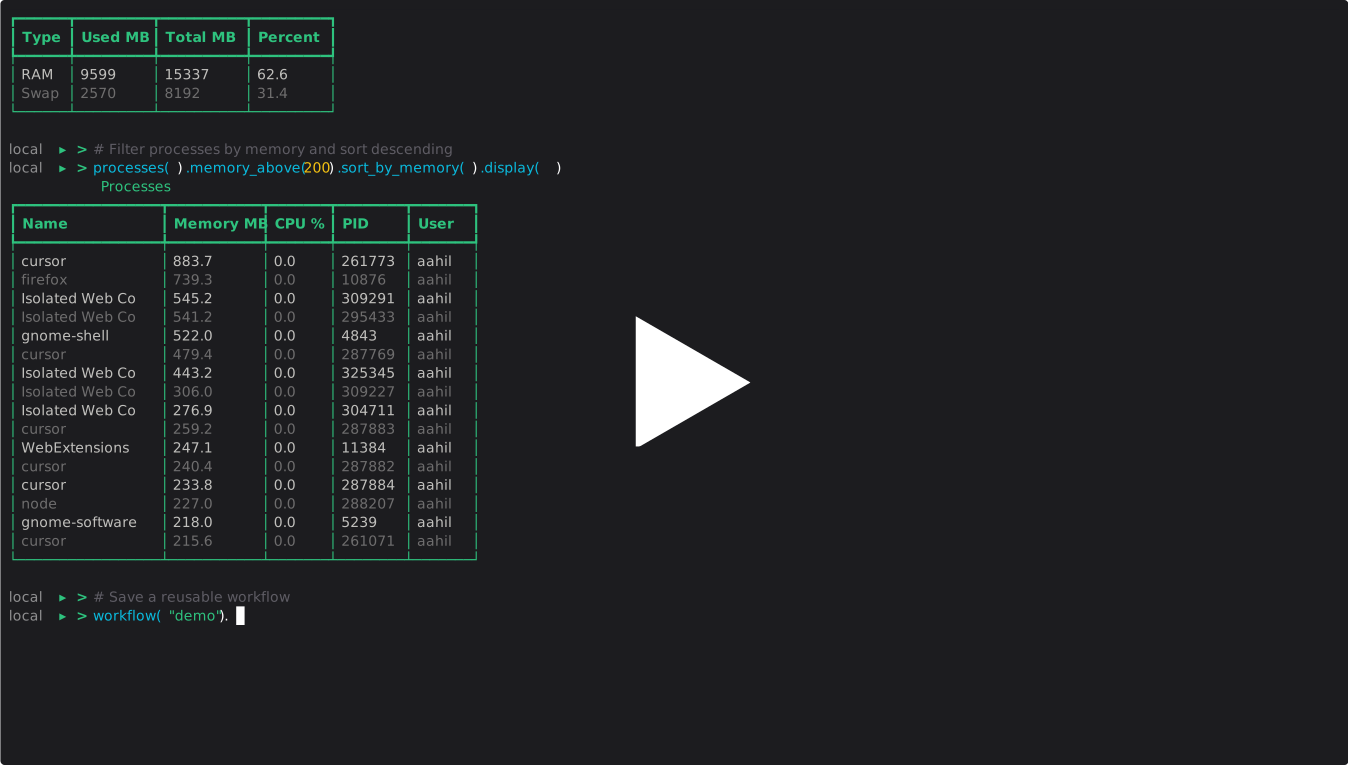
You'll see:
- Host memory and process collections queried through the REPL
- A workflow composed in one line and saved to
~/.serverkit/workflows/ - The same workflow executed on a remote host without changing the JSON
flowchart TB
    subgraph clients [Clients]
        REPL[serverkit REPL]
        PY[Python scripts]
    end

    subgraph facade [Facade layer]
        SRV[Server]
        REM[RemoteServer]
        PROTO[ServerFacade Protocol]
    end

    subgraph domain [Domain collections]
        PROC[ProcessCollection]
        LOG[LogFile]
        WF[Workflow engine]
    end

    subgraph infra [Infrastructure]
        OS[psutil / system tools]
        SSH[Paramiko SSH]
    end

    REPL --> SRV
    REPL --> REM
    PY --> SRV
    PY --> REM
    SRV --> PROTO
    REM --> PROTO
    PROTO --> PROC
    PROTO --> LOG
    PROTO --> WF
    SRV --> OS
    REM --> SSH
| Layer | Responsibility |
|---|---|
| Facade | Server / RemoteServer — single entry point per host (serverkit/core/server.py, serverkit/core/protocol.py) |
| Collections | Eager snapshots + fluent filters + terminal .summarize() / .display() |
| Workflows | JSON schema_version: 2 pipelines; _server injected at runtime for local or remote |
| Shell | Pattern-matched REPL → SDK calls (serverkit/shell/parser.py) |
| Decision | Rationale |
|---|---|
| Facade + Protocol | ServerFacade lets workflows and tests treat local and SSH targets uniformly without duplicating step logic. |
| Fluent collections | Filters apply eagerly on in-memory snapshots; chains read left-to-right; terminal methods make execution explicit. |
| Workflow as composite | Steps are registered strategies (StepFactory); executor walks a shared context dict — easy to add step types without changing the REPL. |
| Thin REPL | Parser maps strings to SDK calls; no embedded Python eval — keeps shell and library boundaries clear. |
| Optional extras | rich, remote, docker, ai as install extras — core SDK stays small; OptionalDependencyError guides installs. |
Tradeoffs we accepted
- Eager snapshots over streaming (simpler mental model; fine for inspection, not for log tailing at scale)
- REPL coverage is a subset of the SDK — scripts are the fully composable surface
- Remote parity is broad but not exhaustive (workflows are authored locally, executed with remote
_server)
REPL — chains map directly to SDK calls:
memory
processes().memory_above(200).sort_by_memory().display()
workflow("audit").processes().memory_above(300).summarize().save()
run audit
Python — same objects, scriptable:
from serverkit import Server

server = Server()
print(server.processes().memory_above(500).sort_by_memory().summarize())
server.workflow("audit").processes().memory_above(500).summarize().save()
server.run("audit")
Remote — Server.connect() returns a facade that implements the same protocol:
with Server.connect("host", user="deploy", key_path="~/.ssh/id_ed25519") as remote:
    remote.run("audit")  # workflow JSON local; execution uses remote _server
More: examples/ · memory_audit.py · remote_audit.py
pip install "serverkit[rich]"    # recommended: SDK + REPL + tables
pip install "serverkit[all]"     # + remote, docker, ai
serverkit                        # interactive shell
Config is created at ~/.serverkit/config.json on first launch. Optional extras, AI, and full REPL reference: User guide.
| Guide | Description |
|---|---|
| User guide | Mental model, SDK, REPL, remote, AI, troubleshooting |
| Examples | Runnable sample scripts |
- Anoushka Awasthi (GitHub)
- Aahil Khan
python -m venv .venv && source .venv/bin/activate
pip install -e ".[dev]"
pytest
Integration tests (live OS): pytest -m integration
MIT — see LICENSE.