

Calibrated decisions for any text.



Website · Demo · Model · Video · Blog
WaterSheep answers yes/no, single-choice, rating and multi-label questions about any text, with a probability for every option.
pip install transformers torchfrom transformers import pipeline
ws = pipeline(model="samratduttaofficial/WaterSheep", trust_remote_code=True)
ws("I was charged twice.", question="Which team should handle this?", options=["billing", "shipping", "support"])| Type | Options | Answer |
|---|---|---|
noul |
none (yes/no) | probability of yes |
choice |
any labels | the best option |
score |
a digit scale, e.g. 1 to 5 |
the expected level |
multi |
any labels, with type="multi" |
every option above the threshold |
Every answer includes a probability for each option.
WaterSheep is an open-source alternative to Jev. Run it as a local server:
pip install git+https://github.com/SamratDuttaOfficial/WaterSheep
watersheep --model samratduttaofficial/WaterSheep --serve
It answers Jev's POST /v1/systemone requests on your machine, and TypeSafe's Python SDK works against it
without code changes:
export TYPESAFE_BASE_URL=http://127.0.0.1:8766Any API key value works locally. Multi-label questions ("type": "multi") work too, as plain JSON.
WaterSheep is independent and not affiliated with TypeSafe AI.
hf download samratduttaofficial/WaterSheep --local-dir WaterSheepOr with Git (requires Git LFS):
git clone https://huggingface.co/samratduttaofficial/WaterSheepThen load it from the folder, offline:
ws = pipeline(model="WaterSheep", trust_remote_code=True)Deploy it as a Hugging Face Inference Endpoint, then:
curl https://YOUR-ENDPOINT -H "Authorization: Bearer $HF_TOKEN" -H "Content-Type: application/json" -d '{"inputs": "I was charged twice.", "parameters": {"question": "Which team should handle this?", "options": ["billing", "shipping", "support"]}}'No install; runs in the browser:
<script type="module">
  import { decide } from "https://samratduttaofficial.github.io/WaterSheep/watersheep.js";
  console.log(await decide("I was charged twice.", "Which team should handle this?", ["billing", "shipping", "support"]));
</script>
With a downloaded copy on your web server, call load({ base: "WaterSheep/" }) first.
Other languages: run onnx/model_quantized.onnx with ONNX Runtime; watersheep.js shows the input format.
pip install git+https://github.com/SamratDuttaOfficial/WaterSheepfrom watersheep import WaterSheep
ws = WaterSheep.load("samratduttaofficial/WaterSheep")
ws.decide("I was charged twice.", "Which team should handle this?", ["billing", "shipping", "support"])decide returns the answer, its confidence and a probability for every option. ask answers several
questions about one text:
ws.ask({
    "state": {"customer": "Priya (premium plan)",
              "message": "Charged twice for order #4411 and the package is 12 days late."},
    "questions": {
        "escalate": {"type": "noul", "instructions": "Should a human agent take over now?"},
        "team": {"type": "choice", "instructions": "Which team should handle this?",
                 "criteria": {"billing": "payments, refunds", "shipping": "delivery problems"}},
        "frustration": {"type": "score", "instructions": "How frustrated is the customer?",
                        "criteria": ["calm", "annoyed", "frustrated", "furious"]},
        "issues": {"type": "multi", "instructions": "Which issues are reported?",
                   "criteria": ["double charge", "late delivery", "damaged item"]},
    },
})| Type | Question | Answer |
|---|---|---|
noul |
yes/no | probability of yes |
choice |
single choice | the option, with a probability for each |
score |
rating scale | the expected level, with a probability for each |
multi |
multi-label | every option above the threshold, with probabilities |
Command line:
watersheep --model samratduttaofficial/WaterSheep --question "Which team should handle this?" --options billing,shipping,support --state "I was charged twice."--serve runs a local HTTP API on port 8766.
pip install "watersheep[langchain,llamaindex] @ git+https://github.com/SamratDuttaOfficial/WaterSheep"A LangChain Runnable, so it fits in any chain:
from watersheep.integrations.langchain import WaterSheepRunnable

route = WaterSheepRunnable("samratduttaofficial/WaterSheep",
                           question="Which team should handle this?", options=["billing", "shipping", "support"])
route.invoke("I was charged twice.")
A LlamaIndex node postprocessor that drops retrieved passages the model judges irrelevant to the query:
from watersheep.integrations.llamaindex import WaterSheepRelevanceFilter

engine = index.as_query_engine(similarity_top_k=10,
                               node_postprocessors=[WaterSheepRelevanceFilter(url="http://127.0.0.1:8766", threshold=0.5)])
Each takes a model (anything WaterSheep.load accepts) or url= for a running watersheep --serve.
For agents, watersheep_tool (LangChain) and watersheep_function_tool (LlamaIndex) answer yes/no and
classification questions with a probability for every option.
| Evaluation | Accuracy | ECE |
|---|---|---|
| In-distribution test split | 77.8% | 0.026 |
| Held-out datasets, not seen in training | 61.2% | 0.043 |
ECE is the expected calibration error (lower is better).
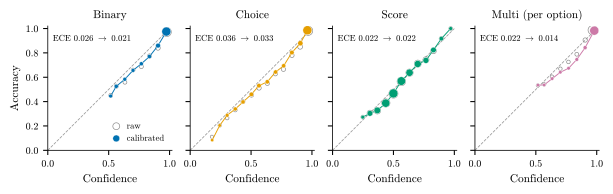
Accuracy against confidence for each question type, before (raw) and after calibration.
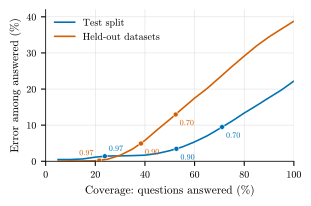
Error among the questions answered when the model only answers above a confidence threshold. The dots mark thresholds of 0.70, 0.90 and 0.97.
| Benchmark | Suite | Questions | Accuracy | ECE | In training data |
|---|---|---|---|---|---|
| goemotions | sentiment | 2000 | 22.4% | 0.023 | other split |
| hatecheck | safety | 2000 | 75.1% | 0.139 | no |
| legal_abercrombie | legal | 95 | 21.1% | 0.316 | no |
| legal_contract_nli_confidentiality_of_agreement | legal | 82 | 69.5% | 0.177 | no |
| legal_corporate_lobbying | legal | 490 | 68.4% | 0.216 | no |
| legal_cuad_audit_rights | legal | 1216 | 86.3% | 0.041 | no |
| legal_definition_classification | legal | 1337 | 56.9% | 0.279 | no |
| legal_function_of_decision_section | legal | 367 | 24.3% | 0.245 | no |
| legal_hearsay | legal | 94 | 56.4% | 0.307 | no |
| legal_overruling | legal | 2000 | 62.5% | 0.151 | no |
| legal_personal_jurisdiction | legal | 50 | 50.0% | 0.160 | no |
| legal_privacy_policy_qa | legal | 2000 | 58.9% | 0.274 | no |
| legal_proa | legal | 95 | 51.6% | 0.379 | no |
| legal_ucc_v_common_law | legal | 94 | 62.8% | 0.171 | no |
| prompt_injection | safety | 116 | 91.4% | 0.079 | other split |
| xstest | safety | 450 | 73.6% | 0.140 | no |
- Base model: answerdotai/ModernBERT-base, fine-tuned with a decision head.
- Data: openly licensed public datasets (listed in NOTICE) and synthetic decisions from Qwen3.5-4B.
- Calibration: a temperature per question type, fitted on a validation split.
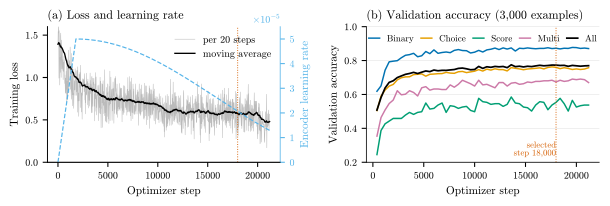
Training loss and learning rate (left); validation accuracy by question type (right).
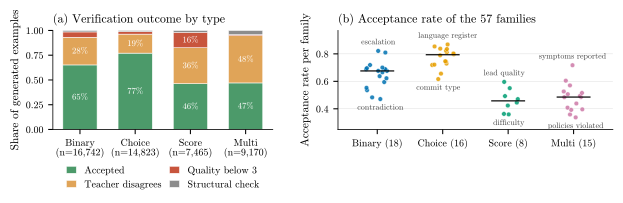
Share of synthetic examples kept after verification, by question type (left) and by family (right).
- English only.
- Long inputs are truncated. The
watersheeppackage and its server mark such answers with"truncated": true. - Rating-scale answers are less accurate than the other types.
- Probabilities are calibrated on data like the training data; validate them on your own.
- Not for high-stakes decisions (medical, legal, financial, hiring) on its own.
git clone https://github.com/SamratDuttaOfficial/WaterSheep
cd WaterSheep
./scripts/run.shWaterSheep can warm-start from an existing WaterSheep export or Hugging Face model and train on local WaterSheep-format NDJSON without copying that data into the repository.
A typed semantic graph can first be projected into relation-completion decisions:
python tools/semantic_graph_to_records.py \
  --nodes /path/to/concepts.json \
  --edges /path/to/relations.json \
  --out /path/to/semantic-records.jsonl \
  --source-name my-semantic-graph
Then fine-tune the published WaterSheep weights on those local records:
python -m watersheep.run \
  --set use_public_sources=false \
  --set record_imports=/path/to/semantic-records.jsonl \
  --set init_model=samratduttaofficial/WaterSheep \
  --set audit_per_source=0 \
  --set synth_target=0
record_imports are explicit local inputs: a missing, empty, or malformed configured import stops the sources stage. The files are fingerprinted
for stage invalidation, and their contents are not added to this repository. Imported records are taken as supplied and are not teacher-audited. The graph converter only
projects edges already present in the supplied graph; it does not infer or verify new semantic claims.
For a serious generalization benchmark, separate held-out semantic families before conversion rather than treating the pipeline's random train/validation/test split as evidence of relational transfer.
Use scripts\run.bat on Windows.
The figures, tables and data are in results/. To remake them after training and
scripts/run-benchmarks.sh (.bat on Windows), run these from the project root with the Python in .venv:
| Script | Needs | Writes to results/ |
|---|---|---|
tools/results/data_stats.py |
a trained model | data/data_stats.json |
tools/results/make_figures.py |
data_stats.py, benchmarks |
figures/, data/synth_outcomes_by_type.json |
tools/results/gen_tables.py |
data_stats.py |
tables/sources.tex, tables/families.tex |
tools/results/bench_table.py |
benchmarks | tables/bench.tex, tables/speed.tex, data/bench_summary.json |
Each uses the newest model unless --model is given.
Apache 2.0 (LICENSE). Attributions: NOTICE.
@misc{watersheep,
  author = {Samrat Dutta},
  title  = {WaterSheep: calibrated decisions for any text},
  year   = {2026},
  url    = {https://huggingface.co/samratduttaofficial/WaterSheep}
}