



Search X from the pi coding agent.
xAI runs x_search on their own servers and hands back a paragraph. The posts
it read do not come back with it, and the citations field the documentation
points at is null in practice, so a client that reads it ends up with a
confident summary and nothing behind it.
pi-x-search asks for the posts' own words, takes the URLs from where they
actually are, and throws out answers that never searched.
pi install npm:pi-x-search
pi install git:github.com/SI-RUI-ZHANG/pi-x-search@v0.1.1
Then ask for what you want:
Find the latest posts from @<handle> about <topic>.
Quote the key ones and include their URLs.
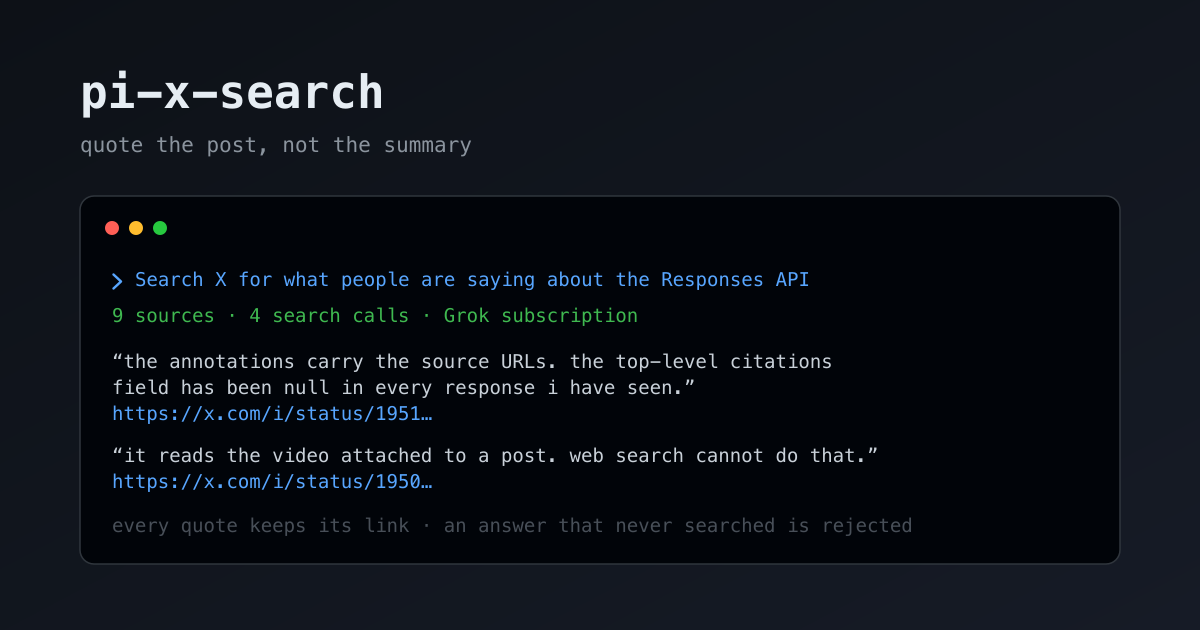
❯ Search X for what people are saying about the Responses API

9 sources · 4 search calls · Grok subscription

“the annotations carry the source URLs. the top-level citations
field has been null in every response i have seen.”
https://x.com/i/status/1951…

“it reads the video attached to a post. web search cannot do that.”
https://x.com/i/status/1950…
The quoted text above is illustrative and the post ids are cut short. Real results carry the full URL.
- Ask. Every request carries the same instruction: answer the question, then quote the key posts word for word with each URL beside its quote. Without it, nothing is ever quoted in full and there is nothing to cite. It also makes the answer shorter rather than longer, because the model stops padding with paraphrase.
- Read. Sources come from the
url_citationannotations on the output text. Reading the documented top-levelcitationsfield instead returns nothing at all. - Check.
usage.server_side_tool_usage_details.x_search_callsrecords whether a search ran. Zero means the model answered from memory, which happened in roughly one run in eight: retry once, then fail instead of passing it off as a result.
The measurements behind those choices, the request contract, and the full failure matrix are in docs/design.md.
| Parameter | Behavior |
|---|---|
allowed_x_handles |
Search only these handles, up to 20 |
excluded_x_handles |
Skip these handles, up to 20 |
from_date / to_date |
Inclusive calendar dates, YYYY-MM-DD |
enable_image_understanding |
Look at images attached to matching posts |
enable_video_understanding |
Look at video attached to matching posts |
A leading @ is optional and duplicate handles are dropped. The two handle
lists are mutually exclusive. Video understanding is specific to X search;
ordinary web search cannot inspect a video attached to a post.
Either path works, and both belong to pi's built-in xai provider.
Grok subscription. Run /login in pi and pick xAI (Grok/X subscription).
pi stores the credential and serializes refresh; the extension only receives the
resolved token at the moment a search runs.
API key. Set XAI_API_KEY before starting pi. A stored subscription login
takes precedence, and a failed refresh or a rejected request never quietly falls
through to the billed key.
Subscription login goes through the first-party CLI's OAuth client id, because
xAI publishes no way for anyone else to register their own. If you would rather
not rely on that, use XAI_API_KEY alone.
The extension never touches the Grok CLI's credential store. xAI's refresh tokens are single-use, so borrowing one would log you out of your own CLI.
- Requests go to
https://api.x.ai/v1/responsesand nowhere else. Redirects are rejected before an Authorization header can follow one somewhere else. - No credential value is logged, returned, or placed in tool details.
- Upstream error bodies are classified by status code and then dropped, so a hostile error page cannot reach your agent's context.
- Response size, JSON depth, and node count are capped before anything is read, and model-facing output stays under pi's 50 KB limit.
- Post text is untrusted third-party content. It is labeled that way for the model, and terminal control sequences are stripped before anything renders.
- xAI does the searching. Recall, ranking, and freshness are theirs.
- The API returns synthesized text and citations, not post objects. There are no engagement counts, no author metadata, and no thread trees; that is the API boundary, not something a client can work around.
- Verbatim is an instruction to the search model, not a guarantee. The URL sits beside every quote so you can check the ones that matter.
Requires pi v0.82.1 or later.
pi-x-search and pi-grok both register a
tool named x_search. Enable one or the other; pi reports the duplicate and
keeps whichever loaded first.
Built on lessons from stnly/pi-grok and
Hermes Agent, which were useful
prior art for pi integration and for xAI's annotation-based citation shape.
Issues and PRs are welcome. Keep the invariants intact: the official xAI origin only, credentials owned by the host, sources taken from annotations, untrusted content bounded, and no answer accepted that never searched.