

Big logs and command output are the expensive part of talking to an AI. tanuki-context makes them 79 to 91% cheaper, keeps every byte recoverable, and tells you when it is not worth doing.




Try it · Set it up · Commands · Is it worth it? · Which model? · Evals · Changelog · Manual
Paste a 200 KB log into a chat and you have just spent about 51,200 input tokens. The painful part comes next: every following turn resends the whole conversation, so you pay for that same log again, and again, for as long as the session lasts. A long debugging session can spend more on re-reading one log than on all the actual thinking.
tanuki-context makes the bulky parts small. It draws text as dense image pages the model can read, or parks it outside the conversation so the model pulls back only the lines it needs. That same 200 KB log costs 10,752 tokens as pages, and 5,264 if the repeated noise is dropped first.
Three things it will not do to you:
- No AI summarising. Nothing is reworded or "condensed" by a model. Error lines survive character for character.
- No lost passwords or ids. Secrets are never drawn as pixels. Exact strings like ids, hashes and MAC addresses always travel as real text.
- No selling you something that does not pay. When plain text is cheaper, it says so and recommends you skip it. It refused to image two of the four real files we pointed it at.
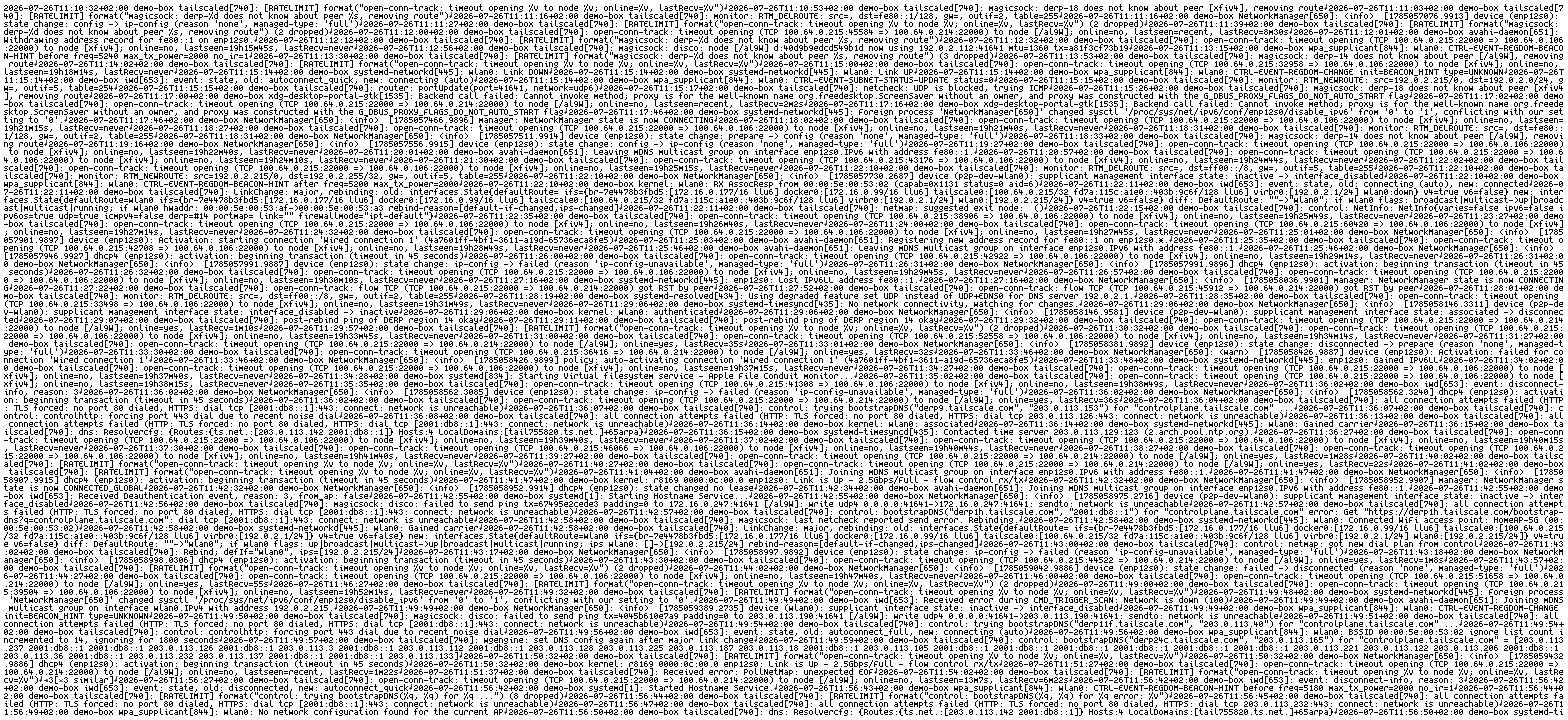
Nothing to install and nothing to sign up for. It renders no images and costs nothing to run. All it does is the arithmetic:
npx tanuki-context estimate your.logHere is a real run on a 200 KB slice of system journal. It comes out at 81,527 text tokens rather than the 51,200 quoted above because this particular journal is denser, and the estimator prices character classes instead of dividing the character count by four:
{
  "rawTextTokens": 81527,
  "imageTokens": 10416,
  "pages": 8,
  "fidelity": { "level": "high", "approxAccuracy": "~98%" },
  "route": {
    "pick": "image",
    "savedPct": 77,
    "reason": "imaging clears the read-back band and beats the text side on tokens"
  },
  "cost": {
    "cheaper": "PIPELINE",
    "textUsd": 1.222905,
    "imageUsd": 0.15624,
    "savedPct": 87
  }
}
You only need four of those fields:
| field | what it is telling you |
|---|---|
route.pick |
The recommendation. image means draw it as pages, text means shrink it but keep it as text, raw means leave it completely alone. |
route.reason |
Why, in a sentence. Worth reading when the answer surprises you. |
cost.cheaper |
PIPELINE or TEXT, in real dollars. Add --model to price it for your model, and --cached if the content is already in the prompt cache. |
fidelity.level |
How reliably a model can read the pages back. high is safe, unreliable means keep it as text. |
Ask for a price against your own model:
npx tanuki-context estimate your.log --model claude-opus-5
npx tanuki-context estimate your.log --model gpt-5           # OpenAI tile rule
npx tanuki-context estimate your.log --model gemini-2.5-pro  # Gemini tile rule
And watch it turn itself down. Two real refusals, both from the command above:
--model claude-sonnet-4-5   (a model measured at 0% on reading pages)
  "pick": "text"
  "reason": "this model reads dense pages at 0% task success while scoring
              100% on the same task as text (EVALS §3) - stay text"

a file containing an AWS secret key
  "pick": "raw"
  "reason": "credential content is never imaged - stay text"
Four ways to use it, and they do not conflict. Most people want the first two together.
| If this sounds like you | Go to |
|---|---|
| I use OMP (oh-my-pi) or pi | OMP or pi plugin |
| I use Claude Code, Cursor, or another app that supports MCP | 1. MCP server |
| I want the model to use it properly without me asking | 2. Add the skill |
| My app cannot be configured, or I do not want to touch it | 3. Proxy |
| I just want to shrink a file or a command's output myself | 4. Terminal only |
You need Node 18 or newer, or the single Rust binary. There is nothing to compile, no dependencies to pull in, and no config file anywhere.
One command installs the tools, the skill, and a router for shell output:
omp plugin install tanuki-context     # oh-my-pi
pi install npm:tanuki-context         # pi
Restart the session. You get all eight tanuki_* tools as native tools (no MCP
entry needed; drop an old tanuki-context MCP server or the model sees both),
the skill below, and the bash router: like context-mode, a bash result
over 8,000 characters from a build, test, or install tool (cargo, npm, pnpm,
yarn, bun, pytest, go, tsc, eslint, make, gradle, mvn, pip, uv, docker, jest,
vitest) is rewritten before the model reads it, through the same rules as
tanuki-context run (crush, distill, errors kept verbatim), with the text it
received stashed and one tanuki_fetch line pointing at it. When omp already
cut the output, the line after it names omp's artifact:// holding every line.
File and diff views (cat, sed, git diff, jq, ...), pipelines, smaller
results and every other tool pass through untouched: distill is lossy, and the
model must not edit from a view with lines missing.
One lossless rewrite applies more widely: a result that is one pretty-printed
JSON document, from an MCP server or a data command (gh, curl, kubectl,
docker, npm, aws, ...), loses its indentation and the spaces between
tokens, line breaks kept (omp cuts a result line at 768 bytes, so no line may
grow). Strings stay byte-exact and numbers are never re-printed, so nothing the
model reads changes meaning: npm view <pkg> --json in a live omp session went
6,885 -> 5,574 chars and parsed back equal. read/write/edit results and
file-reading commands keep their layout.
[tanuki run] exit 3 · 585 -> 15 lines · 97% of chars removed
...
test suite::broken ... FAILED
  ×575 (template)  test suite::case_0 ... ok
stashed: tanuki_fetch {"id":"2ab362e1c9fc","query":"<regex>"} or {"id":"2ab362e1c9fc","lines":"a-b"}
omp cuts every result line at 768 bytes before a hook sees it, and gh api
prints compact one-line JSON when it is not on a terminal, so its answer used to
arrive cut mid-string. A lone gh api ... step (no --jq/--template, no
pipe or redirect) is now rewritten before it runs to
(o=$(gh api ...); rc=$?; printf '%s\n' "$o" | jq . 2>/dev/null || printf '%s\n' "$o"; exit $rc):
the JSON arrives pretty-printed (so no line hits the cap), the exit code is gh's,
and anything jq cannot parse is passed through verbatim. gh api repos/Osyna/tanuki-context
went from one 5,910-char line cut at 768 bytes to 149 complete lines that parse;
.../commits?per_page=3 then shrank 14 % under the lines-kept minify. Needs a
jq on PATH that keeps number spellings: it is probed once, and a 20-digit id
and 1.50 must come back byte for byte (jq 1.7+ and jaq do; jq 1.6 rounds big
ids). Otherwise the step runs unchanged. The rewritten command is what the model
sees in its own tool call.
TANUKI_ROUTE=off turns the router off; TANUKI_MINIFY=off keeps JSON results
indented (hook and proxy) and leaves gh api alone; TANUKI_DELTA=off turns off
the run-to-run delta (below). TANUKI_BIN=/path/to/tanuki-context
runs the tools on the Rust binary instead of Node; the stash is shared, so a
routed output fetches the same on either engine.
MCP is the standard socket for handing an AI app extra tools. Plug tanuki in and the model decides for itself when something is too big, without you prompting it.
Claude Code, one line:
claude mcp add tanuki-context -- npx -y tanuki-contextAny other MCP client takes the same command in its config file:
{
  "mcpServers": {
    "tanuki-context": { "command": "npx", "args": ["-y", "tanuki-context"] }
  }
}
Restart the app, then check it connected:
claude mcp listtanuki-context: npx -y tanuki-context - ✔ Connected
The model now has five tools it can reach for on its own:
| tool | what the model uses it for |
|---|---|
tanuki_estimate |
Price something before touching it. Always the first call. |
tanuki_render |
Draw the text as pages, once estimate says it pays. |
tanuki_stash |
Park a big thing outside the conversation, get back a small map of it. |
tanuki_fetch |
Pull back only the slices it needs: regex search, line range, or free-word find. |
tanuki_verify |
Check a value it read off a page against the original bytes. |
Three more tools (tanuki_distill, tanuki_compress, tanuki_stats) are hidden
by default, because every advertised tool costs you tokens on every single
request. Turn them on with TANUKI_ALL_TOOLS=1 if you want them.
The MCP server gives the model tools. The skill gives it the habits: estimate before rendering, stash anything large, never retype an id off a page, quote errors from the sidecar rather than the pixels. Without it you will find yourself prompting the workflow by hand.
npm i -g tanuki-context
cp -r "$(npm root -g)/tanuki-context/skills/tanuki-context" ~/.claude/skills/
From a git checkout it is cp -r skills/tanuki-context ~/.claude/skills/. The
same file works in any skill-aware harness that reads that directory.
Use this when the app cannot be configured, or when you would rather not touch it. The proxy sits between your app and the model's API and rewrites the oversized parts as they go past. Your app carries on thinking it is talking straight to Anthropic.
npx tanuki-context proxytanuki-context proxy on http://127.0.0.1:8484 -> https://api.anthropic.com
level=0 distill=false codebook=false font=normal recency=1 minChars=4000 ratio=0.75 minSave=300
rules: system prompt & tools untouched · edits spliced into your own request bytes (nothing else moves)
· in-place blocks only · last 1 message(s) kept as text · secrets never imaged
· cache_control blocks never imaged · identical blocks imaged once · imaged prefix marked cacheable
· auto cache breakpoint once the prefix holds · pretty JSON tool results minified (lossless)
point your client at it: export ANTHROPIC_BASE_URL=http://127.0.0.1:8484
Then, in the shell that runs your app:
export ANTHROPIC_BASE_URL=http://127.0.0.1:8484It prints its own rules on startup because those rules are the reason it is safe to leave running. Your system prompt and your tool definitions are never touched. The most recent message always stays as text (a pretty-printed JSON tool result in it loses its indentation, nothing else). Anything holding a secret is left alone. If a transform throws for any reason, your original bytes are forwarded unchanged rather than the request failing.
One rewrite is lossless and applies everywhere, the latest message included: a
tool_result that is pretty-printed JSON loses the whitespace between its
tokens (strings byte-exact). It is the same output for the same input on every
request, so the block never changes under the API's prompt cache.
A rewritten request is your own request with only the changed values replaced,
byte for byte: key order, spacing, escapes and number spellings of everything
else (system prompt, tools, every other message) reach the API exactly as your
client wrote them, in both engines, so an id past 2^53 or 1.50 is never
re-printed. A request that images nothing and holds no pretty JSON result is
forwarded untouched; TANUKI_MINIFY=off turns the JSON minify off. Each block is
minified once per session (a memo keyed by its hash, with a whitespace pre-check
that skips already-compact JSON without a parse): 200 messages of 28 KB pretty
JSON cost 17 % as much on the second request of a session as on the first.
Cache breakpoint (opt-in). With --auto-cache or TANUKI_AUTO_CACHE=on, if
your client never places a cache_control on a message, the proxy adds one after
two consecutive requests whose earlier messages matched (the prefix demonstrably
holds), on the last block before the recency window: never a fifth breakpoint
(system, tools, message blocks and blocks nested in a tool_result all count),
never on a thinking or empty block, never when you placed one yourself.
--no-cache turns off every breakpoint. It is off by default because it has not
been measured against the live API. If your client rewrites the same message on three requests in a row
(a timestamp inside a message, say) the cache never holds; the proxy says so once
on stderr and logs client_break per request.
The events log now carries the estimator's predicted input tokens next to the
billed ones (input + cache_read + cache_creation), and tanuki_stats reports
estimatedInputTokens, billedInputTokens and estimatorRatioPct (100 = the
estimator that gates imaging matches the bill; below 100 it under-predicts).
Client-sent images and unknown block types count 0 in the estimate.
Tool pruning (opt-in). --prune-tools [stub|drop] (or TANUKI_PRUNE_TOOLS) leaves out tools your client advertises but never calls. The proxy counts, per tool, in how many conversations it was advertised and called (names only, in ~/.tanuki/tool-usage.json, filled even while the flag is off). On the first request of each conversation (tool list + first message) it reduces the tools advertised in at least --prune-min (default 20) conversations and called in none, and forwards the same bytes on every later request of that conversation so the cache holds; a conversation that starts after a tool crossed the threshold is pruned too, and since unused tools cross it together the pruned set rarely changes between conversations. stub keeps name, first description line and an open schema, so a wrongly pruned tool still works; drop removes it. Measured with Claude Code and Sonnet 5.5: 38,157 -> 16,675 input tokens per request, cost per session -17 %, 20/20 tasks solved (EVALS 20).
Knobs worth knowing: --auto-cache (or TANUKI_AUTO_CACHE=on) adds the
automatic breakpoint, --distill drops repeated log noise before drawing,
--min-chars 4000 sets how big a block has to be before it is worth touching,
--recency 1 is how many recent messages stay text, --port and --upstream
move it somewhere else.
No AI client involved at all. Useful for shrinking something before you paste it anywhere, or just to see what a file would cost.
npx tanuki-context estimate your.log       # what would this cost?
npx tanuki-context run -- npm test         # run a command, keep the output small
npx tanuki-context stash big.log # park it, get a map backEvery command works with npx tanuki-context <command>, or directly if you
installed it globally.
| command | what it does |
|---|---|
estimate <file> |
Prices the file. Renders nothing. Add --model, --cached, --distill, --codebook, --font tiny. |
run -- <command> |
Runs your command, prints a shrunk version of the output, stashes the full thing. |
stash <file> |
Parks the file and returns a map of it plus an id. |
fetch <id> |
Pulls slices back out with --query <regex>, --lines 40-90, or --find "free words" (BM25-ranked windows: plain language works, rare words outweigh common ones, log synonyms and inflections match at half weight, each window header lists the ask words it matched; never imaged). |
verify <id> <value> |
Checks a value against the stored original. No model involved. |
render <file> [level] [outdir] |
Writes the actual PNG pages to a directory. |
distill <file> |
Prints the text with repeated lines collapsed, errors untouched. |
proxy |
Starts the middlebox described above. |
serve |
Starts the MCP server on stdio. This is the default with no arguments. |
It wraps any command, so long output stops being a problem you have to think
about. Real output from journalctl, with hostnames trimmed out:
npx tanuki-context run -- journalctl --no-pager -n 3000[tanuki run] exit 0 · 3058 -> 1795 lines · 41% of chars removed
stashed e82f2452b264 · 394225 bytes · 3058 lines
distill map: 3058 -> 1795 lines · 41% of chars removable · 370 error/warn lines
top repeats:
×176 Jul 31 08:00:55 tailscaled[801]: magicsock: derp-14 does not know about peer, removing route
×78 Jul 31 08:01:12 tailscaled[801]: open-conn-track: flow TCP got RST by peer
×72 (template) Jul 31 08:00:42 iwd[668]: event: state, old: disconnected, new: autoconnect_quick
first: Jul 31 08:00:38 systemd[1]: Reached target Local Integrity Protected Volumes.
last: Jul 31 08:19:48 tailscaled[801]: open-conn-track: timeout opening to node; online=no
fetch: tanuki_fetch {"id":"e82f2452b264","query":"<regex>"} or {"id":"e82f2452b264","lines":"a-b"}
The exit code is preserved, the error and warning lines are all still there, and
the full 394 KB is one fetch away whenever you want it.
More output types (0.23). run also reads the shape of what a command
printed. NDJSON lines lose the whitespace between tokens (per line, strings
untouched); column-aligned tables (docker ps, kubectl get, ps aux,
df -h, pip list) get one TAB between columns instead of padding (no cell is
ever split; needs 10 % saved); kubectl ... -o yaml|json --show-managed-fields
drops metadata.managedFields (server bookkeeping) and says how many lines went;
terraform plan/apply collapses the Refreshing state... / Reading... /
Read complete progress lines into one count line while every #, +, -, ~
diff line, the Plan: summary and every error stay byte-exact. Rules chain
(cargo+ndjson, table+list-cap) and the full capture is stashed as always.
On real captures: a kubectl YAML dump of 29,863 chars comes back as 572 (0.22.1:
2,847, mostly the first 200 lines of bookkeeping); a terraform plan of 6,085
chars with nothing to change, 352; docker ps 824 -> 560. A document whose
cleaned form is still bigger than the answer 0.22.1 gave falls back to the stash
map, described from the cleaned text, never to a larger answer.
Delta between runs. Run the same command again in the same directory and the
answer leads with what changed instead of repeating itself:
[tanuki delta] vs previous run 9f8c1c7644bb · exit 101 (same) · 1 fixed · 1 new,
the fixed and new failing tests, changed counts (was: / now:), and every
block identical to the previous run collapses to
(same as previous run: 4 lines, fetch id 9f8c1c7644bb). Two npm test runs that
differ only in timings: 2,353 -> 212 chars (2,412 alone; 832 -> 78 o200k
tokens). The previous run lives in the stash, one fetch away.
TANUKI_DELTA=off turns it off. Caveat: a change that only touches a masked token
(a timestamp, a duration with its unit, a 0x address of 6+ hex digits, a test
thread's id in thread 'x' (N)) reads as identical; every other number, counts
in parentheses included, is content. The fixed/new lists rely on test-runner
vocabulary. The stash is capped at TANUKI_STASH_MAX_MB (default 512): past it,
each write deletes the oldest entries down to 75 % of the cap.
This is the part with no fidelity risk at all, because nothing becomes a picture unless the slice you ask for is genuinely enormous.
$ npx tanuki-context stash app.log
stashed a45a0618b179 · 74514 bytes · 1204 lines
distill map: 1204 -> 87 lines · 94% of chars removable · 40 error/warn lines

$ npx tanuki-context fetch a45a0618b179 --query "FATAL"
verify is the backstop for the one thing pixels are bad at. If a model reads a
value off a page and gets a character wrong, this catches it without asking any
model anything:
$ npx tanuki-context verify a45a0618b179 42440ce06042
{"candidates":[],"found":"42440ce06042","line":401,"status":"exact"}

$ npx tanuki-context verify a45a0618b179 42440ceO6042   # the 0 misread as an O
{"candidates":[],"found":"42440ce06042","line":401,"status":"corrected"}

$ npx tanuki-context verify a45a0618b179 deadbeef1234
{"candidates":[],"found":null,"line":null,"status":"absent"}
absent is the important one. It means the model invented the value, and you
found out for free.
Sometimes. Here is the case against, first, because you should read it before you rely on any of this.
| the catch | the measurement |
|---|---|
| Pages need a capable reader | 2 of 5 models tested score 0% on a task they solve 100% of the time as text |
| Exact strings never survive pixels | 0 of 14 test strings came back character-perfect on any model, so they ride a text sidecar instead |
| The money case is capped by caching | cached content bills at $0.30/Mtok, so plain inlining wins the median case by 3.5× |
So the honest claim for imaging is predictable, not cheaper: $0.124 to $0.225 across nine runs, against inlining's $2.94 worst run. And every percentage on this page is input-side. With output measured at 53% of spend, halving your input tokens is at best about a 23% cut to the bill (EVALS §6).
Two capabilities carry none of those caveats, and they are the ones to reach for first:
- Park, fetch, verify is exact by construction. stash, fetch and diff over
19.7 MB of real logs recovered 19,722,893 of 19,722,893 characters
byte-identical.
tanuki_verifyturns a one-character misread intocorrectedwith no model call at all (EVALS §7). - Text reduction has no fidelity risk and no model dependence.
distillcuts a real pacman log 45% and a JSON dump 94%, and the output is still ordinary text (EVALS §4).
The strongest evidence the router is built honestly is that it refuses to sell itself. Pointed at four real files it declined to image two of them, one for credentials and one for being past the read-back cliff.
There are two separate questions here, and mixing them up is the usual mistake. Can the model read a dense page? And what does that page cost on its provider? The second is implemented for three tile rules. The first can only be answered by measuring, and we have measured five models.
Same task, same file, text version against imaged version (EVALS §3):
| model | as text | as pages | verdict |
|---|---|---|---|
claude-opus-5 |
100% | 100% | use pages freely |
claude-opus-4-8 |
88% | 88% | use pages freely |
claude-sonnet-5 |
100% | 88% | use pages freely |
claude-sonnet-4-5 |
100% | 0% | keep it text |
claude-haiku-4-5 |
100% | 0% | keep it text |
Page-reading does not track how good the model is. claude-sonnet-4-5
solves this task every time as text and never as pages, while the older, smaller
claude-opus-4-8 manages 88% at both. No ordering here could have been guessed
from benchmark scores or parameter counts, which is exactly why the next section
asks you to test rather than telling you what to expect. Pass model to
tanuki_estimate and it will refuse to route a measured weak reader to images.
The same 200 KB journal, rendered once, counted by each provider's own rule:
| provider | how it counts an image | image tokens | vs Anthropic |
|---|---|---|---|
| Anthropic | 28 px patches | 10,528 | n/a |
| OpenAI | 512 px high-detail tiles, 85 + 170/tile | 10,880 | +3% |
| Google Gemini | 768 px tiles, 258/tile | 6,192 | −41% |
| anything else | falls back to the patch grid | 10,528 | approximate; set TANUKI_RATES {"default":{...}} |
Gemini's coarser tiles make an identical page notably cheaper to send. That is a counting fact and nothing more. It says nothing about whether Gemini can read the page, which is the question above.
The models below are unmeasured. We are not going to guess on your behalf, and the table above is the reason why.
| model | read-back |
|---|---|
| GPT-5 / GPT-5-mini | unmeasured |
| Gemini 2.5 Pro / Flash, Gemini 3 | unmeasured |
| GLM-4.6 / GLM-4.5V | unmeasured |
| Qwen2.5-VL, Qwen3-VL | unmeasured |
| DeepSeek-VL, Mistral, Llama vision | unmeasured |
The fixtures are committed, so testing one takes a few minutes and needs no changes to the harness. The question is stored beside them, word for word:
This service log has exactly one FATAL panic line - the root cause. Reply with ONLY the component name in its
component=field (the word aftercomponent=, drop any #id).
- Text arm: send
reference/task/seed-11.logwith that question. - Image arm: send
reference/task/seed-11-default/page0.pngplus theverbatim.txtbeside it, same question. - Both should answer
vclock-merger. Ground truth for every seed is inreference/task/answers.json. Repeat acrossseed-23andseed-37.
A model that answers the text arm and fails the image arm is a weak reader, and
belongs in the refusal list. npm run taskqual automates this, but it posts to
the Anthropic API today, so other providers need the manual run above or a
provider adapter, which is a very welcome contribution.
Please open an issue with what you find, including the model id and which seeds you ran. Measured results go into the table above and into the router's refusal list, where they stop other people wasting money.
One sweep, four real corpora (journald log, pacman log, JSON, TypeScript
source), current engine. [calc] means arithmetic at published rates rather
than an end-to-end measurement. Every row is reproducible from the linked eval
section.
| Feature | Applies to | Tokens saved (measured) | Task / fidelity result | Verdict & comment | Evals |
|---|---|---|---|---|---|
| (text-side transforms) | |||||
L1 whitespace |
any text | 0% on all 4 corpora | lossless | Safe no-op. Only pays on ragged or indented text. | §4 |
L2 prose / L3 dense |
prose | 0–0.1% | light/medium loss | Not worth enabling. Irreversible rewording for a tenth of a percent. | §4 |
L4 caveman |
prose | 0–1% | heavy loss | Not worth enabling. Worst trade in the codebase. | §4 |
distill (stage 0) |
logs, noisy output | 30% log · 45% pacman · 94% JSON · 16% TS | keeps every error line verbatim | Best text feature. The only text tier that pays for itself. | §4 |
table (columnar) |
JSON/NDJSON only | 59% JSON · 0% elsewhere | reversible | Excellent, narrow. Keys stated once. | §4 |
codebook (sigils) |
repeated long tokens, paths | image 5,264 → 3,808 (−28% off image) | reversible; confusability guard | Free win, no downside measured. | §4 |
crush knob (0.20) |
big JSON/NDJSON row sets | 94% on 500 rows (96% with table) |
reversible: full set stashed, pointer line names the id | headroom's SmartCrusher shape fused with the stash. Keeps head 10 / tail 5 / every error row. | §12 |
run rule table (0.20) |
dev-command output | 79% weighted on 13 real fixtures | errors kept verbatim; never-worse guard; exit code passes through | rtk's design: success elision + noise rules. Full output always stashed. | §11 |
Hedge rewrites L2+ (0.20) |
hedge-laden prose | hedge-dense fixture: L2 0→27% | README control: byte-identical | caveman's rewrite rules. Fires on hedges, zero effect on technical prose. | §13 |
recommend.crush composed route (0.20) |
row sets, priced on every estimate | 500 thin rows: old route 14,247 tok → 112 (99%); fat rows 44,804 → 1,008 (98%) | selection then table × codebook × pages; probe is pure (stashes nothing); route.reason steers |
The new selection feeding the old imaging walk - neither wins alone on fat rows. | §15 |
| (imaging) | |||||
| Imaging, normal font | bulk you will read | 85–91% vs raw text | capable readers match their own text score (88–100%); 2 of 5 models score 0%; exact strings 0/14 | The headline, and the only conditional capability here. | §2, §3 |
tiny font (4×6) |
bulk you will never read | 91–96% (−40% off image) | 0/5 task, 3/10 needle recall | Cheapest number on the page and it cannot do the job. Lossy-bulk only. | §3, §4 |
distill + imaging |
navigation index | 88–100% | 1/5 task | Locating only, never understanding. | §4 |
| (exactness & safety) | |||||
verbatim sidecar |
ids, hashes, MACs, base64 | costs ~42% of render payload | 100% of at-risk ids over 19.7 MB; 94.5% on never-seen shapes | Essential. It is what makes imaging safe at all. | §7 |
verbatim: "lazy" |
cold, one-shot renders | cuts 42% of payload | no measurable cost win; 97% cache hit | Opt-in. Cached bytes bill at $0.30/Mtok, so cutting them saves the cheapest thing. | §6 |
stash |
content beyond the window | n/a, a capability | 19,722,893 / 19,722,893 chars byte-identical | Flawless. Not an optimisation, a capability. | §7 |
fetch + match-count |
slice retrieval | n/a | retrieval precision 73.3% across 5 strategies | Essential. The match-count marker is the only text route to an aggregate answer. | §10 |
fetch --find (0.20, BM25 since 0.22) |
bare-word and plain-language asks | n/a | 3/3 bare-word answers as text; on a real 6,000-line journal with asks mixing common and rare words, right line first 25/200 vs 11/200 under the old flat count (pure rare-word asks tied); 0.23 adds a small hand-made log-synonym table and light stemming: on 24 asks whose answer shares no whole word with the ask, right line first 3/24 vs 1/24 on a set written blind to the table (19/24 vs 0/24 on the set written alongside it: fitted); nothing else moved | Rare words outweigh the ones on every line; a synonym counts half a direct hit. Never imaged. | §10, §16 |
| JSON minify (0.22) | pretty-printed JSON tool results (proxy, omp/pi hook) | 17-28% fewer o200k tokens one-line (proxy), 11-20% with line breaks kept (hook), on real npm view --json, gh api | jq ., gh run list --json, docker inspect |
lossless: whitespace between tokens only, strings and number spellings byte-exact; cache-stable (same bytes from the first request) | Default on, TANUKI_MINIFY=off to disable. File views never touched. |
this README |
verify |
settling a misread value | ~40 tokens | corrects one-character misreads, no model | Flawless backstop. Covers the sidecar's residual. | §7 |
| Credential gate | secrets | refuses to image | never imaged | Essential. | §8 |
Redaction on fetch |
secrets in returned slices | n/a | 2 false positives in 166,985 lines, both real secrets | Essential. fetch returned secrets as text until 0.18. |
§8 |
dense refusal |
identifier-dense pages | forces text | 2 of 1,393 pages flagged | Correct. Prevents a silently capped sidecar. | §7 |
| Weak-reader gate | haiku-4-5, sonnet-4-5 | forces text | those two: 100% as text, 0% as pages | Essential, but only fires when the caller passes model. |
§3 |
| Filename gate (0.20) | .env*, keys, .aws/... |
refuses render/distill/stash |
deliberately overcautious (secretary-notes.md refuses too); --allow-sensitive overrides |
caveman's pre-flight complement to the content scanner. | §13 |
| Fidelity band | all imaging | n/a | band now agrees with outcome: good ↔ 100%, unreliable ↔ 20% | Honest since 0.19. Previously called distill "degraded" while it solved 1/5. |
§9 |
| Router | every call | n/a | declined to image 2 of 4 real corpora (credentials; past the cliff) | Best evidence the engineering is sound: it refuses to sell itself. | §5 |
| (proxy) | |||||
| In-request dedupe | repeated blocks | repeat → ~283-byte pointer | safe: the first copy still carries pages and sidecar | Keep. | §6 |
| Cross-request reuse | n/a | n/a | rejected: changes the prefix and invalidates the cache it meant to save; also drops the sidecar | Built, measured, reverted. Guard test mirrored into Rust. | §6 |
cache_control breakpoint |
multi-turn conversations | 2.1× / 3.0× / 4.7× at 3/5/10 turns [calc] |
byte-stable pages | Biggest cost lever found. Cache writes are the whole variance story (5.1×). | §6 |
| Fail-open | any transform throw | n/a | survives malformed, astral-plane and null-byte bodies | Essential. A throw used to kill every in-flight call. | §6 |
| Session diagnostics (0.20) | every proxied request | n/a (diagnosis, not savings) | cache-break attribution, never-invoked tool tax, volatile-system-prompt flag; zero forwarded bytes changed | ctxdiff's questions answered live; found a real classifier bug via a Rust panic. | §14 |
| (accounting) | |||||
textTokens (class-weighted) |
every routing decision | n/a | real content median 3.3% / worst 16.2% vs chars/4 at 38.3% / 65.6% (fit against Claude counts); against OpenAI's o200k on the committed command outputs it over-counts by 29% (token-weighted; mean per-payload error 32%), worst on short punctuation-heavy output |
Fixed a 3× error in both directions. Over-counting only makes imaging and minify decisions more conservative. Documented bounds: 239% on pure camelCase blobs; the o200k drift is gated so it cannot grow. | §9, §19 |
| Output-share reporting | every workload | n/a | output = 53.3% of spend | The ceiling: no input-side tool can cut more than 46.7% of the bill. Tightens as the tool succeeds. | §6 |
The three-line version. Unconditional value: distill (30 to 94%), table
on JSON (59%), and stash with verify (byte-exact). Conditional value:
imaging at the normal font (85 to 91%), for a measured-capable reader, for
comprehension, never for exact strings. Not worth enabling: L2, L3, L4,
and both tiny font and distill+imaging when the goal is understanding.
Measured on a 200 KB slice of a real system journal (identifiers rewritten,
repetition and every error line untouched). Reproduce with npm run tiers.
| how the log enters the conversation | tokens | saved |
|---|---|---|
| pasted as raw text | 51,200 | 0 |
| drawn as image pages | 10,752 | -79% |
| noise removed first, then drawn | 5,264 | -90% |
| plus codebook and tiny font | 2,576 | -95% |
Every row is one command on your own file:
npx tanuki-context estimate your.log 0 --distill --codebook --font tinyThe last two rows are lossy on purpose, and measured, they are lossy about
the task as well. On a capable reader the normal font holds 5/5 on the
root-cause task while cutting 76%, distill drops to 1/5, and tiny font
to 0/5 (EVALS §4). Reach for them when you only need
the gist of something, never for a log you will be asked questions about.
- Your model cannot read dense pages. Measured at n=8: Opus-4-8, Opus-5 and
Sonnet-5 match their own text score off pixels (88 to 100%), while Sonnet-4-5
and Haiku-4-5 score 100% as text and 0% as pages
(evals). Pass
modeltotanuki_estimateand it refuses to route those to images. Profile your own withTASK_MODELS=… npm run taskqual. - The exact bytes have to survive. Secrets and credentials are auto-refused
and never imaged, and they are masked out of a fetched slice
(
redact:falsewhen you really do want them). Dense random strings misread silently: even frontier models read back only 0 to 1 of 14 test strings character-perfect (evals). That is why theverbatimsidecar ships ids, hashes, MACs, pod names and base64 as text beside the pages, covering 97% of unrecoverable identifiers across 19.7 MB of real logs and 92.9% against id shapes it was never designed for. - The content is small, or your bill is output-dominated.
tanuki_statsreports the output share so you can tell which one you are. - You are not on Anthropic pricing. Pass
modeltotanuki_estimatefor provider-correctcost(OpenAI tiles, Gemini tiles), overridable withTANUKI_RATES.
Ideas that were built or priced and then declined. A dead end nobody records costs the next reader a week:
tinyfont as a densification lever. 1.67× denser, and 0/5 on the comprehension task where the normal font scores 5/5. It stays what the fidelity band always called it: a lossy-bulk tier, not free tokens.verbatim: "lazy"as the default. The sidecar is 42% of a render's tokens, so deferring it looked like the largest payload cut available. Measured as its own arm it halves cache writes and lifts the hit rate to 97%, and saves nothing outside the noise, because a cached payload bills at $0.30/Mtok, so removing 42% of it removes 42% of the cheapest thing in the request. Lazy stays opt-in, and stays right for cold one-shot renders (EVALS §6).- Sidecar prefix-folding. Factoring shared prefixes out of the carried strings saves 68 tokens, which is not worth a second encoding that both engines have to agree on byte for byte.
- Template dedup inside distill. distill already cuts a real pacman log 70.9%, above the ceiling a naive template-collapse pass was projected to reach.
- In-block frequency for needle detection. It would add 19 to 32 false
needles per page on real logs (
DISCONNECTED,configuration,firmware), enough to tip pages todense, which forfeits imaging outright, all to chase a shape with zero instances across 19.5 MB of real logs (EVALS §7). - Back-off for commands whose output is fetched back. Showing the crushed output whole after repeated fetches cost 3,500 tokens per run against about 500 per fetch it prevented; live it moved billed input +6 % and reduced no fetches. Removed; the fetches are counted instead (
stashNetintanuki_stats, EVALS 20).
- Changelog: every release with the measurement or the decision that caused it, including the ideas that were built and then rejected.
- Full manual: three run modes, all eight tools, stash and fetch, the table knob, benchmarks, internals.
- Design notes: why each pipeline stage exists.
- Evals: we publish the harness rather than a number.
needles(read-back fidelity),paired(cost per successful task),taskqual(task success on pages against text). - Research roadmap: how tanuki maps onto DeepSeek-OCR, Glyph and VIST.
Prior art. ctxdiff by @salmanzafar949 (Apache-2.0), a local-first debugger for the agent context window: content-hashed block capture, git-style turn diffs, prompt-cache break attribution, and detection of tool schemas you pay for on every call but never invoke. It answers what did the model see and what changed; tanuki decides what it sees at all, so the two compose rather than compete. Run ctxdiff around an agent using tanuki and the imaged blocks show up as ordinary diffs. Its fail-open guarantee and schema-bloat framing are the source of the three properties audited in 0.16.1.
More prior art, new in 0.20.0 - each entry is a technique tanuki reimplemented from scratch, measured, and credits:
- rtk (rtk-ai, Apache-2.0): CLI proxy that
filters dev-command output with per-command rules.
tanuki-context runalready followed its wrapper shape; 0.20 adds its rule table - success elision, noise strips, a never-worse guard - measured at 79% weighted on committed real outputs (EVALS §11). - headroom (Tejas Chopra,
Apache-2.0): context-optimization layer. Its SmartCrusher keeps head, tail
and anomalous rows of big JSON arrays behind a retrieval sentinel; tanuki's
crushknob is that shape fused with the existing stash (94-96% on a 500-row NDJSON, EVALS §12). Its CacheAligner volatile-prefix warning became the proxy'svolatileSystemflag. - caveman (Julius Brussee, MIT): telegraphic compression. tanuki's L2-L4 independently converged on the same filler/function-word core; 0.20 ports the rules it lacked - fourteen hedging rewrites (hedge-dense prose L2 0% → 27%) and the filename-based credential gate (EVALS §13).
- context-mode (Mert Koseoğlu,
Elastic-2.0): park-and-search with a BM25/FTS5 knowledge base. tanuki's
stash already followed the park shape; 0.20 adds
find, and 0.22 ranks it with BM25 over lines, reimplemented independently (no SQLite, no code shared; scores are integer micro-points so both engines order lines identically) (EVALS §10). - Laya and
CLM (both Apache-2.0): their
eval gates (a baseline with a tolerance, failing the build on a worse number)
are the shape of
reference/gate.mjs; CLM's typed-state rendering was measured for token savings and rejected (0-14 % more tokens than minified JSON), which is why the JSON rewrite here only drops whitespace.
A model-free gate on committed and seeded inputs fails the build if any of
these gets worse versus reference/gate-baseline.json: run-rule savings per
real command output (chars and o200k tokens, and that each 0.23 rule fires),
delta second-run size, distill size with its planted answers, id catch rate,
find ranking (seeded set and the vocabulary-gap set), JSON minify, proxy saving
(estimator tokens, not billed ones), proxy memo reuse (a warm call rescans nothing), byte-exact splicing and
the automatic-breakpoint schedule, the estimator's drift from o200k, imaging
cost, and speed as a ratio to a fixed workload in the same process.
Model-dependent figures (read-back accuracy, billed tokens) are outside it; a
nightly job (EVALS §18) measures read-back when an API key
is configured, and EVALS §17 compares the run rules with rtk
and context-mode, including where rtk is smaller.
bun reference/gate.mjs runs in CI after the tests; --update records a new
baseline and refuses while anything regressed.
Rust instead of Node. Same engine, one static binary, held byte-exact and pixel-exact with the npm package by a parity harness:
cargo install --git https://github.com/Osyna/tanuki-context --branch rustPolyForm Noncommercial 1.0.0. Personal, research, hobby and noncommercial-organisation use is free. Companies may not use tanuki-context (in products, services, or their internal processes) without a written commercial license from the author; ask via github.com/Osyna. Earlier releases (npm up to 0.20.0, git up to 0.20.1) were published under MIT and those copies stay MIT.
The bundled glyph atlas (assets/glyphs.*) is not covered by these terms: it
derives from the Spleen font, GNU Unifont, and pxpipe and stays under their
licenses; see NOTICE.