


A pump–probe experiment asks how a sample changes after a laser pulse. The laser excites the sample; an X-ray pulse records a diffraction image after a chosen delay. Repeating this at many delays produces thousands of detector frames, not yet a plot of what changed over time.
QoraFlow turns those frames into a time series. It separates shots taken with and without the laser, corrects detector background and incoming-beam intensity, and averages images at each delay. It then tracks how the intensity and position of a selected diffraction peak change with time.
For PAL-XFEL data, the inputs are HDF5 files containing JUNGFRAU detector
images, laser-on/off flags, and QBPM beam-monitor readings. The outputs are
processed image arrays (.npz/.mat), plots, TIFF stacks, and a CSV of
peak measurements. More specific processing steps, including LSB quantization,
are documented in the pipeline.
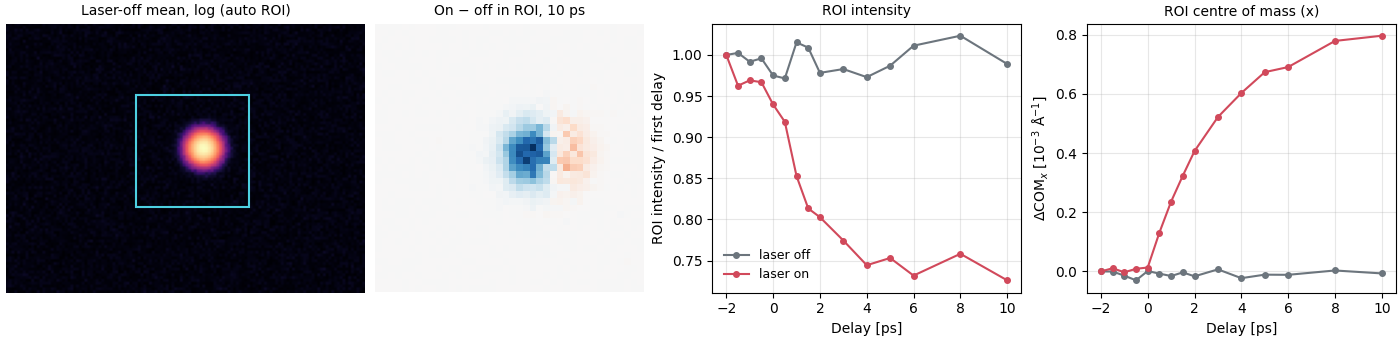
What to look at: the first panels show the reference diffraction image and the change when the laser is on. The plots track the selected peak's intensity and centre position across 15 delays. The input is synthetic: after time zero, the simulated peak becomes 25% weaker and moves 1.5 detector pixels. The example adds Poisson noise, detector background, and beam-intensity fluctuations. Figure script.
The repository ships no measured data. Examples use generated synthetic data;
the paths in config.yaml and the notebooks are placeholders. The dark frame
some notebooks and scripts/temp load is written by:
uv run python examples/synthetic_dark.py # -> notebooks/dark.npy (514x1030 float32)- Run the pipeline: installation and configuration show how to process a PAL-XFEL run.
- Understand each correction: reduction steps explain the dark frame, beam-monitor normalization, and output arrays.
- Check the scope: validation describes the tests and limitations. This repository does not distribute measured beamtime data.
Requires Python 3.11-3.13 and uv.
1. Clone the repository
git clone https://github.com/NaNIsaac/QoraFlow.git
cd QoraFlow
2. Install the dependencies
uv sync --python 3.133. Check the install
Runs the tests; it exits non-zero if anything is broken.
uv run pytest -qRun the scripts from the repository root with src on the path (shown below).
Edit config.yaml in the repository root. The main fields:
runs: [109]
path:
  log_dir: ./logs
  load_dir: /path/to/raw_data/h5/type=raw   # contains run=XXX/scan=YYY/p*.h5
  analysis_dir: /path/to/analysis
  raw_dark_dir: /path/to/dark/run=171/scan=001
  save_dark_dir: ${path.analysis_dir}/dark_images/dark.npy
  output_dir: ${path.analysis_dir}/output_data
  mat_dir: ${path.analysis_dir}/mat_files
  processed_dir: ${path.analysis_dir}/processed_data
param:
  merge_num: 7          # HDF5 files (repeats) merged per dataset
  chunk_size: 100
  pump_setting: 60HZ
  hutch: eh1
  detector: jungfrau2
  xray: HX
  sdd: 1.3              # sample-detector distance [m]
  dps: 7.5e-05          # detector pixel size [m]
  beam_energy: 9        # keV
  x1: 0                 # ROI (pixels) used by analyzing_main.py
  x2: 1
  y1: 2
  y2: 3
${path.x} placeholders are resolved when the config is loaded. Then, from the repository root:
export PYTHONPATH=src
uv run python scripts/make_dark.py          # stack dark frames -> save_dark_dir (averaged when subtracted)
uv run python scripts/integrating_main.py   # raw HDF5 -> processed .npz / .mat
uv run python scripts/analyzing_main.py     # ROI intensity and COM vs delay
integrating_main.py writes one file per preprocessor to
processed_dir/run=XXX/scan=YYY/: run=XXXX_scan=YYYY_LND.npz (LSB
quantization, QBPM normalization, dark subtraction) and ..._raw.npz, each with
pon, poff and delay arrays (pon_delay/poff_delay if the two differ),
plus .mat files per array in mat_dir. The QBPM-normalization ROI is picked
automatically around the brightest region of the middle file.
analyzing_main.py opens a Qt window to select the ROI and reads scan 1 only,
from run=XXXX_scan=0001_LND.npz (change suffix in the script to raw for
the unprocessed images).
The raw files follow the PAL-XFEL layout:
p0110.h5
├── detector/eh1/jungfrau2/image
├── metadata
├── qbpm/eh1/qbpm1
├── oh, oxc, pd
PalXFELLoader reads the frames from image/block0_values and their
timestamps from image/block0_items, sums qbpm1/waveforms.ch1..4/block0_values
per shot, and takes metadata (a pandas table indexed by timestamp) for the
laser-on flag timestamp_info.RATE_<xray>_<pump_setting> and the delay
(th_value, else delay_value; one delay per file). Shots are matched across
the three by timestamp.
To pick an ROI interactively (Qt window; --roi prints the selected rectangle):
uv run python -m QoraFlow.gui processed 109 --roi --log        # from run=0109_scan=0001_LND.npz (--suffix raw)
uv run python -m QoraFlow.gui raw 109 1 110 --roi --vmax 500 # from raw run/scan/p-fileAll test data is synthetic; no measured data ships with the repository.
examples/synthetic_pump_probe/runs the reduction end to end on a scan with a known laser response and compares the ROI curves with it.expected.jsonkeeps the truth (with tolerances) apart from a regression snapshot;tests/test_example_synthetic_pump_probe.pychecks both.- Known limit found by it: the ROI centre of mass reads peak shifts about 4 % low when the ROI holds a background (#28); that check is a strict expected failure until it is fixed.
src/QoraFlow/
  integrator/     HDF5 loader (PalXFELLoader), integration, npz/mat savers
  preprocessor/   dark subtraction, QBPM normalization, LSB quantization
  analyzer/       ROI intensity / center-of-mass analysis and figures
  gui/            Qt ROI selector
  config/         YAML config with pydantic validation
  datacheck/      raw-file size checks and MAD outlier detection
scripts/          entry-point scripts (run from repo root)
notebooks/        exploratory analysis notebooks
examples/         synthetic data generators (README figure, dark frame)
QoraFlow is a refactor of the earlier XFEL_data codebase written by Kim Jooheun (@paulpeterkim), 2021-2023.
See CITATION.cff.
MIT, see LICENSE.md.