Repository navigation
Cached-prefix prefill runs 10-40x slower than a cold prefill on a hybrid MoE model (scheduler spends 90% in _invalidate_prefill_buffer + stream sync) #501
Description

Labels sugeridas: bug, performance
Environment
- FreeToken built from source, commit
b123202(branchwork, includes feat(kvcache): store the KV cache as fp8 e4m3 codes (--kv-cache-dtype… #354 and two local fixes described below) - Model: Qwen3.8-Flash-Next-mixed-FP8 (hybrid GDN + QSA sparse attention, 512 experts/layer, 48 layers)
- Hardware: EPYC 7K62 (48c/96t), RTX 4070 Ti Super 16 GB, 251 GB DDR4-3200, PCIe Gen4
- Server flags:
--memory-ratio 0.92 --max-prefill-length 4096 --moe-cache-size 1024 --ple-backend pinned --max-running-requests 2 --enable-special-token-ckpt --enable-cache-report --kv-cache-dtype fp8 - No KV host offload on this instance (all KV in VRAM, 189,376 tokens)
Symptom
We run WorkBuddy (an agentic coding/chat client) against a single FreeToken instance for
multi-hour sessions. The prefix cache works: every turn matches 82k-170k cached tokens.
But the wall time per turn grows with the cached context, and the client waits 20-150 s
before the first token. Real numbers from the production log (one conversation, same server):
| new tokens | cached tokens | reported input throughput | wall time |
|---|---|---|---|
| 4,096 | 162,944 | 26.9 tok/s | 152 s |
| 1,868 | 93,120 | 12.8 tok/s | 146 s |
| 4,096 | 94,976 | 85.3 tok/s | 48 s |
| 3,231 | 82,880 | 42.2 tok/s | 76 s |
| 4,096 | 101,184 | 261.9 tok/s | 15.6 s |
For comparison, a cold 4096-token prefill on the same server runs at ~1,238 tok/s. So the
per-chunk cost is 10-40x higher when the chunk attends over a large cached prefix.
Profile evidence (py-spy, engine scheduler process)
Captured during a slow cached-prefix turn (4,096 new over ~101k cached), 9,194 samples:
| leaf function | % of samples |
|---|---|
synchronize (torch/cuda/streams.py:254, called from _process_last_data at scheduler.py:314) |
70.1% |
_invalidate_prefill_buffer (moe/offload_cache.py:635) |
20.7% |
replay (CUDA graph replay) |
3.0% |
prepare_chunk_indices |
0.6% |
nvidia-smi --query-gpu=utilization.gpu sampled at 1 Hz during the turn reads 0-3%.
The GPU is idle while the scheduler blocks in _invalidate_prefill_buffer and in the
copy_done.synchronize() wait.
What _invalidate_prefill_buffer does
def _invalidate_prefill_buffer(self, buffer_id: int) -> None:
    slot_start = buffer_id * self.num_experts
    slot_end = slot_start + self.num_experts
    old_ids = self.id_of_slot[slot_start:slot_end]
    self.slot_for_id.view(-1)[old_ids[old_ids >= 0].long()] = -1
    old_ids.fill_(-1)
    self.usage[slot_start:slot_end].zero_()
This runs twice per chunk (once per double-buffer slot). The boolean-mask index
old_ids[old_ids >= 0] produces a data-dependent shape, so every call hides a
device-to-host synchronization. Each of those syncs drains ALL work already enqueued on
the device, which includes the attention over the full cached context. The prefill-overlap
pipeline (copy stream + compute stream) therefore serializes: per layer, the host waits
for the enqueued kernels before prefetching the next one, and the wait grows with the
cached-context length. That matches the profile: ~90% of scheduler time in the
invalidation plus its sync, ~3% doing actual work.
We reproduced the same anti-pattern in a second place:
kvcache/kv_host_offload.py::ensure_write_pages (also a boolean-mask index on a
data-dependent shape, 48 calls per chunk). We patched both locally:
ensure_write_pages: replacedtorch.unique+ boolean indexing with a fixed-shape
Triton kernel (stride samples + one boundary sample per request run). After the fix,
the offloaded-KV path boots with--max-running-requests 2(it previously died at
CUDA graph capture withAssertionError: ensure query of 1340 pages exceeds the 742 physical slots)._invalidate_prefill_buffer: single fixed-shape Triton launch (scatter with a sink
entry instead of the boolean index). The function disappears from the profile.
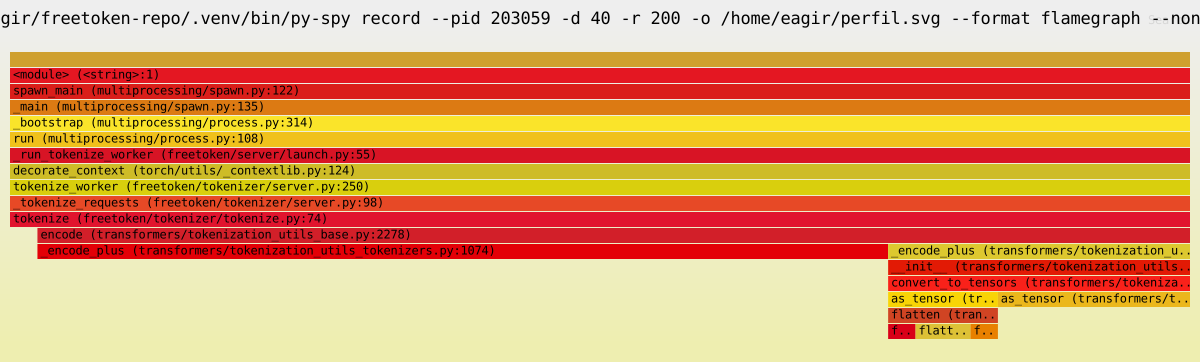
A flamegraph of the engine scheduler during a slow turn is attached
(freetoken-flamegraph-prefix-cache.svg).
Second finding: the tokenizer re-tokenizes the whole prompt every turn
In the same workload, a separate py-spy capture of the cached-prefix turn shows the
scheduler spending 67.7% of its samples in tokenize <- encode <- _encode_plus and
~29% in as_tensor/flatten (tensor conversion), with the GPU at 3.4% utilization.
The client resends the full conversation text every turn, and the tokenizer worker
re-tokenizes all 70k-170k tokens from scratch. An incremental tokenizer prefix cache
(keep the token ids per conversation prefix, tokenize only the delta, like SGLang/vLLM
do) would remove most of that cost for agentic sessions.
Third note: single-request context is capped by the rope table
The KV pool can be sized beyond the model's native context (we measured 424k logical
tokens with --kv-host-pages 5000 --num-pages 1635), but the engine refuses requests
past the rope table:
ValueError: --max-seq-len-override 520192 exceeds the model's rope table (262144
positions). Serving past it would read out of bounds; extend the checkpoint's
rope_scaling
That is reasonable behavior; it just means the extra pool capacity is only usable by
concurrent requests and by the prefix cache, not by a single longer request. Worth
documenting, since "KV capacity" reads like "single-request context".
Related
- hybrid MoE strategy 20-40x slower than offload on an offload-heavy box (24 GB card, PCIe gen 3) #436 (hybrid 20-40x slower than offload on PCIe gen 3; same model family)
- Long-context decode: client wall-clock is ~half the scheduler gen throughput #306 (long-context wall-clock gap)
Questions
- Is the per-layer buffer invalidation required for correctness, or can the two
double-buffer slot ranges be invalidated once per chunk atbegin_prefill? - Would a sink entry in
slot_for_id(one extra id, so the scatter is fixed-shape)
be acceptable upstream? Happy to send the patch. - Is an incremental tokenizer cache on the roadmap?
Engine scheduler flamegraph during a cached-prefix turn (46 s window, 9,194 samples):
Activity