




Celesto gives an AI agent its own computer for running code, browsing the web, and using desktop apps. You can run that computer on your machine during development or in Celesto Cloud for remote and production work.
Each computer is a lightweight virtual machine, starts in about 500 ms, and can keep files and state between sessions. Because the agent runs in a separate computer instead of a process on your machine, Celesto provides a stronger boundary for untrusted code.
These docs use one word for each idea. See the glossary for what "computer", "desktop", and "browser session" mean.

OpenMuse is our open-source computer coworker, built end to end on Celesto. It browses public websites in its own disposable Linux desktop while you watch, approve clicks and form changes, or take control.
OpenMuse is a preview. Clone this repository to run it locally.
On Linux or macOS, this command installs the Celesto CLI and Python SDK, prepares the machine, and checks that it is ready:
curl -fsSL https://celesto.ai/install.sh | bashManual local setup
Install Celesto with Python 3.11 or newer, prepare the machine, then check the setup:
pip install celesto
celesto setup
celesto doctor
On macOS, setup uses Homebrew to install QEMU. On Linux, setup may ask for sudo.
Give the computer a name so later commands can find it:
celesto computer create --name my-computercelesto sandbox remains an equivalent spelling for every celesto computer subcommand. See older names you will still see.
Everything after -- runs inside the computer:
celesto computer exec my-computer -- python --versionDelete it when you no longer need its files or state:
celesto computer delete my-computerUse celesto computer stop my-computer instead when you want to keep it for later. Restart it with celesto computer start my-computer.
Local CLI and Python SDK usage telemetry displays a notice before sending limited
installation and feature counts. PostHog may infer approximate location from the
request IP address. To turn telemetry off, run celesto config telemetry off
or set CELESTO_NO_TELEMETRY=1 in your environment. See the
CLI reference and
privacy policy.
The installer includes the Python SDK. The with block creates a local computer when the block starts and deletes it when the block ends:
from celesto import Computer

with Computer() as computer:
    result = computer.run("echo 'Hello from Celesto!'")
print(result.stdout)Cloud computers do not require virtualization software on your machine. First, set your API key:
export CELESTO_API_KEY="your-api-key"Then run the same Python code with the cloud provider:
from celesto import Computer

with Computer(provider="cloud") as computer:
    result = computer.run("echo 'Hello from Celesto Cloud!'")
print(result.stdout)| Provider | Best for | What your machine needs |
|---|---|---|
| Local | Development, tests, and private workloads on your machine | Local virtualization setup |
| Cloud | Remote tasks, persistent workspaces, and production workloads | Python package and CELESTO_API_KEY |
Celesto commands print readable output by default. Add --json when a script or agent needs stable, machine-readable output. Every JSON response contains ok, command, exit_code, data, and error fields.
Check the machine before accepting work. --strict makes warnings fail the check:
celesto doctor --strict --jsonCreate a named computer and capture the JSON response:
celesto computer create --name agent-job --jsonRun a command without opening an interactive shell:
celesto computer exec agent-job --json -- python -m pytestAlways clean up the computer by its exact name when the job ends:
celesto computer delete agent-job --jsonUse unique names for concurrent jobs. Prefer exec for automation; reserve shell, ssh, and desktop for interactive work. Commands return a nonzero exit code on failure, and JSON errors include a recovery command when Celesto can provide one.
For a coding agent with its CLI already installed, start a preset directly:
celesto codex startCelesto also provides presets for Claude Code, Pi, Hermes, OpenCode, and OpenClaw. See the agent presets guide for credentials, naming, and unattended usage.
Use celesto computer list to see computers, celesto computer logs my-computer to inspect startup output, or celesto computer shell my-computer to open a fast interactive shell.
Add --follow to stream logs. Use celesto computer ssh my-computer when you need an SSH session. See the CLI reference for every command and shell completion.
Celesto exposes one default API and focused APIs for browser and desktop work:
| Runtime | Use it when an agent needs | Python API | CLI |
|---|---|---|---|
| Minimal computer | Commands, code, and files | Computer() |
celesto computer |
| Browser session | Chromium, CDP, screenshots, or a live viewer | Celesto.browser() |
celesto browser |
| Computer with a desktop | A full desktop and multiple GUI apps | Celesto.computer() |
celesto computer create --desktop |
| Windows computer | PowerShell or Windows software | Celesto(os="windows", ...) |
celesto computer create --os windows --image PATH |
| macOS desktop | App or installer tests on Apple Silicon | — | celesto computer create --os macos |
Use Computer for the common minimal computer path. Use the Celesto factories for focused browser and desktop runtimes. Use Celesto(...) directly when you need low-level options such as the backend, communication channel, operating system, shared folders, or network policy.
| Capability | What it provides |
|---|---|
| Fast start | A ready computer in about 500 ms, without an image pull on each start |
| Isolation | Each computer is separate from your machine and from other computers |
| Local or cloud | The same Computer API across development and production |
| Persistent state | Files and state that survive across sessions |
| Shared folders | Read-only or writable access to selected folders on your machine |
| Snapshots | Pause and restore memory, disk, and active processes |
| Network policy | Disable outbound access or allow specific IPv4 ranges on Linux with Firecracker |
| Multiple operating systems | Linux, Windows 11, and macOS preview support |
Use a browser session when an agent only needs Chromium. Celesto exposes a CDP endpoint for automation and, in visible mode, URLs for live view and screen control.
from celesto import Celesto

with Celesto.browser(headless=False) as browser:
    print(browser.cdp_url)
    print(browser.viewer_url)
print(browser.display_url)cdp_url: connect Playwright or another CDP client.viewer_url: watch the browser from another browser.display_url: connect a VNC client or computer-use agent.
Use headless=True when the agent only needs CDP. Start a visible browser from the CLI with:
celesto browser start --liveSee examples/browser_sandbox.py for a complete example.
Use a computer with a desktop when an agent needs to see and use more than a browser. The default image includes Chromium, a terminal, a file manager, and a text editor.
from celesto import Celesto

with Celesto.computer() as computer:
    print(computer.display.viewer_url)
    print(computer.browser.cdp_url)

    computer.files.write("/workspace/task.txt", "Review this file")
    print(computer.run("ls -la /workspace").stdout)
The API groups screen access under computer.display and Chromium access under computer.browser. If Chromium closes while the desktop stays active, call computer.browser.launch().
The first start downloads and verifies the Linux desktop image. Later starts reuse the cached image, so Docker is not required.
celesto computer create --desktop --name assistant
celesto computer open assistant
celesto computer delete assistant --desktop
See the desktop guide for Python and TypeScript examples.
Use a Windows computer when an agent must run PowerShell or Windows software. Celesto can boot Windows 11 from a baseline image, upload files, set environment variables, and start multiple computers from the same image.
from celesto import Celesto

with Celesto(
    os="windows",
    image="~/.celesto/images/win11.qcow2",
    ssh_user="celesto",
    ssh_password="celesto",
) as computer:
    print(computer.run("Write-Output 'hello from windows'").stdout)
Create an image from a Windows ISO:
celesto windows build-image \
    --iso ./Win11.iso \
    --virtio-win-iso ./virtio-win.iso \
    --output ~/.celesto/images/win11.qcow2
Windows computers need a Linux machine with KVM. Shared folders, network controls, and snapshots work only on Linux computers. See the Windows guide for image setup and requirements.
On an Apple Silicon Mac, Celesto can create a temporary macOS desktop for app and installer tests without changes to your main system.
Prepare the reusable local image:
celesto setup --macosCreate and open a desktop:
celesto computer create --os macos --name test-mac
celesto computer desktop test-mac
The first setup downloads macOS from Apple, requires about 50 GB, and takes 20–40 minutes. The image stays on the Mac that created it. Celesto supports at most two macOS computers at once. See the macOS desktop guide for limits, shared folders, and cleanup.
Give a local computer access to an existing project without a copy step:
celesto computer create --name my-computer --mount ~/Projects/my-app
celesto computer shell my-computer
ls /workspace
Shared folders are read-only by default. The computer can read the source files, but writes under /workspace stay inside the computer and do not change the copy on your machine.
Choose a path inside the computer, or share multiple folders:
celesto computer create \
    --mount ~/Projects/my-app:/code \
    --mount ~/data:/mnt/data
Add --writable-mounts only when the computer must change the files on your machine:
celesto computer create \
    --mount ~/Projects/my-app \
    --writable-mounts
The flag applies to every shared folder in that command. Do not combine a writable project folder with a folder that must remain unchanged.
The same option exists in Python:
from celesto import Celesto

with Celesto(mounts=["~/Projects/my-app"], writable_mounts=True) as computer:
computer.run("echo hello > /workspace/from-computer.txt")Copy a config, script, or small input into a running computer:
celesto computer file upload my-computer ./prompt.txt /tmp/prompt.txtOr upload a file to a temporary computer from Python:
from celesto import Celesto

with Celesto() as computer:
    computer.upload_file("./prompt.txt", "/tmp/prompt.txt")
The destination must be an absolute path inside the computer. Celesto replaces any file that already exists at that path.
Computers have internet access by default. On Linux with Firecracker, use vsock to keep command and file-transfer access while you disable outbound network access:
from celesto import Celesto

with Celesto(
    backend="firecracker",
    comm_channel="vsock",
    internet_settings={"mode": "off"},
) as computer:
    print(computer.run("echo hello").stdout)
Use mode="restricted" with allowed_cidrs to allow specific IPv4 addresses or ranges. The restricted modes require private network mode and do not support shared folders or exposed ports. Explicit command output and file downloads still work when outbound access is off.
An allowed_domains list resolves domains during setup and permits the resulting IP addresses. It does not check the hostname on each connection. DNS servers do not receive automatic access. See the network guide for supported combinations.
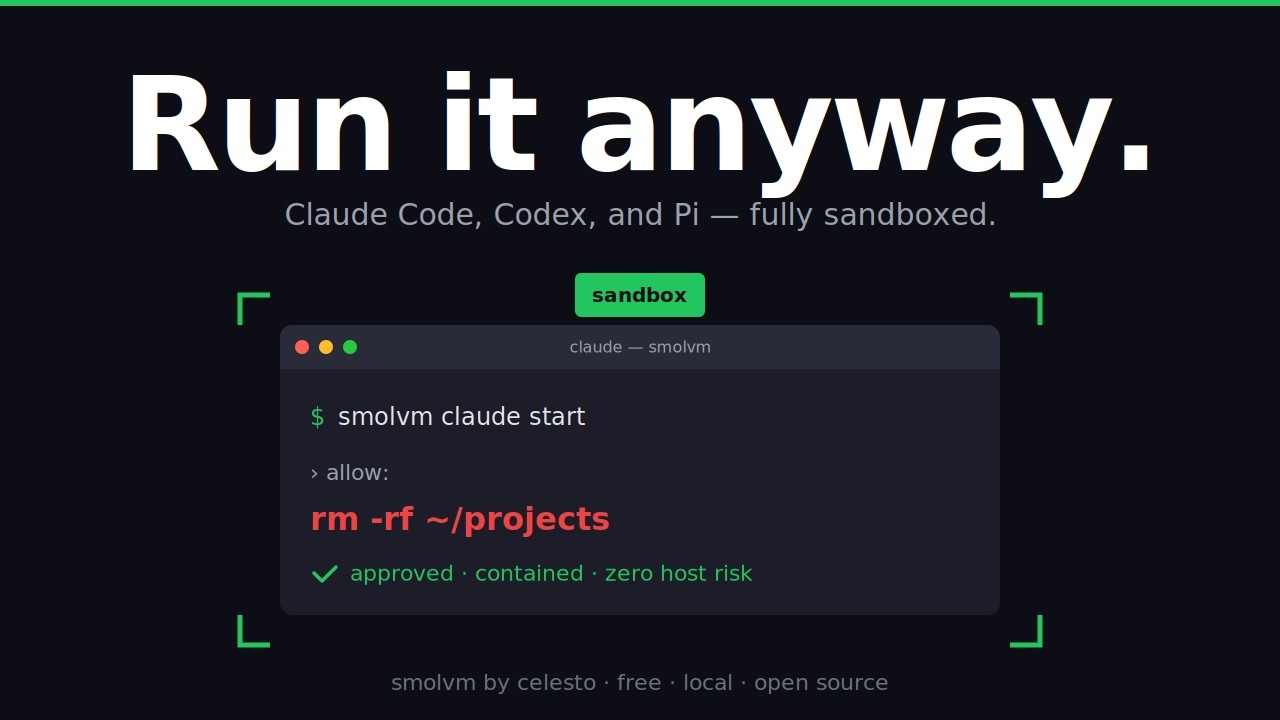
Run a supported code agent in its own computer so it can edit and execute code without direct access to your machine:
celesto codex start
celesto claude start
celesto pi start
celesto hermes start
celesto opencode start
celesto openclaw start --name openclaw-work --no-attach
Open the private OpenClaw dashboard after the computer starts:
celesto openclaw open-ui openclaw-workThe first OpenClaw start can take several minutes while Celesto installs its supported Node.js runtime and pinned OpenClaw release. See the agent presets guide for credentials and dashboard access.
| Goal | Example |
|---|---|
| Run code in a computer | quickstart_sandbox.py |
| Start a browser session | browser_sandbox.py |
| Pass environment variables | env_injection.py |
| Framework or task | Example |
|---|---|
| OpenAI Agents | openai_agents_tool.py |
| LangChain | langchain_tool.py |
| PydanticAI shell tool | pydanticai_tool.py |
| PydanticAI computer across turns | pydanticai_reusable_tool.py |
| PydanticAI browser automation | pydanticai_agent_browser.py |
| Computer use | computer_use_browser.py |
Each example includes any extra package command it requires.
Each computer runs in its own virtual machine, which provides a stronger isolation boundary than process-level containers. Isolation still depends on secure configuration of your machine, the hypervisor, images, credentials, shared folders, and networking.
Celesto trusts a new local computer on its first connection to simplify development. Do not expose computer ports to the public internet without authentication and network controls. Treat writable shared folders, forwarded credentials, and services the computer can reach on your machine as explicit trust decisions.
See SECURITY.md for the security policy, threat model, and disclosure process.
The benchmark suite measures cold start, time to interactive, pause and resume, and snapshot create and restore. It uses the public Python SDK with the native backend for your machine: Firecracker on Linux and QEMU on macOS.
uv run python scripts/benchmarks/bench.pySee the benchmark guide for flags, output, and metric definitions.
See CONTRIBUTING.md to set up a development environment and submit a change. Coding agents should also read AGENTS.md for repository-specific commands, CLI conventions, release checks, and writing guidelines before editing the project.
Apache 2.0. See LICENSE for details.
Built with 🧡 by Celesto AI