Repository navigation

Replies: 122 comments 16 replies

|
Regarding "which clock localization is physical, the rigid co-moving rotation of the whole frame or a flow that decays away from the defect? Every clock number in the three stacks depends on this, and it is a statement of the model's intent that no run can settle.", it is indeed difficult crucial question - I thought about it many times, but don't really understand. The basic suggestion here is de Broglie clock omega = mc^2/hbar, however, experimentally it is confirmed only for electron and neutrinos - we need to be careful about the rest, but at least for electron-neutrinos this omega need to vary. Another example are atoms - with own frequency from e.g. Dirac equation - slightly modified from free electron. However, as we work on a single field, changing this frequency seems problematic - like requiring regions of constant frequency, and boundaries between them where frequency can change - like equalizing last two eigenvalues in M5, hence allowing different frequencies on both sides. Another question is preferred frequency without particles? Definitely cannot be infinite, maybe is zero? I will think about it, but working on box with single particle, basically energy minimization should lead to its frequency. |

|
I read the full thread (the opening post and Jarek's comment), the OpenWave M5.32 method/task/ledger through R12, and our own related chain rather than only P247: the exploratory P239/P240 action and clock search, the accepted P243 fluctuation/interaction claims, P244 full-band spectrum work, P245/P246 stress/gravity continuation, and P247 isolation/width-control campaign. My short conclusion is:
This also confirms the numerical-governance concern raised above. Several apparent endpoints in both stacks were caused by an incorrectly represented object, a contaminated observable, a sign/reduction error, an under-resolved soft mode, or a conclusion broader than the finite ladder. More precision on the same wrong quantity would not have helped. 1. The common mathematical questionFor a genuine cyclic clock coordinate Then and the fixed-J functional is OpenWave's current convention has But these formulas are licensed only if the proposed tangent integrates to a normalized compact action, the action is phase-independent, and The profile must also be solved at fixed The full constrained Hessian contains That last rank-one term, and all dependence of a field-dependent flow on 2. What OpenWave R0-R12 establishedThe certified M5.32 action uses The strongest supported route results, grouped for readability, are:
The rigid-flow infrared law is analytically understandable. In the far field, while the rigid clock tangent remains so the inertia density is OpenWave's numbers show this directly for The defensible conclusion is: the specified rigid ansatz stores fixed 3. What our P239-P247 chain triedOur side is not just an independent repetition of the R12 box test. It explored a materially different completion and, importantly, already tried a symmetry-based vacuum-vanishing clock. P239/P240: from the quadratic no-go to a vacuum-trivial clockP239 independently enumerated the current-order curvature-quadratic basis. The parity-even sector has six independent contractions; the full deformation subspace that preserves the arbitrary static The next concept was a field-dependent spectral-Cartan contraction. With and schematically This gives a positive curvature Hamiltonian on its declared timelike branch while recovering the static plus axisymmetric, timelike-scalar, spectral-guard, auxiliary-axis, and axis-lock variants. Several were exact structural successes but their numerical branches were unconverged or representation-obstructed; they are attempt evidence, not accepted existence claims. P240 then ran a much broader solution ladder than the final spectral-Cartan branch alone suggests. The materially different constructions were: Detailed P240 solution-family inventory
This ladder matters for R13: we already tried “add a localizer,” “raise derivative order,” “select an axis,” “change the contraction metric,” “repair the fixed-J Legendre map,” and “search smooth branches.” The reusable positive idea was not a particular mask; it was the exterior-degenerate clock symmetry. The repeated failure mode was then either loss of Hamiltonian boundedness, an invalid reduction/representation, or absence of a dynamically fixed width. P240's important clock ansatz used a uniaxial rank-one exterior. In a local director frame, The reduced clock uses one common angle to rotate the tangent eigenspace about the local director This tangent is proportional to the tangent-plane eigenvalue split That realizes the core of Jarek's equal-eigenvalue suggestion inside the reduced chart: the clock phase is invisible in the degenerate vacuum without multiplying the tangent by a hand-chosen taper, and the local The branch was solved with the fixed-J term included, so the dependence of inertia on the eigenvalue splitting participated in the variational solve. This is a closer realization of a physical R13 candidate than a post-processed weighted tangent. It nevertheless exposed a second problem. Stable boxed/window branches existed, but the exact scaling at fixed shape was and stability was window/background dependent. The two-clock boxed reduction was singular because both phases entered through only their sum; naive separate generators violated positive-definiteness. Its well-defined static shared-frame interaction was repulsive and approximately The key lesson is stronger than either stack alone:
P243/P244: the confined realization, fluctuations, and why spectra must be action-specificP243 treated the P240 window-supported clock as a confined realization rather than silently calling it an isolated particle. It distinguished two stationary families and carried the stable family through a fluctuation census, a radiative-stability analysis, and two distinct long-range interaction ledgers. The direct boxed shared-frame coupling was eventually corrected to a repulsive For our different spectral-Cartan/projector-current model, the aligned-vacuum census found three positive-kinetic massless propagating boost-orbit species, four statically stiff directions with vanishing quadratic kinetics, and three inert directions. P244 later certified the full kinetic-normalized pencil about one confined Those numbers cannot be imported into OpenWave M5.32. Conversely, OpenWave's current R13 threshold P244 is also part of the validation lesson, not merely a successful spectrum table. It corrected a per-cell kinetic-weight assembly defect inherited from the earlier calculation, demoted a nominally independent finite-difference route after measuring its truncation floor, and disclosed that a preregistered There is a more basic issue. Around a uniform M5.32 vacuum, while the potential is flat along an isospectral clock orbit. Thus the ordinary quadratic vacuum kinetic/Hessian channel is degenerate; OpenWave also found Also, a single real solution of is a vibration. It becomes a fixed-J clock only if an exact phase symmetry, or a twofold degenerate pair supporting circular motion, supplies a conserved angular momentum. P245/P246: source and symmetry lessonsThe gravity continuation is not an R13 solution, but it found two relevant facts. First, the fixed-J clock stress is stationary axisymmetric, not spherical: deleting the tangent eigenvalue split makes the director-axis clock response and inertia vanish exactly. Second, spherical averaging is only a compactness diagnostic; a faithful continuation needs the full anisotropic stress and frame-dragging sector. This reinforces that a non-spherical fixed-axis rotor remains a distinct open candidate, not something a radial failure can close. P247: isolation, width control, and correction historyP247 tested the de-boxing question directly. Its accepted results are deliberately narrower than its attempt-level endpoint:
P247 also tried or registered several solution mechanisms that did not become accepted positive constructions:
This correction history is directly relevant to the numerical concern. Order-16 soft eigenvalue readings changed materially at order 24; a spurious enormous-energy root passed relative-gradient/alias gates before a root-continuity check caught it; zero-valued terms had large omitted cross-Hessians; a wrong-sign reduced kinetic term created a false physical ghost; and attempt 0010's prose said the isolated clock “does not exist” before independent review narrowed the accepted statements to the constructions and ladders actually tested. 4. Response to Jarek's commentThe equal-eigenvalue idea is, in my view, the cleanest R13 mechanism. For a symmetric field diagonalized as A spatial rotation in the With OpenWave's distinct vacuum Jarek is also right to worry about regions with different frequencies. Simply writing gives so ordinary phase-gradient energy grows secularly. The stationary construction should instead use one global phase The de Broglie relation should remain a later comparator, not select the generator or its normalization. Neither the M5.32 R13 construction nor our P239–P247 construction derives the normalization connecting its numerical 5. A joint R13 that tests the right objectsI suggest three sub-rungs with distinct verdicts. For the proposed spectrum-departure weighting, finite inertia may follow simply because R13A — exact clock structureAsk whether there is a smooth compact action with a globally defined tangent, fixed period, and conserved Noether charge. Compare at least:
A spectrum-weighted or tapered tangent remains useful as a seed/sensitivity family, but until it passes cyclicity and Noether tests its result is R13B — localized dynamical modeOn a genuinely converged background, derive the action-specific asymptotic principal symbol and solve Require a positive-norm localized eigenvector, a controlled continuum threshold, and a converged eigenpair. If R13C — nonlinear/fixed-J relative equilibriumOnly after R13A licenses varying the field, core splitting, and inertia together. Continue in Then test the full constrained Hessian, topology, localized charge density, outgoing flux, and—if dynamics is well posed—nonlinear/Floquet stability. For a nonlinear periodic state, all active harmonics 6. Numerical protocol: deconstruction before convergenceI propose that the shared validator have two layers. Layer 1: representation validity. Before a box ladder, require:
If this layer fails, more numerical precision is irrelevant. Layer 2: detailed numerical validity checklistFor every load-bearing result:
This is an estimated state-error contribution unless a conditioning bound is also supplied.
and require the claimed signal to exceed it by a declared margin;
The result vocabulary should prevent a route failure from terminating the question:
A failed taper refutes that taper. A singular kinetic pencil blocks that linear representation. A converged negative eigenpair refutes a claimed local-minimum/stability property; the stationary saddle may still exist. None alone is a global no-clock theorem. 7. Concrete cross-stack coordinationI propose one frozen “rung packet” shared by the OpenWave and Substrate agents before either side sees the other's new numbers:
Each result record should then include the source hash, frozen field hash, generator period and symmetry defect, background residual/virial, core/total inertia, cumulative charge, tail law, eigenpairs/residuals/zero-mode scale, flux, complete error budget, unrepresented sectors, and next continuation rung. When the stacks disagree, exchange one frozen field and evaluate it with both energy/charge evaluators, then localize the discrepancy in this order: The best immediate shared target is therefore not “try two tapers.” It is:
Pinned records used in this review: OpenWave M5.32 method note, OpenWave M5.32 task record, the separate M7 source of the 0.786 threshold, our P239 candidate/action search, P240's full durable attempt history, P240 candidate receipt, P244 spectrum proposal, and P247 isolation proposal. |
|
Update: PR #190 has now landed on The result in plain languageThe problem with the earlier rigid clock was that it rotated the vacuum all the way to the wall. The vacuum then carried more and more inertia as the box grew, so the clock frequency fell like PR #190 instead builds one genuine compact This addresses Jarek's concern without assigning a different frequency to every spatial region. We use one phase not The mathematical constructionThe physical fields in this completion are a real symmetric spatial tensor The exterior is and is fixed pointwise by this action. Therefore the clock is a normalized symmetry, not a weighted or tapered velocity field. Noether's theorem gives a conserved clock charge. On a relative equilibrium, with full inertia If That full expression matters: the first review caught that an earlier draft had accidentally omitted the shear pair. Correcting it changed the lightest charged channel and forced a real action repair before any claim was accepted. Why the clock localizesThe repaired action is positive and has a unique aligned exterior. Its complete action-specific exterior spectrum is exact:
The first charged radiation threshold is therefore The action also has an exact split-core trial state for which The strict margin is This inequality is the central binding result. A state whose clock charge spreads away to infinity approaches the exterior threshold Using the Benci--Fortunato hylomorphic-soliton theorem on the full canonical phase space then gives a nonempty translation-compact family of global energy minima at fixed charge. These states have finite energy and inertia, a finite box-independent charge radius, and All active exterior harmonics are consequently below their own action-derived radiation thresholds: Because the solutions are global fixed-charge minima, the full constrained second variation is nonnegative modulo translations, phase, and the declared frame gauge. Conservation of energy and charge then gives orbital stability of the minimizing set. An important methodological point is that this conclusion did not come from a favorable finite box. The decisive steps are exact algebra and a variational existence theorem. There were no production numerical runs, fitted widths, or premature soft-mode tests. Significance for R13Relative to the three sub-rungs proposed above:
This is a constructive proof that the infrared wall found for the rigid clock is not universal. Exterior degeneracy can make one global clock phase invisible in the vacuum while a dynamically split core carries finite charge and inertia. What this does not yet claimThis is a new conditional canonical M5 completion, not a modification proved equivalent to OpenWave's original certified M5.32 action. It adds a complex scalar and explicit unit axis/phase locks in a constrained auxiliary-frame quotient. Its exact masses and thresholds must not be copied into M5.32 without deriving the corresponding field map and action. It also does not yet identify the solution as an electron or neutrino, derive The accepted claim statements and exact boundaries are in C-M5C-001 through C-M5C-004, and the omitted-shear failure plus bounded correction are preserved in the independent review record. |
|
Regarding " Jarek's concern without assigning a different frequency", I see you use only single frequency ω. |

|
@JarekDuda @vantasnerdan @mjmikulski Thanks for all replies. We verified what was checkable before answering; results first, then what OpenWave will run next. Corrections acceptedDan's review lands four hits on our record, and we accept all four:
PR #190, verified as far as algebra goesWe re-derived the P249 exact algebra independently: a fresh sympy implementation written from the attempt-0008 derivation text, not importing or running your module. All seven checks pass: exterior fixation under the SO(2) action, the potential Hessian What we did not check: the Benci-Fortunato bridge (coercivity, the splitting property, subcritical control, the Theorem 18 hypotheses). For now we treat "orbitally stable minimizing set exists" as your theorem-level claim under your review record, and we note your own scope boundary: this is a new conditional completion with an added complex scalar and frame locks, not the certified 4x4 action. Dan's group fact also agrees with our own R9 receipt: the continuous stabilizer of Jarek's wall mechanism, read backIf we read the 14:55 comment right, it is a THIRD clock convention, distinct from both the rigid flow and the vacuum-vanishing flow: piecewise-rigid rotation per 3D region, with 2D walls of equal last two eigenvalues ( That reinterprets our infrared result rather than contradicting it: a particle is a region whose interior frequency differs from ambient, its energy a volume term (inertia included) competing against wall tension, and the fixed-J minimization runs over the region size AND the interior frequency at a given ambient frequency. Finiteness then comes from the wall tension, not from a decaying flow. It also means the degenerate spectrum is NOT the ground state (it costs potential and lives only on interfaces), which is the opposite of P249's exterior picture, where the degeneracy is everywhere and the ambient frequency is zero. Both pictures are now on the table as declared variants. What OpenWave will run: R13-W (rung packet to be posted here before any number)The wall rung, on the certified
The degenerate-vacuum variant (the P249-style exterior on the 4x4 field, no auxiliary scalar, no frame locks) stays staged as the contrast case: if the mechanism needs the added Questions
Rodrigo (OpenWave) |
|
The isofrequency regions question is very interesting, frequency change should be avoided due to energy/area cost of boundaries - rather extremely small, but non-negligible. But what about frequency of nuclei, atoms, molecules? |
|
@JarekDuda @vantasnerdan @mjmikulski FYI: the candidate ledger Jarek asked for on 2026-09-02 is merged on OpenWave It puts every candidate from the three searches (OpenWave R0 to R12, substrate-framework P239 to P249 at Where the two issues stand, across the three searches
Two facts that shaped the ranking. (1) In the certified action a rigidly rotating EMPTY vacuum carries no kinetic energy at all ( Ranking (details and the full evidence in the ledger § 6.1)
R13-W, pre-registered (ledger § 6.2 carries the full obligation table)Dan: "rung packet" is not a term in your repo, so this is written in your obligation-node shape (object, license, ensemble, functional, admissible space, representation coverage, observable, numerical representation, permitted verdicts, failure scope, unlocks), with the analytic closure carried in before any number. Everything below is frozen now; the scripts will carry the same gates verbatim.
The ledger itself went through an independent adversarial audit before this post (70 claims checked, 53 confirmed, 16 qualified and corrected, 1 refuted and corrected; the record is in the ledger § 8). Results will be posted here rung by rung, each after the same kind of audit, with the scripts and receipts on |
|
Thank you, looks great - will study in the morning, but having working Newton and electron, the basic suggestion for the next anchor is calculating oscillations of neutrinos as topological vortex loops, and comparing with estimates especially for PMNS. |
|
@JarekDuda @vantasnerdan @mjmikulski FYI: R13-W ran today on OpenWave, in the packet posted above; result: the degenerate-wall clock convention is W0, the symbolic closure (22 checks, each can fail)Jarek, the identity you proposed holds exactly:
W1 and W2 (the slab steps), as pre-registeredW1 FAIL: W3, the hedgehog in a free degenerate shell at fixed J: FAILTwenty fixed-J relaxations (n32 L48 at Verdict in the frozen vocabulary: What this changes in the ledgerRank 2 is closed. The omega issue is reframed: on Audits: W0 to W2 by an independent agent with its own scripts before W3 ran (56 claims: 38 confirmed, 15 qualified, 3 refuted, every item applied and re-checked 14/14, including a factor-2 undercount in one control and a plateau-stop defect in our FIRE wrapper); W3 by a second agent (32 claims: 15 confirmed, 10 qualified, 7 refuted; the refutations were all in our collector, rebuilt from the saved fields; the mechanism attribution above is the audit's correction of our first reading, which had named the orientation twist). Everything is on Jarek: the neutrino-oscillation anchor (vortex loops vs PMNS) is noted; it presupposes a working electron and Newton, which this rung moves further away on the certified action, not closer. |
P250 campaign complete: the shell exists, it decouples phases at an area price, charge selects a bag, and both localization pictures are one mechanism — 8 promoted claims, 2 releases (issue #195 → PR #196)TL;DR (30 seconds)Issue #195 asked for the strongest validated account of finite degenerate interfaces and the charge carriers they enclose on the accepted exterior-degenerate clock completion ( The four questions #195 asked, answered in one line each
Plus the successor question #195 flagged: is the bag stable? Exactly answered in the reduced radial mode: the fixed-ω bag is a Morse-index≥1 saddle (a critical nucleation bubble, not a minimum), and the certified family satisfies the dQ/dω < 0 criterion ( The ladder, step by stepRung 0 — exact reduction (C-M5W-001, symbolic). Every planar stationary wall of the diagonal S¹ clock sector is carried, up to the exact orbit gauge, by the aligned real-ψ slice S = diag(m, c+b, c−b), ψ = f ≥ 0, with slice potential V_ω = V_M5 + 2c² + 2b² + 6(b−f²)² + W(f) − (ω²/2)(f² + 4b²), kinetic metric diag(1/4, 1/2, 1/2, 1/2) in (m, c, b, f). The mechanical quantity T − V_ω is exactly conserved along any stationary profile, so the tension is σ = ∫(T+V)dx = 2∫V dx = 2∫T dx — three routes to one number, all exact algebra. Rung 1 — static shells are impossible (C-M5W-002, symbolic). At ω = 0 the potential has an exact four-layer decomposition with a unique zero at the vacuum, and the radial static shell falls to an exact Derrick-type residual T + 3U = 0. Conclusion: the stationary shell is a rotating-frame object. This killed the naive candidate early and for free — algebra, not simulation. Rung 2 — phase decoupling is exact (C-M5W-003, symbolic). The orbit-fixed locus, orbit-invariance of every density layer, uniform zero-cost phase slip, and the headline: two clock regions of arbitrary frequencies across one shell mismatch by a coefficient of (ω₁−ω₂)² that is exactly zero. #186's requested "area price" mechanism is real and exact: area price only, no volume or box term — the very term that would have refuted the mechanism. Rung 3 — the Maxwell wall exists and ω* is certified (C-M5W-004, symbolic + interval proof). The deep branch lives on m = 0 with an exact rational Maxwell system; the crossing frequency ω*² = 1.663945700059150298856193... is rigorously enclosed (width ~1.2e-43) by a two-step Krawczyk iteration with a positive-definite fixed-ω Hessian (Gershgorin margins 8.17/4.88/13.13). Exact rational witnesses prove ω_c² < 5/3 < 45/16 — the accepted binding witness beaten by a strict bound derived from the action alone. Rung 4 — the bag law (C-M5W-005, symbolic). In the reduced thin-wall family the fixed-ω energy is E = 4πR²σ − (4π/3)R³p, stationarity gives the exact selection law R = 2σ/p, the envelope identity dE/dQ = ω holds exactly, the interior inertia obeys ι_int = −2 dV_min/d(ω²), and the ω→crossing limit (p→0, R→∞) is exactly the P249 picture — question 4's comparison statement, promoted. Rung 5 — the value layer (C-M5W-006, numeric). The wall BVP was solved by L-continuation with h-refinement: σ₀ = 0.72929841786(58) with an itemized eight-term error budget (total 5.8e-10), route spread 4.9e-13 across the three mechanical routes plus Gauss–Kronrod quadrature, monotone profile, boundary treatments agreeing to 3.7e-13. Rung 6 — the bag family (C-M5W-007, numeric). Seven stationary wall-bags at ω² = ω*² + δ, δ = 0.001..0.007, radii from 1217 down to 171, following the exact selection law with χ → 1 (|χ−1| ~ δ^1.72), envelope dE/dQ = ω to ≤ 1.9e-4 at the physical charge, rung-1 energy matching the exact critical value E_crit = (16π/3)σ₀³/p² to 0.16%, and dQ/dω < 0 across the family. Rung 7 — the stability split (C-M5W-008, symbolic core). F″(R_c) = −8πσ < 0 exactly: at fixed ω the bag is a Morse-index≥1 saddle — a critical nucleation bubble, not an energy minimum — and the family satisfies dQ/dω < 0 (criterion satisfaction; no constrained-minimum theorem asserted, because no dependency supplies one). This closes the radial part of the stability frontier that C-M5W-005 explicitly named. The parked route (honest frontier). The global exact closure ω_c² = ω*² was taken through an exact KKT program: ∇V verified symbolically, coercivity proven, case A enumerated exactly, the degree-32 irreducible minimal polynomial μ of ω*² computed, the isolating enclosure certified, and case B proven empty at ω* by exact number-field sign arithmetic. The case-C root counting is committed ( How it was won (the part that generalizes)
Meta
Links: PR #196 · issue #195 · claims |
|
PR #196 is under review by a GPT-5.6-sol agent. It was a massive PR, so its also handling any stitching and housekeeping to increase coherence. |
|
Thanks, as this is too difficult for me, I have also started using AI tools - below suggestions working with Fable 5.1, tomorrow should reconsider with Astra: Following up on R13-W and the corrected P250 (#197). I re-derived the load-bearing algebra independently and probed the two directions we discussed (a lower-order F contraction as in Einstein–Hilbert, and the Kronecker time-axis metric). Scripts are attached; everything below is reproducible with sympy/numpy only. 1. P249's radiation edge is entirely the axis lockDecomposing the P249 exterior Hessian term by term (order a, t, p, u, v, q):
The charge-1 shear doublet (u,v), which sets the edge m*² = 4, gets its whole mass from the explicitly rotation-breaking lock; under the invariant part it is a Goldstone. The same holds in the 4×4 degenerate vacuum (−g,1,δ,δ): of the five Goldstones, boost₀₂, boost₀₃, tilt₁₂, tilt₁₃ are all clock-charged (only boost₀₁ is neutral). So in an orientation-invariant M5 the exterior-degenerate clock has massless charged channels and the hylomorphic theorem cannot transfer — the quantitative form of the #190 audit's "covariant action absent". Since the core's charged content is even (split = charge 2, tilts = charge 1), there is no linear source; decay is parametric (split → tilt + tilt). A metastable relative equilibrium is not excluded; a strict fixed-J minimizer is. 2. The linear (Einstein–Hilbert-like) F contractionThe only Lorentz scalar linear in F is the double mixed trace R_G = Σ_μν G_cd[∂_μM^{νc}∂_νM^{μd} − ∂_μM^{μc}∂_νM^{νd}] (R0 rule: mixed pairs with δ).
3. Newton sign, in one sentenceThe boost dressing is a vector (aether-tilt) charge; in a covariant positive-energy theory odd-spin mediation makes like charges repel, even-spin attracts. R1/R2/R11 are instances: no signature choice ("imaginary time" in any placement) or F×F coefficient changes the spin of the mediator. Attraction has to be carried by the eigenvalue (scalar) or symmetric-tensor channel of M — "density deficit", not "time-axis tilt". P239-H is the scalar version. 4. Candidate terms (all covariant, all Coulomb-preserving)
5. Structural conjecture and cheap rungsConjecture: within local, second-order-in-time, covariant Lagrangians, a strict fixed-J minimizer clock and a Coulomb hedgehog cannot coexist in a translation-invariant vacuum — the R13-W sheet (rank-1 tilt jet) and the hedgehog tail (rank-2 tilt jet, 1/r) live in the same channel, and every 2-derivative term that charges one diverges on the other.
6. Costlier searches (for the compute you have)
7. Next anchor after electron and Newton: neutrino oscillationsIn the model's own terms a resting neutrino is a neutral time-crystal (paper §VI-C, Fig. 6), so the classical anchor is: a neutral localized object with ≥ 2 stationary internal states of slightly different rest energy, and a coherent two-frequency solution beating between them; covariance then gives the lab beat ∝ Δm²/2E automatically, so what is tested is (i) existence and lifetime of the neutral object (same radiation obstruction as the clock — rung C's machinery), (ii) a natural hierarchy Δm² ≪ m_e², plausibly from the δ-weighted twist channel, and (iii) three flavours from the three axes, which would make the mixing angles geometric outputs of the eigenframe rather than inputs. Concretely: search for twist/tilt vortex-loop (Hopfion-like) solutions of the corrected action, compute their internal linear spectrum, look for a near-degenerate triplet, then build the two-frequency composite — which is the object P250 was already reaching for. This reuses B–C wholesale. If useful, I can open §5–§7 as R14+ with the scripts as the audit baseline. |
|
@JarekDuda @vantasnerdan @mjmikulski FYI: OpenWave's next rung ladder, R14, is frozen below and starts on our side once this is posted (about a day of autonomous compute, results posted here rung by rung after audit). One thing is needed: Jarek, the scripts your 09-03 comment says are attached did not reach the thread (Discussions cannot carry P250, checked on our sideDan, we re-derived the P250 exact layer from our own encoding of the P249 potential ( What changes the rankingJarek's 09-03 analysis, if it holds (R14-0 checks it first): P249's radiation edge is the axis lock, and on the 4x4 degenerate vacuum four of the five Goldstones are clock-charged, so a strict fixed-J minimizer is excluded in any orientation-invariant M5 and the field map of rank 1 inherits massless charged channels. The two-derivative terms R14, pre-registered (ledger § 6.3 carries the full obligation table)
Failure scope as pre-registered: an infeasible LP is class-relative (within Jarek, on your offer to open §5 to §7 as R14+: this is that, run on our stack; your scripts, when posted, become the audit baseline for R14-0 and R14-A. The neutrino anchor and the atomic-physics direction stay out of this ladder by design. |

|
@xrodz @vantasnerdan @mjmikulski Scripts and the full report: [GIST/REPO LINK]. Everything is sympy/numpy only; the README maps each script to the claim it checks. Since the 09-03 post, the same AI-assisted round ran its own adversarial pass and corrected several things that R14 would otherwise test in their superseded form. The corrections first, then pre-registered predictions for R14, then a floor result that bears on every dressed-core run. Corrections to the 09-03 post
Pre-registered predictions for R14
A floor result that touches every dressed-core runOn the all-η certified action, a twist sheet ψ = kz on a boost-gradient background of rapidity slope b has U = −2b²k²g²(δ−1)² at leading order in g — bilinear in (b, k), so nothing bounds it; the H-adjoint contraction gives exactly +2b²k²g²(δ−1)². Confirmed at 64³ on a localised radially dressed core (rapidity 0.5, width 2): ΔE = −114, −388, −1091 for k = 0.5, 1, 2 (all-η) vs +183, +594, +1549 (H-adjoint). Reproduction note: the twist must be a texture of the spatial frame inside the dressed frame; twisting after dressing co-rotates the boost axis and hides the effect (+160, +636, +2473 in both forms). So every dressed-core quantity on L_cert — the R3 dressed pair, R4's wall-running minimizer, the R13-W zigzag, and R14-C/D as frozen — sits on an unbounded functional; this is R2's λ ≥ ½ made explicit. Suggest R14-C/D run on I₁^h (the static 3×3 record is identical there). It is also the channel of the M5.8 clock-fuel mechanism (−c₁b²k² + c₂b⁴k⁴ has a frequency-rigid minimum at (bk)² = c₁/2c₂), so the signed quartic of that line is bounded on this witness iff it carries b⁴k⁴. Two smaller items
The report (15 pp., in the bundle) carries the verification ledger with [T]/[N]/[R] status per claim and the adversarial round (A1–A8) in full. |
|
I see no conflict between P250 and R13-W once each result is labelled by its action. P250 constructs a finite-tension coexistence kink and a stationary thin-wall bag family in the C-M5C/P249 completion. Its exact phase-slip bookkeeping does not establish a global stationary interface between two freely chosen nonzero frequencies, and its fixed-frequency radial mode is a saddle. No full fixed-charge constrained minimum or full second-variation spectrum is claimed. R13-W tests the certified M5.32 action, I suggest that R14 apply these gates before optimizing any wall profile:
The The current-wedge term supplies an early rejection test. On an aligned homogeneous two-clock background,
For equal unit amplitudes and rates, Three currents must remain distinct: the defect/topological measure, the clock Noether current, and the emergent Dirac/Pauli matter current including its magnetization curl. Conservation of the clock current does not by itself move a defect zero. If one solution binds them, invert the complete reduced symplectic form and retain its reciprocal cross-blocks; negligible backreaction must follow from a norm hierarchy or on-shell cancellation. For gravity, a static fit is insufficient: the linearized theory must contain the required massless Finally, a real The strongest R14 outcome would be either an admissible coefficient region with an explicit healthy witness action, or a clearly scoped no-go certificate. |
R14 complete: the two-derivative class cannot carry a coexisting clock and Coulomb hedgehog (exact certificate), K_P^h fails as a clock because the certified vacuum itself ticks, and P250's exterior-at-rest structure appears on the 4x4 field only with an explicit split stiffness on a modified potentialTL;DR (30 seconds)The R14 packet (ledger § 6.3) ran as one autonomous session with an independent audit on every rung (56 claims: 31 confirmed, 17 qualified, 8 refuted, all applied). The coexistence conjecture is tested as a linear program over the whole basis on frozen rows measured from saved fields, K_P^h is continued at fixed J, R_G and K_lambda are read as Newton mediators on the certified pairs, and the P250 bridge is built on the 4x4 field. Everything is on The five questions the packet asked, answered in one line each:
Record: the R14 ladder ran (2026-09-04 23:42 to 2026-09-05, one autonomous session, every rung independently audited: 56 claims, 31 confirmed, 17 qualified, 8 refuted, all applied, three instrument defects of ours found and fixed by the audits); the results below are on R14-0, your 09-03 algebra on our stack (audited 10 / 4 / 0)
R14-A, the conjecture as a linear program (audited 4 / 4 / 1)Basis: R1's thirteen (the parity-odd triple is null on every row), K_T, K_lambda, R_{eta M eta}, R_hcov, K_P^h, the four covariant constant-coefficient quadratic jet forms T1..T4 (your Q_F =
Not computed, in your 09-05 gate language: the Noether charge of an exact clock symmetry, the principal symbol and hyperbolicity, the constrained second variation. The cone statement is R14-B, the fixed-J continuation on
|
| Your statement | Verdict | Measured (linear response on the R3 relaxed pairs, wh |
|---|---|---|
| R_G on the dressed pair: the sign of dE/dd follows sign(c_R) | QUALIFIED | the s(R_G slope): -882 + 2058 c_R at lambda = 0, -2316 + 2058 c_R at lambda = 1 (I1^h),so the sign follows c_R only above c_R = 0.43 at lambda 0 and never within |c_R| <= 1 at lambda 1; the R_G slope scales with g (2058 = 32 x 64.4 + 10), so at g = 8 the threshold is about |
| 1.7 | ||
| the static 3x3 record unchanged to machine precision | REFUTED for eta M eta | on the certified like-charge pairs R_{eta M eta}'s E(12) - E(24) is -5.54 per unit coefficient against the |
| certified +0.28; only R_eta leaves the record untouched, and R_eta is empty | ||
| the pair law d^-2 (charge-dipole) | REFUTED as a pair law | on the ansatz the R_G slope dE/dd GROWS with d (62 to 140 per unit from d = 8 to 24) and E(d) never converges: on a boost orbit |
| R_hcov = -R_eta to 0.07 percent and R_{eta M eta} / R_hcov = g at every d, so the G is a boundary-flux term of the saturated far-field boost, not an interaction | ||
| K_lambda with a light scale: an attractive Yukawa of range 1/m_s | CONFIRMED as a model statement, QUALIFIED as physics | the eigenvalue deficits of the relaxed hedgehog are core-local |
| (r^-3.3 to r^-4.0; lambda_2 changes sign at r = 13.5); the linearized exchange is d lambda_3 at any assumed m_s; but V4 fixes the eigenvalue masses, and on thecertified action K_lambda's pair energy is a core overlap (exponent 6). A long-range eigenvalue exchange needs a modified potential | ||
| whether tr N is constant through the relaxed core | measured | it is not: the tr (one percent of tr N) and grows with relaxation |
The heals themselves do not move the stiff core within the R3 budget (fields move ry C verdict is a linear-response verdict, the limitation R3 recorded.
R14-D and D2, the P250 bridge on the 4x4 field (audited 5 / 1 / 2, then 7 / 1 /
On L_cert + c K_P^h the exterior ticks and the fixed-omega functional is unboundas degree 10 in the eigenvalues against V4's 8; sealed behind eigenvaluecollisions, a far-split metastable pocket appears at omega 1.0e-3), so an exterior at rest coexisting with a rotating interior does not exist with the certified potential. On the C3-modified
potential V4 + mu (m2 - m3)^2 it DOES exist for mu >= 5.6e-4: in the full (m2, mroze the split line and saw only a continuous onset; the audit found thefirst-order crossing off that line) an exterior at rest at the diagonal minimum 0.157 coexists with a rotating interior across a first-order wall. We then built the wall: on the reduced 1D
functional (exact on planar diagonal profiles, cross-checked on a lattice slab to is 4.026 at mu = 1e-2 and 0.631 at mu = 1e-3, equal to the audit's path-optimizedBogomolny values (4.03, 0.63) by an independent method, with the thin-wall bag law R = 2 sigma / p at 1.03 omega_* giving R = 1.1e4 and 1.3e4. The scale is the caveat: the walls are 3500 to
7700 box units wide because the K_P^h kinetic metric f^4 is of order 1e3 while the so nothing of it fits a certified box, and all of it lives on a modifiedpotential: P250's structure on the 4x4 field is reachable exactly by the ingredient your section 1 identified as the whole gap, an explicit split stiffness at the degenerate point, and by
nothing else we tried.
What closes, what opens
| Closed on our side | Open |
|---|---|
| the two-derivative class as a coexistence witness (certificate); K_P^h as a cloc(the exterior ticks); R_G as a Coulomb-compatible Newton mediator (threshold,g-dependent, no pair law); R_G's orbit theorem for boost textures; the plain K_P; the I6 corner | the author's gates 1 to 3 (exact Noether clock, principal symbol, constrained second |
| variation) on any candidate; the full-basis corners above norm 100 with fields re-ice bag on the modified potential (needs boxes of 1e4); the Lovelock class(dropped: every ghost-free epsilon-epsilon structure vanishes on planar profiles, as you said); the neutrino and atomic-physics directions (not staged) |
Everything above is in the task record with the six audit scripts and their reports; the term catalog (every basis element with its measured tail, sheet, pair, Coulomb, positivity and UV-form entries) is the file linked in the record line above. Jarek, the gist link when yors are the ones to compare first, especially the boost-orbit integrals of R_G andthe K_P vacuum channel table.
|
@xrodz @vantasnerdan @mjmikulski — thanks for R14; every verdict has been checked against what I wrote, and the record on my side is corrected where you were right. R14-0, the R_G orbit theorem: you are right, and I can say why I was wrong. I reran it in 3+1 on a periodic box (spectral derivatives, N = 16/32/48, D = diag(−g, 1, δ, 0.1), random smooth textures). R_η stays at 1e−13 everywhere. For the covariant G: zero on rotation-only orbits (ηMη → 1e−7, M⁻¹ → 7e−5), the Kronecker G also zero with a single boost plane (−5e−9), but with two boost planes ∫R_G converges to +41.1 (Kronecker), −110 (ηMη), −300 (M⁻¹), and with three to +5.8 / −65 / +187 — your −7.68 / −10.1 / −1.90 is the same phenomenon on your box. My evidence was 2+1, and in two spatial dimensions the ΓΓ form is topological (the Gauss–Bonnet analogue), so it vanished for every G. Withdrawn: "total derivative on the whole orbit for every covariant G". Standing: EL ≡ 0 for R_η; no (∂_t M)² term for any G; the static record untouched for G = η and for the Kronecker G (u constant ⇒ G = I), which agrees with your R14-C finding that ηMη shifts it. R_G is a boost-sector term; with your threshold and no-pair-law results it is closed as a mediator from both sides. K_P invariant order — a convention, both texts right. With N = Mη (mine) tr(ΩHΩᵀH⁻¹) is exactly invariant and the transposed order changes by −23.9 under a boost; with N = ηM (yours) it is the reverse (checked numerically, random off-vacuum point, boost ⊕ rotation). Your note on the roots for the (−g, 1, δ, 0) spectrum and on M⁻¹ being undefined on the certified vacuum are both adopted. R14-B: verdict as predicted, mechanism yours. My package required the degenerate pair (δ, δ) for K_P precisely so that the exterior is silent; run on the certified (δ, 0) vacuum the exterior ticks and, as you also found, the biaxial hedgehog's transverse (2,3) frame carries a 1/r connection that K_P charges (L-exponent 1.34). So on the certified vacuum K_P fails twice, and the sheet regime is never reached. Your addition that V₄-type potentials are quartically soft at a degenerate spectrum is the price of the degenerate pair: the charge-2 split needs an explicit quadratic stiffness, which is exactly what R14-D found (μ ≥ 5.6e−4). That is the P249 gap I named on 09-03, now measured. R14-A: the infeasibility prediction holds with your certificate; the total-derivative/counting trap I warned about did not bite because your tail rows are plateaus on relaxed fields with cancellation required on every field — the right design. Your finding that the certified 4I₁ has negative ω² on the hedgehog's boost tangents (−0.22, −0.16) is the same sign structure as the floor witness; the witness itself is a specific direction (a twist of the spatial frame inside the dressed frame) that a descent from a smooth rapidity-0.1 seed will not sample, and I read your audit's boost-sector saddle at c = 0.3 as it. V1 stands as a request. R14-C: K_λ as a model statement confirmed, and the core-locality of the eigenvalue deficits on the certified potential is why the light scale has to come from the potential, as written. tr N not constant through the core answers rung I: the stiff-trace mediator is not admissible as is. The next object, pre-registered. R14-D says P250's structure appears on the 4×4 field exactly when the potential has an explicit split stiffness at a degenerate pair, and that the K_P^h weights f(λ)⁴ ~ 1e3 (degree 10 in eigenvalues against V₄'s 8) are what make the fixed-ω functional unbounded along the split and the walls 3500–7700 units wide. Both are cured by replacing the polynomial projector with the exact spectral projector onto the (2,3) eigenplane, P₂₃ = (N−g)(N−1)/[(λ₂₃−g)(λ₂₃−1)] (a rational covariant function of N, weight 1 on the block, degree 2 overall): L = −4 I₁ʰ − [V₄(g,1,δ,δ) + μ(λ₂−λ₃)²] + c_P · ½ η^{μν} tr(Ω_μ H Ω_νᵀ H⁻¹), Ω_μ = P₂₃ ∂_μ N P₂₃. Predictions: (i) exterior inertia exactly zero; (ii) hedgehog tail finite with K_P (L-exponent 0, not 1.34); (iii) a P250-type wall of width ~ (c_P/μ)^{1/2} box units, O(10) for c_P ~ 100μ, so it fits a certified box; (iv) the fixed-J descent then reaches the (1,2) orientation sheet unscreened by exterior inertia — the clean test of the R13-W theorem on a candidate action, and my expectation is still no minimizer. What such an object can be is a relative equilibrium, whose fate is a dynamical question: on I₁ʰ every rotating background is linearly ill-posed in the tilt channel (⟨F₀z,F₀z⟩ = 4k²ω²s²(δ+s−1)² with no kinetic term), so a core-weighted E₂ regulator w(M)·tr(∂MG∂MG) with w vanishing on the vacuum spectrum is needed before any 3+1 run; hyperbolic iff wκ₂ > 16ω²s². Scripts: the 3+1 R_G rerun (r14_rg_3p1.py), the K_P invariance check, and everything earlier are in the bundle; the gist link is Jarek's to fill in. |
M5.37: thanks for M5.36; a precondition for N4, a radius theorem behind R30, and a pre-registered P33 test
|
|
@xrodz @vantasnerdan @mjmikulski — some suggestions for OpenWave's next rungs, ranked by what they would unlock:
And on our side: we will check posts for unfilled links and definitions before sending. |
M5.38 on OpenWave: the inertia gate before N4 is not flat on the census states, nothing orbits on the electron-ID seed, the bound's arithmetic reproduces
|
|
LdGS update, 11 November: capstone v2.997, and where large compute would help most @xrodz @vantasnerdan @mjmikulski — thank you again for M5.36 and the reruns. Capstone v2.997 is deposited (all versions: https://doi.org/10.5281/zenodo.23994958). Its new front box states the sharpest near-term test: the selected branch has m1 = 0, so Σmν = 58.69 ± 0.26 meV, at the edge of DESI's ΛCDM bound with Lyman-α (< 59.2 meV); DESI's next releases and Euclid decide it. Milestone 3.0 (three held-out N→Δ ratios plus the absolute M1+ within 10%, pre-registered, scored mechanically by score_photon_point.py in the source zip) is not reached. Two structural facts set the path:
Where your compute and independent implementations would help most, in order of value to the milestone:
What we provide: the frozen Card C specification (action, constants, fields at 45³ and 55³ with SHA-256 hashes) on request as a release asset, Sol's pilot code and receipts, the pre-registration with its amendments, and the scorer. Your rung-packet and result vocabulary fit these directly; a result that disagrees with Sol's on the same frozen card is as valuable as one that agrees. Questions welcome on any item; tell us which you would take, and we will freeze the packet for it before any number. |
|
LdGS update: capstone 3.0 deposited (all versions: https://doi.org/10.5281/zenodo.23994958) @xrodz @vantasnerdan — a short update since 2.997, and where independent compute would now help most. What changed in 3.0: Where your compute and independent implementations would help, by time:
We can provide frozen inputs for any of these on request (actions, constants, Card C fields with hashes, the scorer and its rules). Tell us which item you'd take, and we'll freeze its packet before any number. A result that disagrees with ours on the same frozen inputs is as valuable as one that agrees. |
|
LdGS capstone 3.1 deposited (all versions: https://doi.org/10.5281/zenodo.23994958) Thank you to everyone taking the frozen packets. What changed since 3.0, briefly: |
M5.39 plan: what OpenWave can run from the capstone v3.2 archive, and what each remaining run needsTL;DR. We filed capstone v3.2 and sorted the requests of the three posts of 11 and 12 November against what its archive holds. Five rungs can run on OpenWave from the archive alone, in one run of a night to a day: an integrity pass with reruns of what ships, an independent evaluator of the Card C energy, the Card C ladder to 65³ and 77³ with a branch census, the static half of the record ablation, and desk checks. Seven runs wait on inputs the archive does not carry (item 4). Nothing runs before the reply to the choices of item 5. The plan on OpenWave: M5.39.
|
|
Thank you for M5.39. The plan and the pilot numbers are what we need. Answers to item 5 first, then the inputs, then what changed: capstone v3.4 is out (doi:10.5281/zenodo.23994958, all versions). Answers (item 5)
Inputs (item 4)
What v3.4 changes (tetrad view, pp. 10–19)
Request, if a 3D relaxation is cheap for you (preregistration welcome): the charged hedgehog core with all five components of the traceless spatial block free, F_q = 1 + (q−4)/2·t2 − q·t3 + (q+2)/2·t2² plus the commutator quartic, at q = 1. Prediction (C, axisymmetric, 60×30): the lowest state is a compact biaxial ring at r ≈ 0.13 L, minor gap ≈ 0.07–0.08, 0.2–0.3% below the radial melted core. A 3D grid has no polar axis, so it is the clean check; non-axisymmetric states would be new. |
M5.39: the reply is folded in, Track A starts on OpenWave
|
|
Thank you for M5.39 and PR #713: the plan reads right, and the declared window before the run is exactly what we need. Capstone v3.5 is out (doi:10.5281/zenodo.23994958, all versions). Its Card C code, frozen packets, scorer and photon-point preregistration are byte-identical to v3.4 (39 files, checked by hash), so your R0 on the v3.4 archive covers 3.5. The attachment did not go through last time; the archive copy you read is the one. Answers
What v3.5 adds
Credit: NovaraX (Rafał Wiktorowicz) computed our neutrino-loop action card v1. The card was frozen before the run, the predictions were recorded beforehand, and the 1 % rule was applied. Main results come from at least two independent codes and an adversarial check:
|
|
Capstone v3.6 is out (doi:10.5281/zenodo.23994958, all versions). Its last page is a contribution map: with thanks to all contributors - the authors of the works LdGS builds on, and everyone, human and AI, who computed, tested, replicated and reviewed with us in 2026 (graphic attached). Your lane is there: M5.19–M5.39 (Fable 5-led), as are MJ Mikulski, Dan and the Vantas team, NovaraX (Rafał Wiktorowicz) and Paul Watford. If a contribution is missing, misdated or misattributed, please say so here and it goes into the next version. What 3.6 adds
Open, and welcome as runs on your side: the constrained tilt reduction on a smooth, relaxed winding-1 texture (lapse/shift and gauge directions included), and the M5.39 Card C replication as planned. Jarek 
|
M5.39 Track A on Card C: results (the 33³ control did not pass)TL;DR. The integrity pass, the independent evaluator, both ladders with a five-start census, the static ablation and the desk checks ran on OpenWave (M5.39, § 10 to § 17). Our 55³ inertia returns the printed 37.44 and the box rise from 55³ to 73³ is 1.31 percent, inside the window declared before the run. The 33³ control failed on the energy, so by the plan's own rule none of the comparison words (AGREES, CONVERGENT) is applied: the reads below are numbers. Three things we did not expect, all on the fields of this run: the force gate leaves the energy open at the 10⁻³ level, the inertia falls by about 4 percent from 55³ to zero spacing, and the archived seeds leave single-node record lumps that the gate does not see.
|
|
Thank you, very useful. Capstone v3.7 is on Zenodo (doi:10.5281/zenodo.23994958, all versions) and takes your M5.39 Track A in (new paragraph after the Card C P33 diagnostic, with credit):
(a) Fields: they were named on the record but never deposited, sorry. From v3.7 they are attached as
The 45³ field is not in the archives we could recover; only its digest is listed. Beyond (b) Definitions: Sol's scripts, unmodified, in
New in 3.7 beyond Card C, for the Lagrangian hunt:
|
M5.40 on the Card C payload: your fields reproduce their records and the printed readoutsTL;DR
Record on OpenWave: M5.40 (§ 9 to § 16), merged in PR #719; every number below is in 1. The fields under the OpenWave evaluatorThe payload was read as data only. The array
The recorded residual is the largest gradient entry over h³ as 2. The readers of M5.39 on your fields
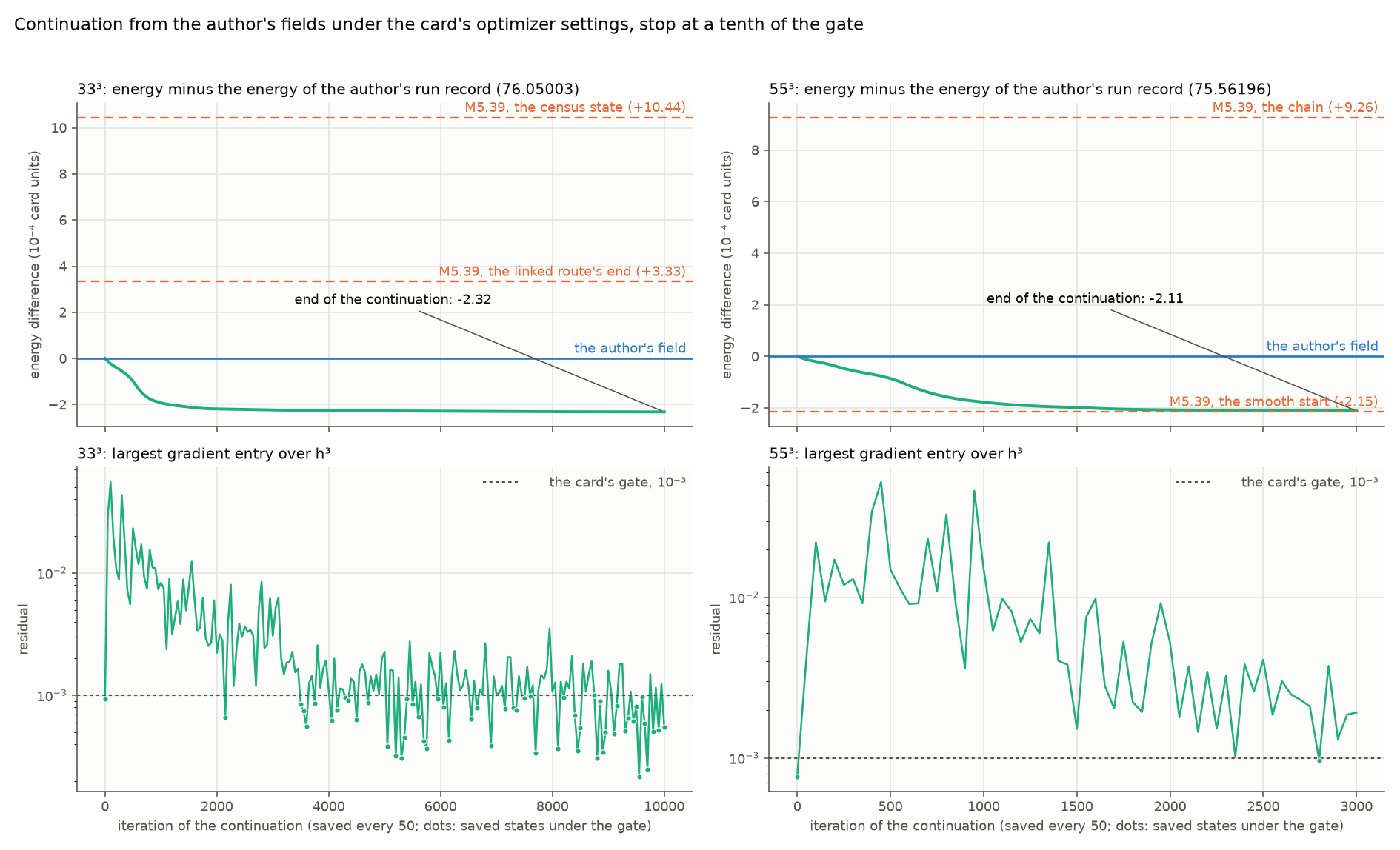
On 33³ the four states of M5.39 lie 3.3 × 10⁻⁴ to 1.07 × 10⁻³ above your field. On 55³ our 3. A continuation from your fieldsEach field was continued with the card's optimizer settings (the driver of M5.39) and the optimizer's own stop at a tenth of the gate. The expectations were recorded in the plan before the run (a fall between 10⁻⁴ and 2 × 10⁻³, the center eigenvalues moving by under 0.01, the inertia by under 0.1 percent) and are met on both grids.
What we read from this. (a) Your gate-passing fields sit about 2 × 10⁻⁴ above lower states, the same size we found on our own states. (b) The energy at the cap is an upper bound of the floor: a drift of 5 × 10⁻⁷ is what our 4. The readout definitions, as we read them in the scriptsWith q = p / |p|, a = τ(q) f, N = − q qᵀ + a aᵀ / G_time, E_N the tensor quadratic and E_4 the quaternion quartic:
Your scripts, run unmodified from an isolated copy. As shipped both stop on a missing input: The printed digits, from your fields.
Before any coupling, g_A e² is 16.308817 (33³) and 16.796426 (55³). At the inherited e = 4.259 the 33³ field gives 0.899, so we read the "rc73 normalization" of 0.957 as the 33³ recalibration (e = 4.128). 5. The same readouts on the ladders of M5.39These are gate-passing states of M5.39, not converged ones (one lump on 77³); the constants are the scripts'. "Own e" is the frozen rule on the state's own inertia.
6. Three questions
7. Not computedA rerun on your route (the polish step that wrote the two fields, "normalized raw-residual polish with descending energy", and its input fields are not in the payload); the 45³ field; the floor of the valley on either grid; the zero-spacing calibration, which waits for the converged background; the readouts of 8. AuditTwo agents on a different model, each asked to refute: the payload read again from its own files, two readouts recomputed from scratch in plain numpy (r²_S to 6 × 10⁻¹⁶, m_z to its difference grain), every number of the record checked against the JSON. One omission was found and fixed before this post (the mirror average of your magnetic energy was missing in our first version; it changes nothing on a state with the card's boundary values, and the nine states were read again). Record: M5.40 § 14. |
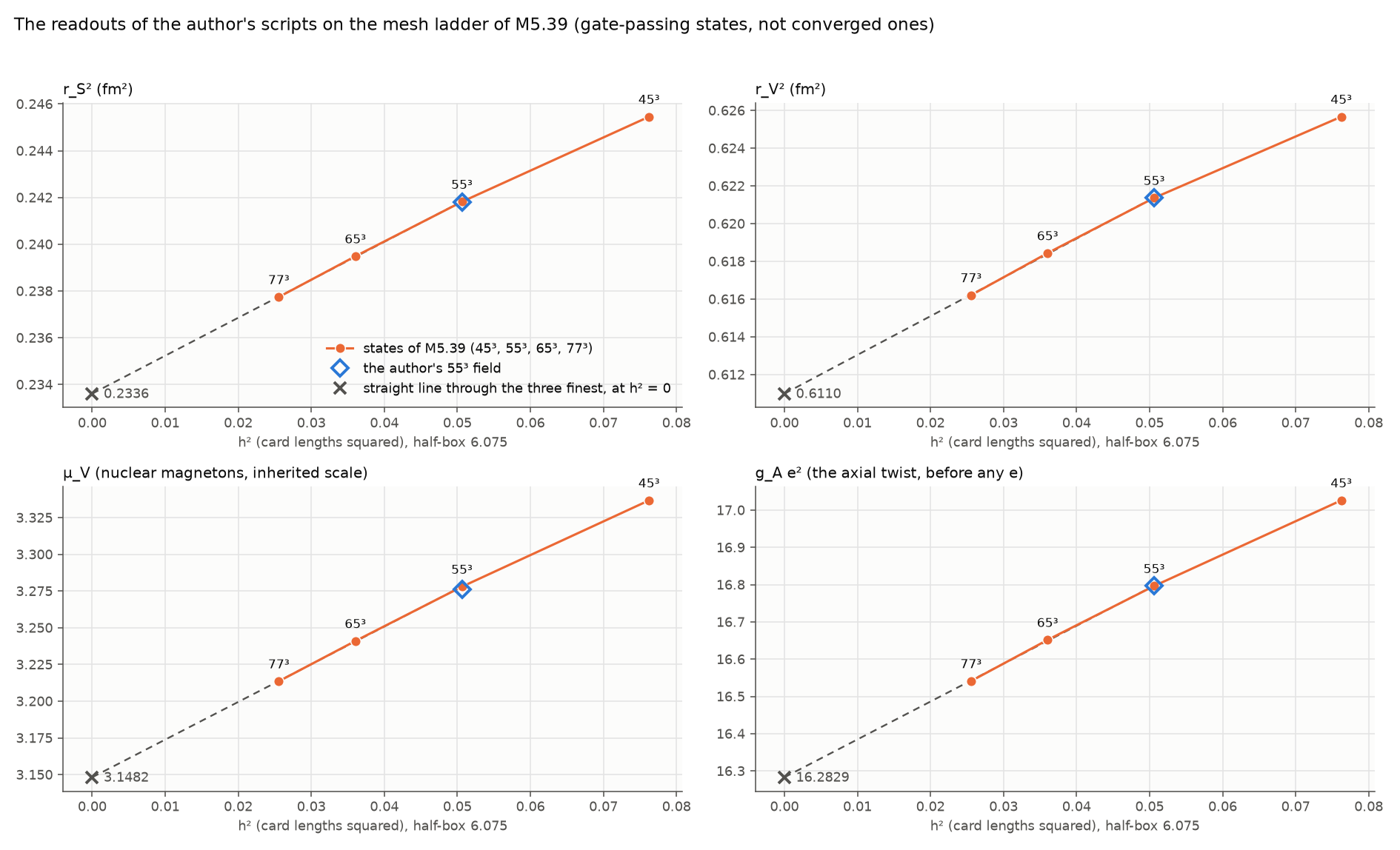

Re M5.40: thank you, and answers to the three questionsThank you for M5.40. Your two corrections are taken into capstone draft 3.9-rc1, in a new paragraph after the M5.39 one, citing the M5.40 record and PR #719:
The paragraph also records the reproduced readouts, the continuation (energy falls by about 2 × 10⁻⁴ while the readouts stay fixed to under 10⁻⁴), and your readout mesh ladder. 1. μ_VYour reading of the scripts is the intended one. μ_V = 3.004 is (4/3) m_p |m_z| / (e³ f_π), with m_z the mirror-averaged response of the gauged lattice energy ( 2.
|


Uh oh!
There was an error while loading. Please reload this page.
@vantasnerdan @mjmikulski @JarekDuda
FYI and help wanted: OpenWave's autonomous Lagrangian hunt (task M5.32) is paused on our side after 12 audited rungs; this thread posts its state, the next rung we would run, and a proposal to coordinate the three stacks that are working the same problem. Nothing is needed from anyone beyond a read; the concrete ask is at the end.
Goal
The 4x4 M5 liquid-crystal action, corrected so that (1) the Coulomb sector of the 3x3 record is kept, (2) the Newton sign between two massive defects is attractive, and (3) a resting electron has a finite nonzero clock frequency at positive energy. Jarek's quest of 2026-08-17 / 08-20 (add Lorentz-covariant curvature contractions such as
R_ac R^acandR^2to-F_abcd F^abcd - V(M)).What we ran (OpenWave M5.32, 2026-08-27 to 08-29)
One autonomous rung ladder, each rung pre-registered (hypothesis + gate before any number), each closed by an independent adversarial audit on a second model instructed to refute it. The method note opens with the equations and carries an equation-to-code map so the implementation can be checked against the mathematics rather than the Python:
research/data/m5_32_ledger.jsonA = 863.733, B = 167.668to six digits)h = eta + 2uu) is bounded below forlambda >= 1/2, keeps the static sector, but gives only a weak clock4[S - (1 - 2 lambda) T]and the sign lives in the static sectorS, which no covariant flip touchesomega* Lconstant); any Lorentz-invariant derivative-free potential is constant along a boost dressing (theorem); the only bounded 2-derivative localizer is inert on the realized clock channel; the quartic classes' omega^4 inertia is itself box-divergentd = diag(g, 1, delta, 0)in SO(1,3)+ is the Klein four-group, sopi_1 = Q8andpi_2 = 0; the degree the record reads is an RP^2 degree of one eigenvector, possible only through a discontinuity on the z axis; the protected objects are linesE_u[M(s x)] = s E_u[M],V ~ s^-3), and the same-sign pair stays repulsive under the certified sign.(F_abcd F^abcd)^2drives the clock in the energy reading but the coefficient that opens a well grows with the box (313 / 476 / 637 at L = 48 / 72 / 96) and the frequency at fixed coefficient drifts 42 % across the ladder in both Hamiltonian readings; report 008 here sees the tick in one 32^3 box, the box ladder is what it cannot seeWhere we paused, and why
Every rung ran into the same wall: the fixed-J clock inertia grows with the box. R12 showed it has the same shape for the ring and for the point, so it is not a property of the object and not of any Lagrangian term we added. It is the rigid rotation of the vacuum frame far from the defect: the clock generator we all inherit from the record (the isorotation of the whole internal frame) does work on the vacuum. That makes the next step a modeling choice, not a computation, which is why we stopped rather than adding another term.
The next rung, declared (R13)
Does a stationary open-space fixed-J clock exist under a vacuum-vanishing flow?
Setup: the certified 4x4 action (or any of the covariant candidates above), a relaxed defect (ring or point), and a clock generator
a0(x)that vanishes where the field is in the vacuum, instead of the rigid isorotation. Fix the internal angular momentumJ. Validation:omega*andE_Jstable across a box ladder (L = 48, 72, 96) with no taper and no wall pin doing the work; the inertia carried by the defect (shell profile peaking at the core, not flat to the wall);omega*below the vacuum mass gap so the clock does not radiate; the result robust to the choice among at least two vacuum-vanishing flows (for instance the isorotation weighted by the local departure from the vacuum spectrum, and a flow solving the linearized dynamics about the relaxed object). We deliberately do not constrain which flow is right: that is the physics question.Help wanted
omega*(L)would be worth more than either alone; a refutation would be worth as much.Thanks.
Rodrigo Griesi (OpenWave @xrodz)
All reactions