
The algorithms of genoxide, a Rust library, with fitness functions in Python and numpy:
- genetic algorithms and local search
- differential evolution, CMA-ES and particle swarm optimization
- NSGA-II, NSGA-III, SPEA2, MOEA/D and SMS-EMOA for several objectives
The API reference: tachsin.github.io/genoxide/api/python
import numpy as np
import genoxide as gx

# OneMax: the genome with the most ones
ga = gx.Ga(
    gx.Binary(100),
    population_size=100,
    select=gx.Tournament(3),
    crossover=gx.UniformCrossover(),
    mutation=gx.BitFlip(rate=0.01),
    seed=42,
)
result = ga.run(lambda bits: bits.sum(), target=100, generations=1_000)
print(result.best_fitness, result.generations)

# Rastrigin with CMA-ES and IPOP restarts, a generation per call
def rastrigin(x):  # x: a genome per row
    return 10 * x.shape[1] + np.sum(x**2 - 10 * np.cos(2 * np.pi * x), axis=1)

cmaes = gx.Cmaes(gx.Real((-5.12, 5.12), length=10), restarts="ipop", objective="minimize", seed=1)
result = cmaes.run(rastrigin, batch=True, target=1e-8, evaluations=500_000)
print(result.best_genome, result.best_fitness)
More in examples/, each the same program in Python and Rust
(python examples/<name>/main.py in the repository), on the docs site, and
played back with charts made for each problem on tachsin.gr:
- OneMax, a knapsack with a constraint, and N-Queens
- the travelling salesman (TSPLIB berlin52) and job shop scheduling (ft06)
- Rastrigin with CMA-ES and L-SHADE, and the pressure vessel and welded beam designs with constraints
- the gear train design, an integer problem
- CMA-ES, SHADE and PSO on twelve test functions, and Himmelblau's four minima by restarts of a local search
- ZDT1 with NSGA-II, and DTLZ2 with NSGA-III
- the constrained BNH with NSGA-II, and Kursawe's disconnected front with SPEA2 and NSGA-II
- XOR neuroevolution with CMA-ES
pip install genoxideWheels for CPython 3.10 or later, with numpy:
- Linux: x86_64 and aarch64, glibc and musl
- macOS: Apple silicon and Intel
- Windows: x64
To build from the repository, with Rust and maturin:
cd python
pip install maturin
maturin develop --releaseA fitness function takes a genome as a numpy array:
| Genome | Array |
|---|---|
Binary(length) |
bool |
Integer(bounds, length) |
int64 |
Real(bounds, length) |
float64 |
Permutation(length) |
int64, an ordering of 0 .. length - 1 |
bounds is one pair (low, high) for every gene, with length, or a list of pairs, one per gene.
It returns one of these:
- a number
Noneor NaN, for a solution that can't be scored(score, constraint_violation): a positive violation marks an infeasible solution. Infeasible solutions rank below feasible ones, and among themselves by violation (Deb's rules).
The fitness function must be deterministic: genoxide doesn't evaluate again a child identical to one of its parents.
With batch=True, the function takes a whole generation as a 2-D array, a genome per row. It returns:
- an array of scores, or a tuple of scores and constraint violations (arrays or
(n, 1)columns) - for several objectives, a 2-D array or a list with a row of objective values per genome, or a tuple of one array per objective (
return f1, f2)
It's one call per generation, and none for a generation whose children are all copies of their parents. Vectorized numpy, a GPU or a remote service pays its cost per call once per generation, not once per genome.
With parallel=True, genoxide calls a non-batch function from several threads at once. It pays off when the function releases the GIL (numpy on large arrays, waiting for I/O), or on free-threaded Python.
An exception in the fitness function stops the run, and run raises it. So does Ctrl+C.
| Problem | Genome | Algorithms, the first preferred |
|---|---|---|
| Yes / no choices (subsets) | Binary |
Ga with UniformCrossover() or PointCrossover(points), and BitFlip |
| An order (tours, sequencing) | Permutation |
LocalSearch, which often beats a GA on permutations; Ga with OrderCrossover() (sequences) or EdgeRecombinationCrossover() (tours) |
| Reals in ranges | Real |
Cmaes; De; Ga with SimulatedBinaryCrossover(eta) and PolynomialMutation(eta) |
| Several objectives | any | Nsga2 for 2 or 3 objectives; Nsga3 or Moead for more |
Cmaesis the strongest general choice for continuous problems with up to a few hundred genes, especially when the genes interact. Its defaults need no tuning. For multimodal functions, addrestarts="ipop"or"bipop". For thousands of genes or separable problems,covariance="diagonal"(sep-CMA-ES): O(n) per sample, no correlations between genes.Deoften needs far fewer evaluations than a GA on continuous problems.Psowithring=1explores longer than the default global topology, for multimodal functions.- For smooth problems that need precise answers, the Rust library also has an evolution strategy,
Es.
| Algorithm | Genomes | Settings |
|---|---|---|
Ga |
all | population_size, select, crossover, mutation, crossover_rate (0.9), mutation_rate (1), scheme, parallel_breeding (False) |
LocalSearch |
all | neighbor (a mutation), neighbors (1), acceptance, restart=(patience, kicks) |
De |
real | population_size (100; with l_shade, 18 × genes, at least 4), l_shade (a budget of evaluations, for L-SHADE), strategy ({"max_p": 0.2, "archive": 1.0}; "rand1", "best1", {"p", "archive"}), control ({"memory": 100}; {"f", "cr"}, {"min_f", "max_f", "cr"}, {"c"}), restarts ({"tolerance": 1e-12, "patience": 200}; "never"), parallel_breeding (False) |
Cmaes |
real | population_size, restarts ("ipop", "bipop"), initial_step, covariance ("full"; "diagonal") |
Pso |
real | population_size (needed), ring (neighbors on each side) |
Nsga2 |
all | objectives, population_size, crossover, mutation, crossover_rate (0.9), mutation_rate (1) |
Nsga3 |
all | objectives, reference_directions, crossover, mutation, population_size (the number of reference directions), crossover_rate (1), mutation_rate (1) |
Spea2 |
all | objectives, population_size (the archive's), crossover, mutation, crossover_rate (0.9), mutation_rate (1) |
Moead |
all | objectives, weights (a subproblem each), crossover, mutation, decomposition (Tchebycheff()), neighbors (20), neighbor_mating (0.9), max_replacements (2), crossover_rate (1), mutation_rate (1) |
SmsEmoa |
all | objectives, population_size, crossover, mutation, offspring (population_size), crossover_rate (0.9), mutation_rate (1) |
Single-objective algorithms maximize, or minimize with objective="minimize".
The multi-objective algorithms take objectives=["minimize", "maximize", ...], 2 to 6 of them. Their fitness function returns a sequence of objective values. Their result is the final non-dominated front: front_genomes, front_objectives and front_violations. A front has each genome once, the first of its copies (MOEA/D's subproblems can hold the same solution), in the result and in the progress alike; different genomes with the same objective values each have a row.
A solution that couldn't be scored has NaN objective values and a NaN violation. A single-objective result without a valid solution has a NaN violation.
Nsga2spreads the front by crowding distance, which works poorly beyond 2 or 3 objectives.Nsga3spreads it along reference directions instead.Moeadsolves a single-objective subproblem per weight vector.das_dennis(objectives, divisions)gives evenly spread directions or weights forNsga3andMoead, a row each: 91 for 3 objectives and 12 divisions.Spea2keeps an archive of the best solutions, the non-dominated ones first, truncated by the distance to their nearest neighbors.Nsga2,Nsga3,Spea2andSmsEmoadrop a child that equals a member of the population or an earlier child, and breed another.eliminate_duplicates=Falsekeeps copies.SmsEmoaremoves the solutions that contribute the least hypervolume, from the last front that fits partly. It costs more per generation thanNsga2: O(N log N) per removal for 2 objectives, O(N²) for 3, O(N³) for 4 and O(N⁴) for 5. For 4 or 5 objectives,Nsga3orMoeadare better choices.
Every algorithm takes a seed. The same seed repeats a run exactly: one genome at a time, in batches or in parallel.
Operators:
- Selection:
Tournament(size),Rank(pressure),Roulette(),StochasticUniversalSampling(),Truncation(fraction),RandomSelection() - Crossover:
- any list genome:
UniformCrossover(),PointCrossover(points),NoCrossover() - real genomes:
SimulatedBinaryCrossover(eta),BlendCrossover(alpha),ArithmeticCrossover() - permutations:
OrderCrossover(),PartiallyMappedCrossover(),CycleCrossover(),EdgeRecombinationCrossover()
- any list genome:
- Mutation:
- binary genomes:
BitFlip(rate=... | count=...) - integer and real genomes:
UniformMutation(rate=... | count=...) - real genomes:
GaussianMutation(sigma, rate=... | count=...),PolynomialMutation(eta, rate=... | count=...) - permutations:
SwapMutation(count),InversionMutation(),InsertionMutation(),ScrambleMutation()
- binary genomes:
- Genetic algorithm schemes:
Generational(elitism)(the default, with 1),SteadyState(replacements),MuPlusLambda(offspring),MuCommaLambda(offspring) - Local search acceptance:
NotWorse()(the default),Improving(),Annealing(initial_temperature, cooling),Tabu(tenure) - MOEA/D decomposition:
Tchebycheff()(the default),Pbi(theta)(penalty-based boundary intersection,theta5 by default).Pbispreads fronts of 3 or more objectives well.
gx.problems has classic test functions from the literature, such as Rastrigin(dimensions),
Rosenbrock(dimensions) and Branin(), all minimized. Each gives its genome, objective,
optimum (value, solutions, proven) and reference, and is a fitness function that run
evaluates in Rust, with no Python call: parallel=True uses every core, and a seed gives the same
result as in Rust. problem(x) and problem.evaluate(genomes) run the same code.
problem = gx.problems.Rastrigin(10)
de = gx.De(problem.genome, objective=problem.objective, seed=1)
result = de.run(problem, target=problem.optimum.value + 1e-8, evaluations=200_000)
print(result.best_fitness, result.evaluations, problem.reference)
The multi-objective problems, Zdt1 to Zdt6 (Zdt5 on a Binary genome),
Dtlz1(objectives, variables) to Dtlz7,
ConvexDtlz2, ScaledDtlz1(objectives, variables, factor), ScaledDtlz2, InvertedDtlz1,
Wfg1(objectives, position, distance) to Wfg9, Schaffer1, Schaffer2, FonsecaFleming,
Kursawe, Poloni, Viennet1 to Viennet3 and the constrained Bnh, Srn, Tnk, Osy and
Constr, run with the multi-objective algorithms in the same way. Each gives its objectives,
for the algorithm, and optimal_front(points), None where the front isn't known; a constrained one
returns (objectives, violation) and gives its constraints(x).
The constrained problems of tunable difficulty work the same way: Ctp1 to Ctp8, the
constrained DTLZ problems C1Dtlz1(objectives, variables), C1Dtlz3(objectives, variables, radius), C2Dtlz2, ConvexC2Dtlz2, C3Dtlz1 and C3Dtlz4, and Ma and Wang's Mw1 to Mw14
(Mw4, Mw8 and Mw14 with any number of objectives).
Two submodules have constrained single-objective problems, whose fitness is (score, violation): gx.problems.cec2006 has CEC 2006's G01() to G24(), and
gx.problems.engineering has WeldedBeam(), WeldedBeamRagsdell(), PressureVessel(),
TensionCompressionSpring(), SpeedReducer(), GearTrain() (an Integer genome),
ThreeBarTruss(), CantileverBeam() and CarSideImpact(). PressureVessel and SpeedReducer
round their discrete genes, and design(x) gives the rounded design.
problem = gx.problems.engineering.WeldedBeam()
de = gx.De(problem.genome, objective=problem.objective, seed=1)
result = de.run(problem, evaluations=40_000)
print(result.best_fitness, result.violation, problem.optimum.value)
problem = gx.problems.Dtlz2(objectives=3)
nsga3 = gx.Nsga3(
problem.genome,
objectives=problem.objectives,
reference_directions=gx.das_dennis(3, 12),
crossover=gx.SimulatedBinaryCrossover(30),
mutation=gx.PolynomialMutation(20, rate=1 / problem.dimensions),
seed=1,
)
result = nsga3.run(problem, generations=100)
print(gx.indicators.igd(result.front_objectives, problem.optimal_front(91)))gx.indicators measures multi-objective fronts, a point per row: hypervolume(front, reference_point), and igd, igd_plus, gd and spread against a reference front.
hypervolume, igd_plus and spread take objectives ("minimize" by default); igd and gd
measure distances, the same for either direction.
run stops at the first of its stop conditions, and needs at least one:
generationsevaluationstarget: a score at least as good (single objective)time: seconds (math.inffor no limit)stagnation: generations without improvement
The result has the condition that stopped it, stop_reason, and the generations, evaluations and seconds it took.
run(..., on_generation=callback) calls callback after every generation, the initial population (generation 0) included. It runs on the thread that called run. It gets a read-only object:
Progress: thegeneration,evaluations,secondsandbest_fitnessso far (Nonebefore a valid solution), thebest_genomeso far, and thepopulation(a genome per row) with itsscoresandviolationsMultiProgress, for a multi-objective algorithm: the same, withfront_size(the number of non-dominated individuals in the population, each genome once) instead ofbest_fitnessand the best genome, the population'sobjectives(a row per genome) instead of its scores, and thefront_objectivesandfront_violationsof its non-dominated individuals
The population's arrays (population, scores, violations, objectives, front_objectives, front_violations) are made when first read, then kept: a callback that reads only the numbers doesn't pay for them. A progress object kept after its callback stays valid, and can be copied and pickled. It isn't a dataclass: dataclasses.fields, asdict and replace don't apply to it.
If callback returns False, the run stops with the stop reason "aborted". If it raises an exception, the run stops and run raises it.
def report(progress):
    if progress.generation % 100 == 0:
        print(progress.generation, progress.evaluations, progress.best_fitness)

result = ga.run(lambda bits: bits.sum(), generations=1_000, on_generation=report)run(..., control=callback) calls callback(algorithm, progress) once per generation, after on_generation, with a handle to the running algorithm and the same Progress. A change applies from the next generation:
| Algorithm | Handle | Settings |
|---|---|---|
Ga |
RunningGa |
crossover_rate, mutation_rate, select, crossover, mutation (any operator that fits the genome) |
De |
RunningDe |
strategy, control (F and CR), in the forms of De's settings |
Pso |
RunningPso |
inertia, acceleration ((cognitive, social)) |
LocalSearch |
RunningLocalSearch |
neighbor, neighbors |
Cmaes |
RunningCmaes |
none: CMA-ES adapts its own |
- Reading a setting gives the one in use, the defaults included.
- A wrong value raises a
ValueError, as in the constructor, and changes nothing. - The callback also runs after the last generation. What it returns is ignored; an exception stops the run, and
runraises it. - The handle works only during the callback.
- A seeded run with a control repeats, and a control that changes nothing gives the same result as none.
import numpy as np
import genoxide as gx

def sphere(x):
    return float(np.sum(x * x))

# a mutation step annealed from 10% to 0.1% of each gene's range
def anneal(ga, progress):
    sigma = 0.1 * 0.01 ** (progress.generation / 300)
    ga.mutation = gx.GaussianMutation(sigma, rate=0.2)

ga = gx.Ga(
    gx.Real((-5, 5), length=10),
    population_size=40,
    select=gx.Tournament(3),
    crossover=gx.UniformCrossover(),
    mutation=gx.GaussianMutation(0.1, rate=0.2),
    objective="minimize",
    seed=1,
)
result = ga.run(sphere, generations=300, control=anneal)
print(result.best_fitness)
algorithm.reevaluate() scores again what the algorithm keeps, for a fitness function that changed during the run: adaptive penalty weights, a retrained surrogate, a moving optimum. The next generation evaluates the population again instead of breeding: on_generation is called again with the same generation number, control isn't, and the best solution is then the best by the new function. Every single-objective algorithm has it: a particle swarm also scores its personal bests again, and a local search its current and best solution.
# maximize the ones, with at most 10 of them allowed: the penalty's weight rises while the best
# breaks the limit
weight = 0.1

def penalized(bits):
    ones = int(bits.sum())
    return ones - weight * max(ones - 10, 0)

def adapt(ga, progress):
    global weight
    if progress.generation % 20 == 19 and progress.best_genome.sum() > 10:
        weight *= 4
        ga.reevaluate()

ga = gx.Ga(
    gx.Binary(32),
    population_size=30,
    select=gx.Tournament(3),
    crossover=gx.UniformCrossover(),
    mutation=gx.BitFlip(rate=1 / 32),
    seed=2,
)
result = ga.run(penalized, generations=200, control=adapt)
print(result.best_genome.sum())  # 10
Multi-objective runs have no control yet.
The package is benchmarked as a library of its own, genoxide (Python), beside the Rust library and the other libraries, on a small, matched suite: three problems, one method each, under public rules. Every library runs a problem only with its own implementation of that problem's method, set to the same written definition: a GA on OneMax 1000, DE/rand/1/bin on Rastrigin 30 (a fixed budget, measured by the time for it and the error at the end) and CMA-ES on Rosenbrock 10. Single-threaded on the same machine, 10 seeds each. More problems, and multi-objective ones, come back after these.
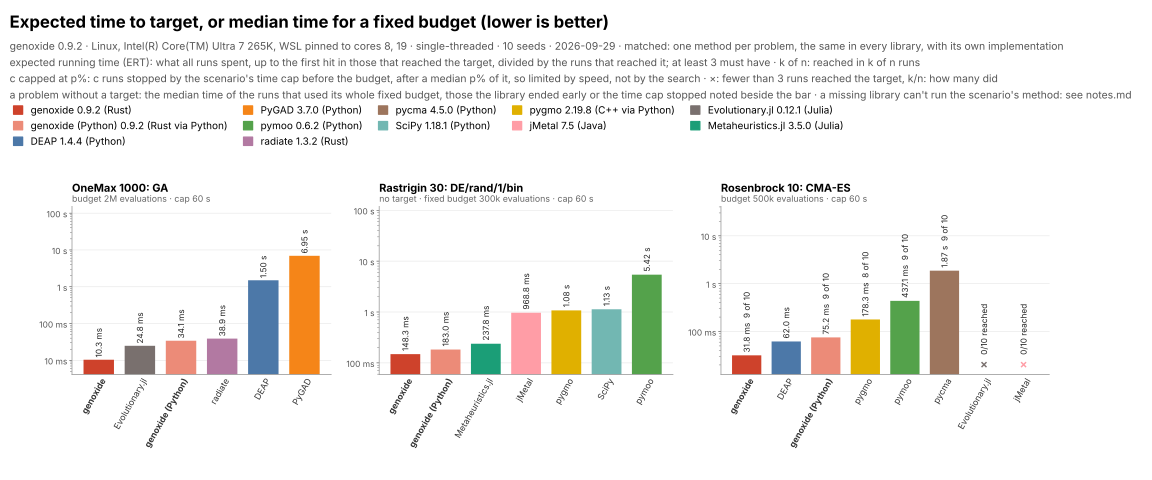
Interactive results, a card per problem: tachsin.gr/projects/genoxide/benchmarks. The methodology, the methods' definitions and a page per library are in docs/benchmarks.
The package covers a subset of the Rust library. These parts are only in Rust:
- the evolution strategy
Es, with self-adaptive mutation - the island model,
Islands SteadyGaand the asynchronous engine, for evaluations of varying duration- memetic search in
Ga, and initial genomes for a population - operators of your own
- checkpoints, to save and resume a run
- observers: statistics, a hall of fame and reports
- stop conditions combined with
and, and custom ones - penalty functions for constraints, and the NaN policy: in Python, NaN is always an invalid solution
- advanced settings:
- CMA-ES: the initial mean
- PSO: the initial inertia and acceleration (a control can change them during a run), and the maximum velocity
- DE: population size reduction other than L-SHADE's
- the rate of
UniformCrossoverand the weight ofArithmeticCrossover
Some names differ:
| Python | Rust |
|---|---|
mutation= |
.mutate(...) |
objective="minimize" |
.minimize(), Objective::Minimize |
Binary(length), Permutation(length) |
Binary::new(len), Permutation::new(len) |
BitFlip(rate=...), BitFlip(count=...) |
BitFlip::per_gene(rate), BitFlip::count(count), and so for the other mutations |
PointCrossover(points) |
PointCrossover::k_point(points) |
MuPlusLambda(offspring), MuCommaLambda(offspring) |
Scheme::MuPlusLambda { lambda }, Scheme::MuCommaLambda { lambda } |
Cmaes(restarts="ipop") |
.restarts(cmaes::Restarts::Ipop) |
Cmaes(covariance="diagonal") |
.covariance(cmaes::Covariance::Diagonal) |
Pso(ring=k) |
.topology(pso::Topology::Ring { neighbors: k }) |
De(l_shade=n) |
De::l_shade(real, n) |
De(strategy="rand1"), De(strategy={"p": 0.1, "archive": 1.0}) |
.strategy(de::Strategy::Rand1), .strategy(de::Strategy::CurrentToPBest { p: 0.1, archive: 1.0 }), and {"max_p", "archive"} for CurrentToPBestRandomP |
De(control={"f": 0.5, "cr": 0.9}) |
.control(de::Control::Fixed { f: 0.5, cr: 0.9 }); {"min_f", "max_f", "cr"} for Dither, {"c"} for Jade, {"memory"} for Shade |
De(restarts="never"), De(restarts={"tolerance": 1e-12, "patience": 200}) |
.restarts(de::Restarts::Never), .restarts(de::Restarts::OnStagnation { tolerance: 1e-12, patience: 200 }) |
Pbi(theta) |
Decomposition::Pbi { theta } |
run(control=...), ga.mutation = ... in it |
Engine::control(...), *ga.mutate_mut() = ... |
ga.mutation_rate = p, de.control = {...}, pso.inertia = w in a control |
ga.set_mutation_rate(p)?, de.set_control(...)?, pso.set_inertia(w)? |
run(generations=..., time=..., ...) |
Stop::generations(...).or(Stop::time(...)) |
time (seconds) |
Stop::time(Duration) |
result.seconds |
Outcome::elapsed() |